Are Joby Joseph Interior Designers Expensive?
Are Joby Joseph Interiors Expensive? Price vs Value
By Joby Joseph, Founder, Joby Joseph Interior Designers, Hennur, Bengaluru, with an office in Sharjah, UAE. 25 years in interiors, 150+ homes delivered. Updated 28 October 2026.
Next to a first quote, yes; next to a final bill, no. The difference starts with a paid design: about 5% of the works, spent first, so the other 95% goes into a home that is fully drawn and priced. My signed price covers the whole home: design, civil, plumbing and electrical work, furniture and furnishing. Across my past projects, the final cost has stayed within 1 to 3% of that signed price, when both sides kept to the signed terms.
Want to know what your budget can build? WhatsApp me your plan and your approximate figure.
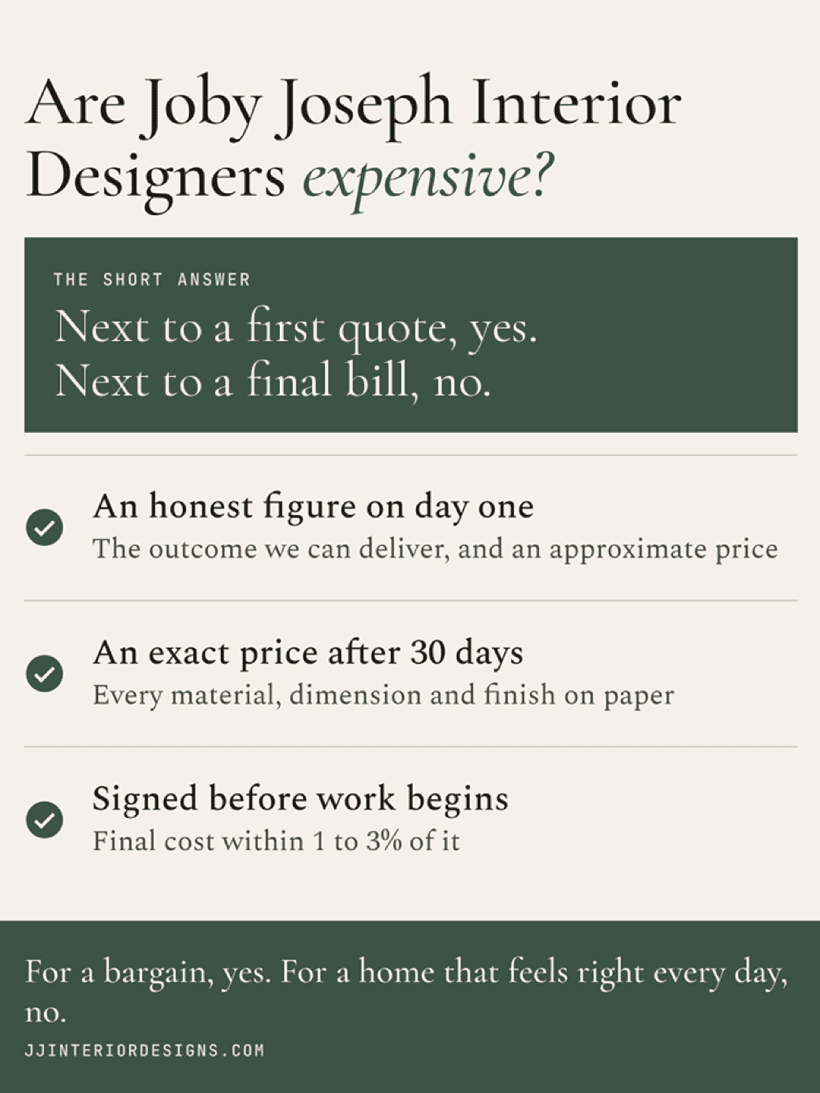
The short answer: next to a first quote, yes; next to a final bill, no.
Most people who read this page heard my name from a friend, or from a family I worked for. Then they saw my starting price next to a lower number from someone else, and they wondered. I would wonder too. So let me show you what sits inside the two numbers.
The flashy approach adds more. The luxury approach gets it right the first time.
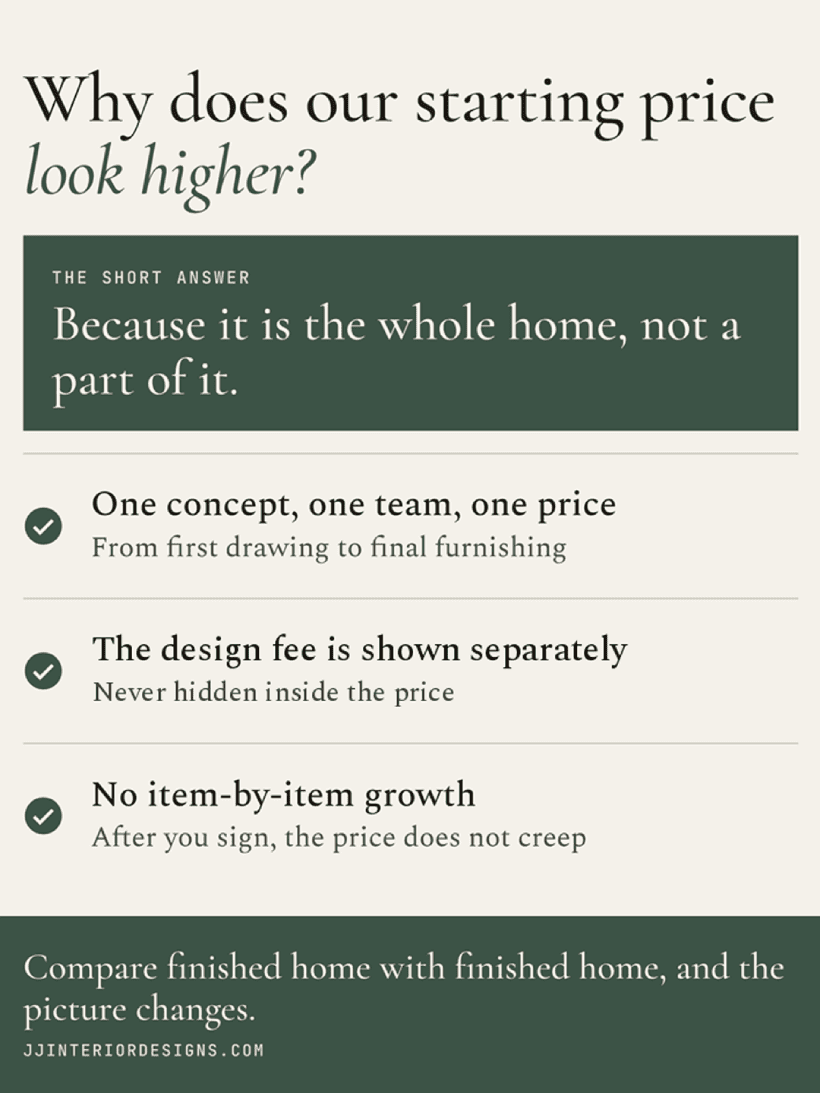
My starting price looks higher because it covers the whole home, with the design fee shown separately.
The two quotes are not describing the same work
Many proposals price only what the eye can see: the kitchen, the wardrobes, the TV unit. Civil changes, plumbing, electrical work, soft furnishing, demolition and debris removal come later, as extras. By then, your deposit is already in their bank. In my experience, a bill that starts like this ends 30 to 40% above the first figure. That gap is six to eight times a 5% design fee.
My price is for the complete scope we agree, from the first drawing to the last cushion. Appliances you pick yourself are outside it. Anything outside the scope is written down before you sign. Nothing is left to be “discussed at site”.
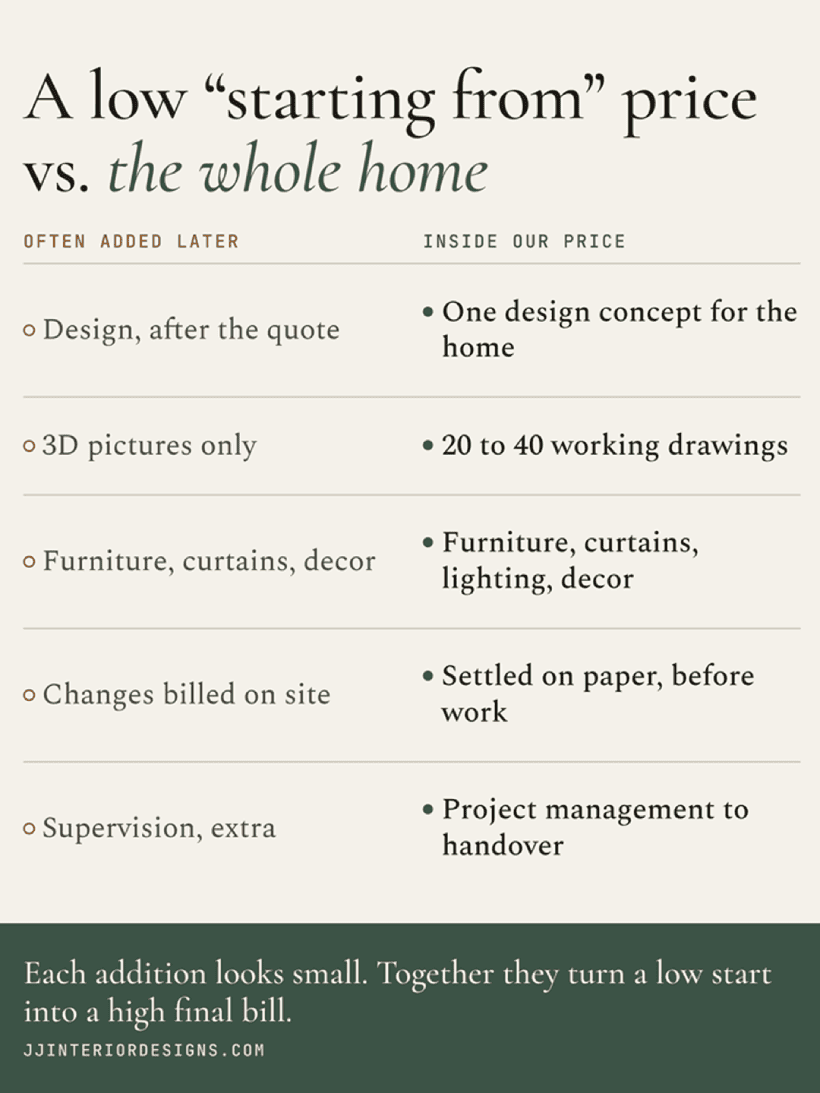
What a low “starting from” price often adds later, against what sits inside my price from day one.
A simple comparison from my files
Take one home and price it two ways. The numbers below are an index, not rupees. But I see this pattern again and again in Bengaluru.
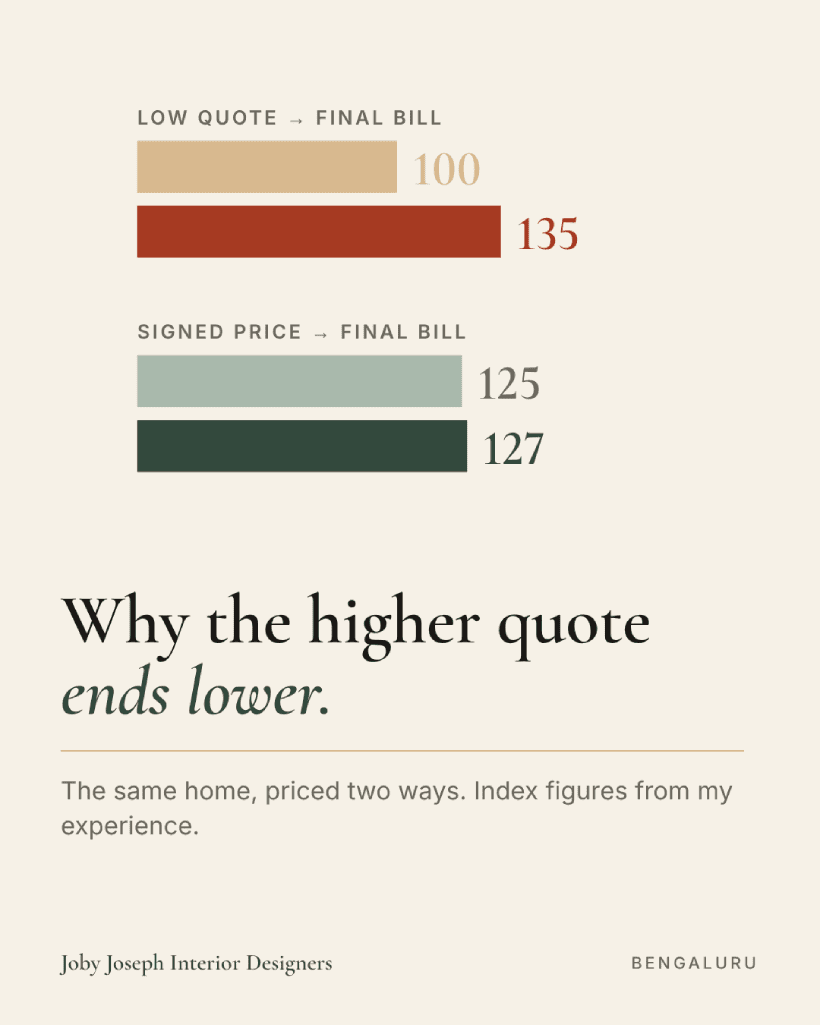
A low proposal is bargained down to 100. By handover it has grown to 130 or 140. The outcome was decided on site, and it is usually below what was shown. My signed price for the same home is 125, and the final bill comes to about 127. That outcome was drawn, priced and approved before a single board was cut.
So my proposal looked 25% higher, yet it ended lower. And the family got the home that was promised. There is no magic in this. I plan the work before I price it, include only what the home needs, and build it once. There is no rework to pay for.
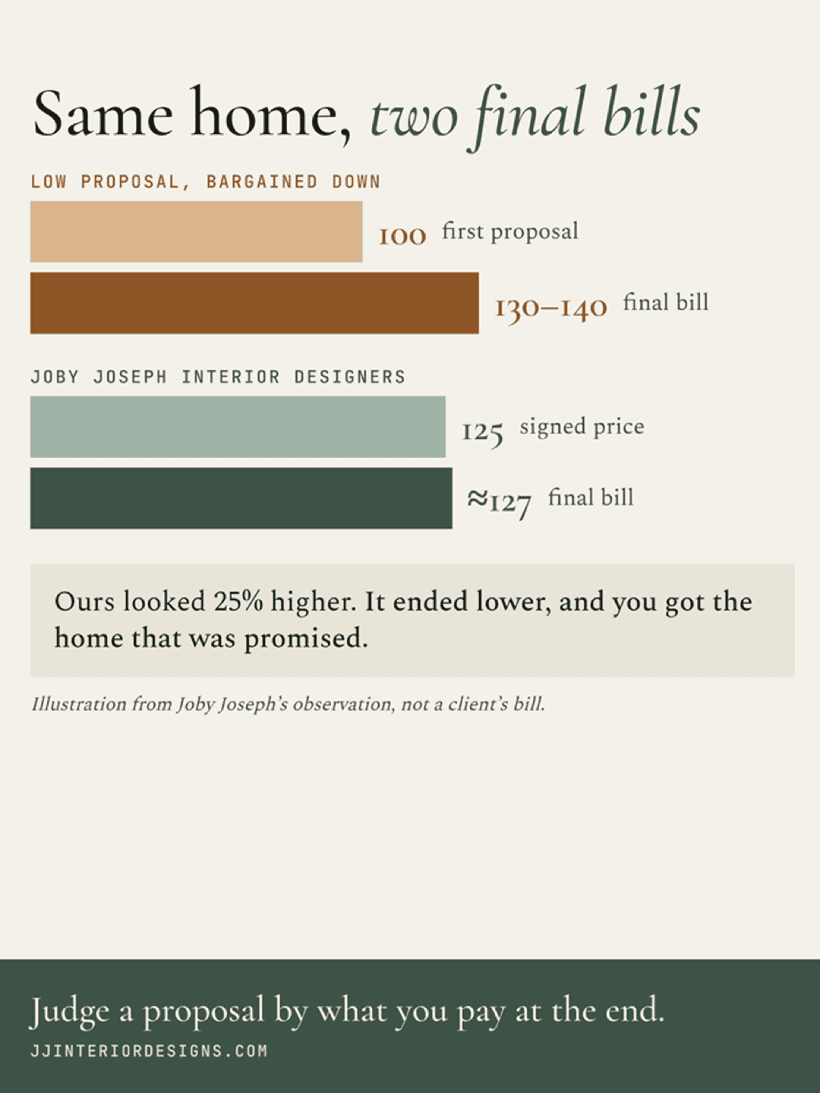
The same home priced two ways. The numbers are an index from my experience, not a client’s bill.
Two sofas that look the same in a photograph
Put these two sofas side by side in a photo, and most people cannot tell them apart. Live with them for a year, and nobody can miss the difference. The market version usually costs about 70% less than mine.
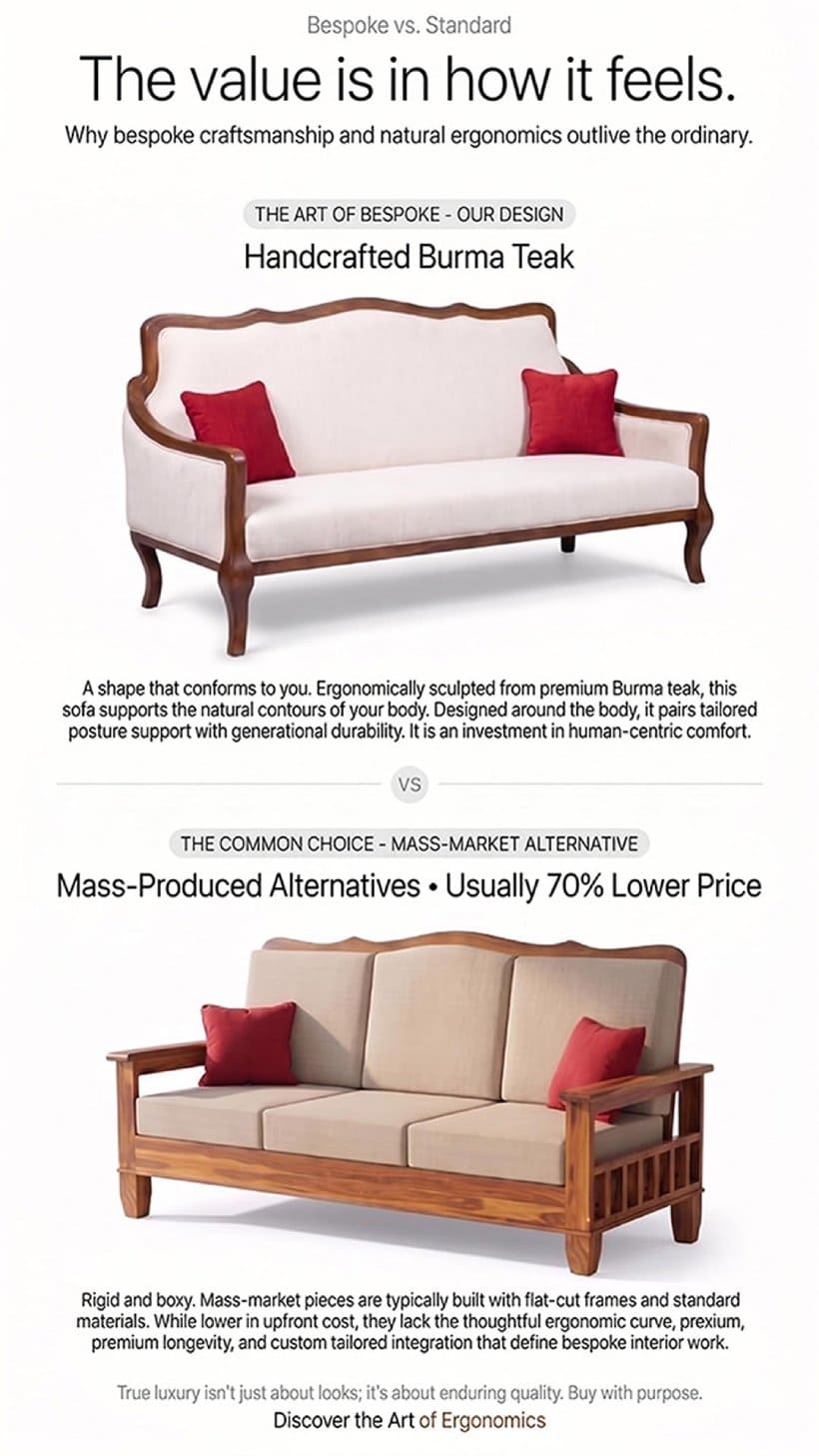
My handcrafted Burma teak sofa, shaped to the body, against a mass-produced sofa that usually costs about 70% less.
The sofa my team makes has a curved Burma teak frame, drawn with balance and proportion. Seat depth, height and back angle are set for how you actually sit. The core is high-density foam, built up in layers. Teak ages well, and this sofa will outlast the people who bought it.
The typical market sofa is often sheesham, cut flat into a stiff, boxy frame. Carving and shiny fabric are added so it photographs well. The foam is low-density, so it sags, and the fabric loosens. Nobody thought about the body that sits in it.
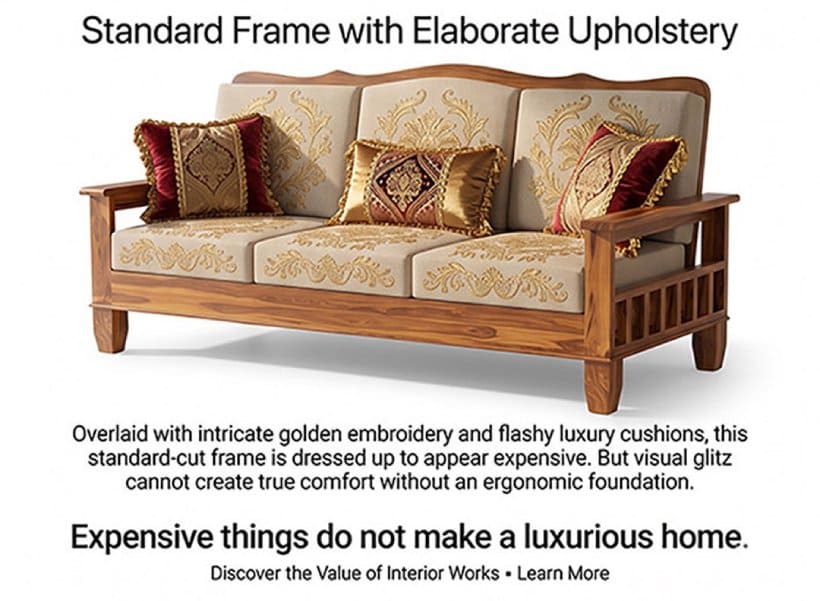
A standard frame dressed in gold embroidery. When the design is missing, the market adds decoration.
You need not take my word on the foam. The Polyurethane Foam Association, the US industry body, says seating foam of 1.8 pounds per cubic foot or more performs better. That is roughly 29 kg per cubic metre. Lower-density foam loses its firmness faster. Whoever you buy from, get the foam density and the frame wood in writing.
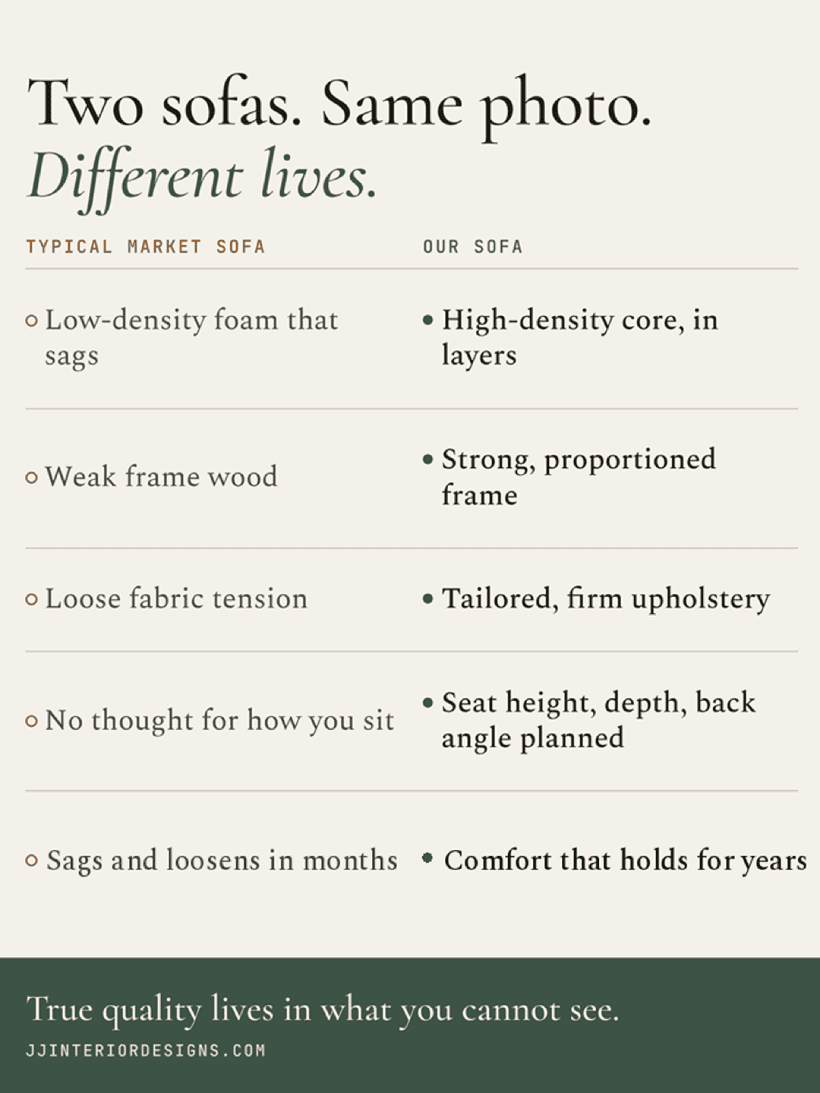
Two sofas can look the same in a photograph. The difference is in the foam, the frame and how the seat fits the body.
Where your money actually goes
In my work, about 30% of the cost is material. The remaining 70% is design, skilled hands and project management. That 70% is what makes a home feel calm years later.
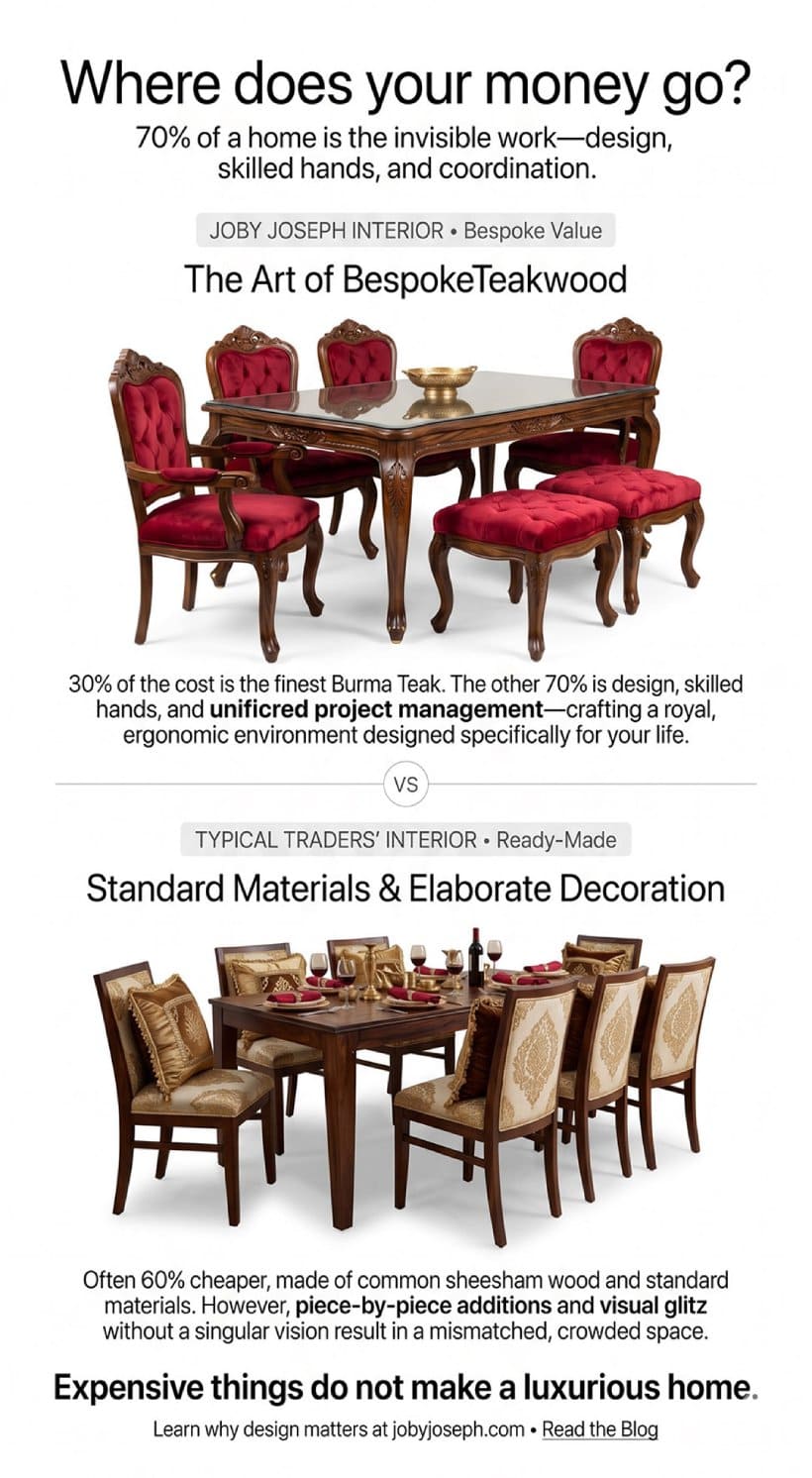
In one dining room the money pays for design and skilled hands. In the other, most of it goes into decoration.
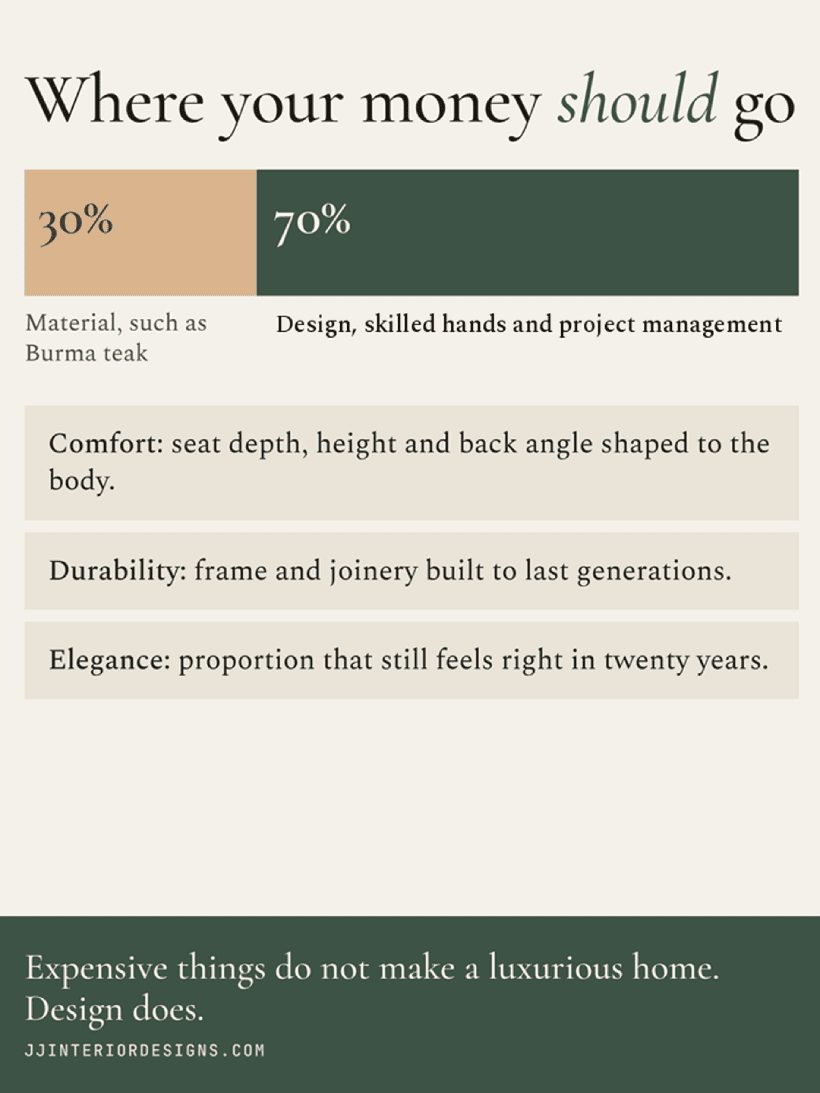
About 30% of the cost is material. The other 70% is design, skilled hands and project management, and that is where comfort, durability and elegance come from.
I often walk into homes where the family spent generously. A sofa from one showroom, lamps from another, a table ordered online, decor picked up on holiday. Each piece is good. Together, the home feels crowded and tiring. The money was never the problem, and neither was the taste. Nothing held the home together.
So, before anything is bought, I settle one idea for the whole home. Each piece is chosen for its place, its size and its use. Balance and proportion come first. Decoration comes last, if at all.
Why I do not give discounts
I do not sell catalogue products, so there is no list price to cut. My price is the work itself, and I never inflate it.
In my experience, many prices in the market are first pushed up by 20 to 30%, then “discounted” by the same amount. Families feel they have won. In truth, they have paid the usual price for less. Indian consumer law treats misleading buyers about price as an unfair trade practice under Section 2(47). The government’s Dark Patterns Guidelines also name drip pricing as something to stop.
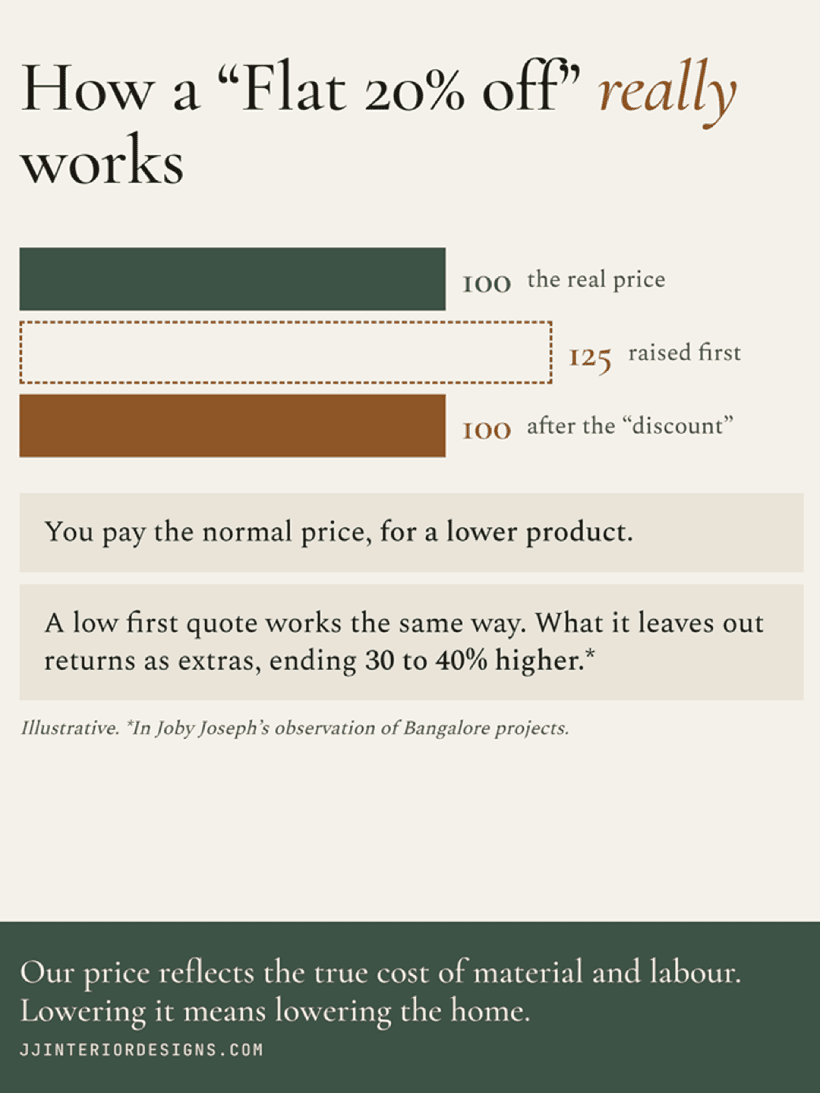
How a “flat 20% off” works: raise 100 to 125, then take 20% off. The buyer pays the usual price for less.
When a fair price is pushed down, the only thing left to cut is the home. If a family wants to spend less, we change the scope together. In one villa, I completed four of the five bedrooms, plus the fifth bedroom’s wardrobe. I advised the family to buy the remaining furniture later. I will leave out an item. I will not leave out quality.
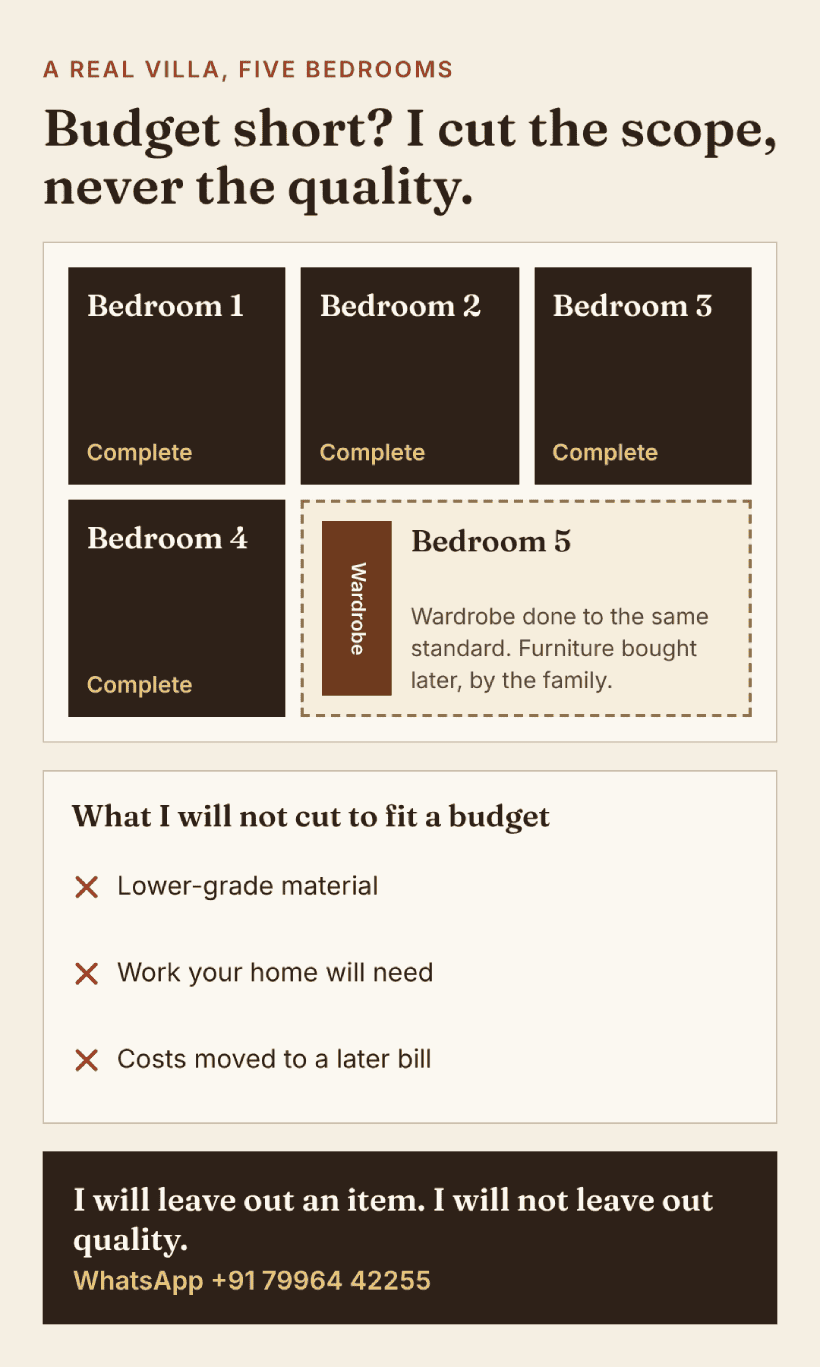
A real villa: four bedrooms complete, the fifth with its wardrobe done to the same standard. When the budget is short, the scope moves, not the quality.
How your price is arrived at
My starting price is the least it takes to build a complete luxury home without cutting corners or hiding costs. Below it, I would have to use lower-grade material, drop work you will need, or bill you later. I will not do any of those.
At the first meeting, you tell me about your family, your home and your approximate figure. I tell you plainly what that figure can build. If we agree, the design stage runs for about 30 days over five to six meetings. It produces 20 to 40 working drawings, with every material, size and finish on paper. Then scope and price are signed. I accept money for the interior works only after you approve the design, the specifications and the price.
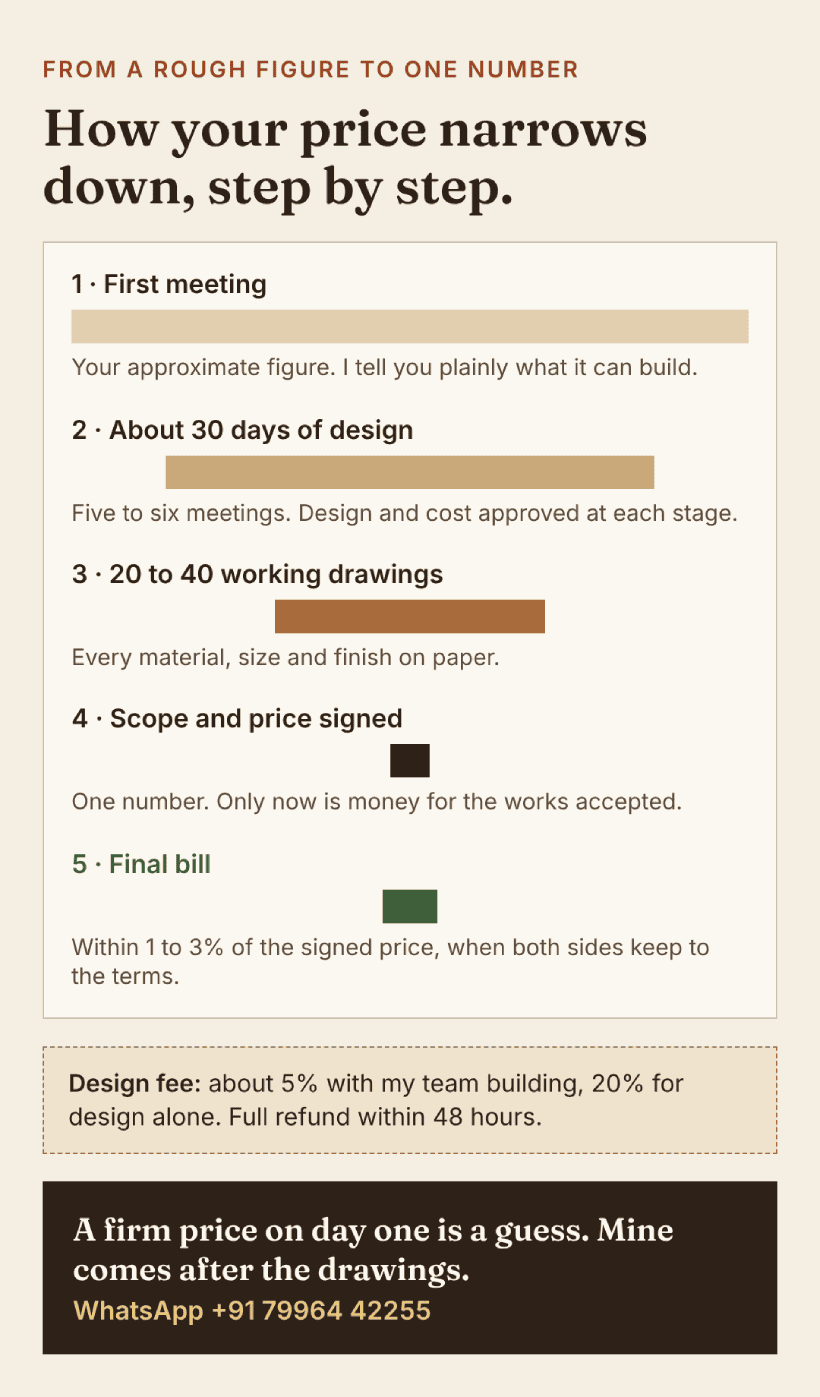
From a rough figure at the first meeting to one signed number after the drawings. The final bill stays within 1 to 3% of it.
My design fee is separate from the interior works: about 5% when my team builds, about 20% for design alone. Change your mind within 48 hours and I return it in full.
Karatmeter: how to test any interior quote, including mine
Two quotes can only be compared when they describe the same home. Ask these eight questions and count the yeses.
1. Same scope? Does the quote cover design, civil, plumbing, electrical, furniture and furnishing, not only what the eye can see?
2. Drawings first? Will I see 20 to 40 working drawings before I sign?
3. A cost against every item? Is each item measured and priced, line by line?
4. Materials named? Is every board named by IS grade, and every hinge by brand and steel grade?
5. Tax shown? Is 18% GST inside the price? Works contracts generally attract that rate (<atarget=”_blank” href=”https://gstcouncil.gov.in/sites/default/files/2024-04/workscontractservices_pra.pdf”>GST Council</atarget=>).
6. Price rises covered? Is it written who pays if material prices rise after signing?
7. An honest price? Is the price free of any “discount” that was added first and taken off later?
8. Final bills shown? Can I see a past client’s signed price next to their final bill?
Eight yeses is pure gold. Below six, the first quote is not yet the real price.
What you can verify for yourself
Nine in ten of my projects come from past clients and their families. More than 30 homes are filmed one to two and a half years after move-in, on my YouTube channel. On a recent project, I returned ₹1,10,000 of unspent money at completion. You can watch the family receive it. My studio also received an award for its commitment from Paul Scully MP at the UK Parliament.
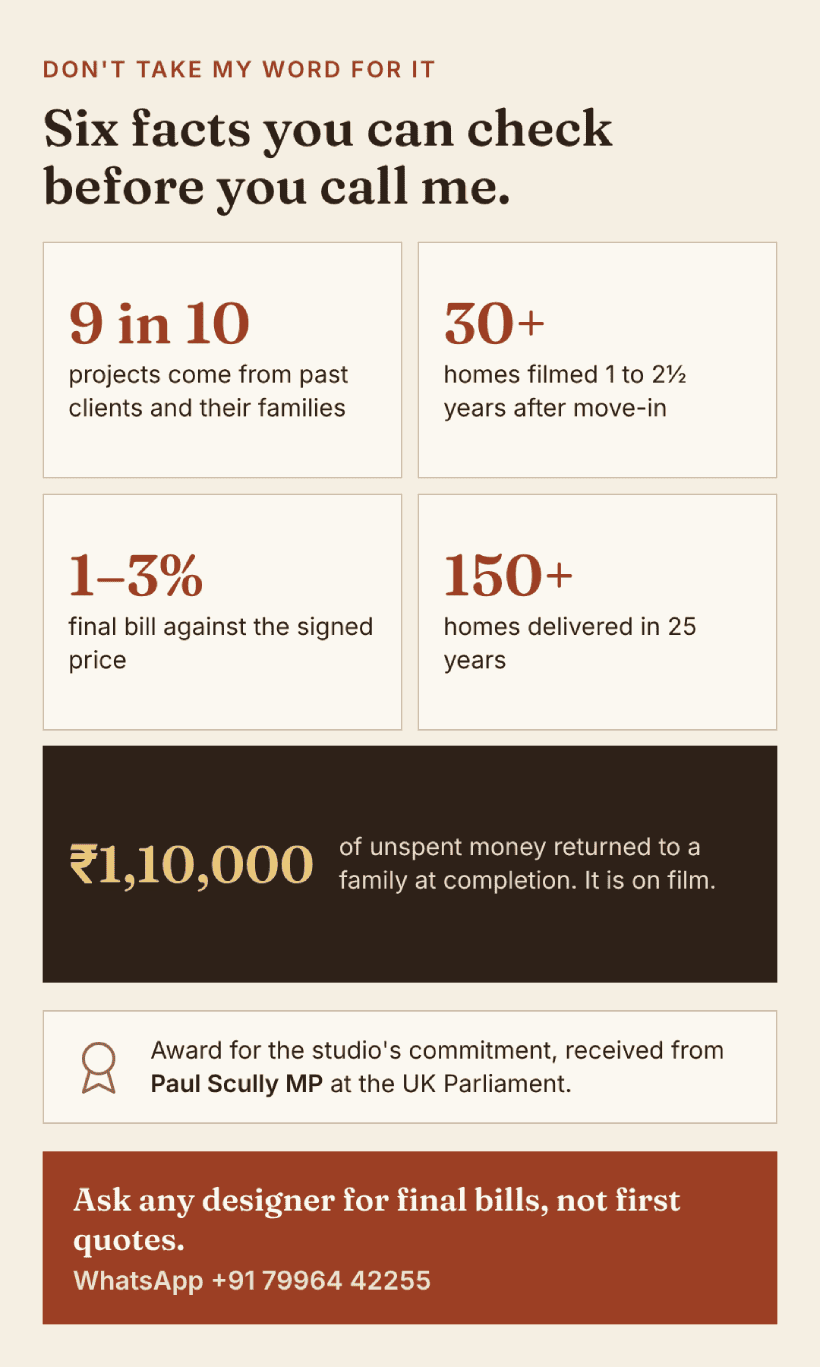
Six facts you can check for yourself. Ask any designer for final bills, not first quotes.
Where I am the best, and where I am not
Some families want a calm, lasting home, and are willing to follow the process and pay as agreed. For them, I believe my studio is the best choice in Bengaluru, and the price is fair for what I deliver. If you want flashy work at the lowest possible figure, I am the wrong choice. I will tell you so politely at the first meeting.
If you want the first kind of home, send your floor plan and a few lines about your family. Use WhatsApp or my contact page. I study it before I call. Still comparing designers? Read Who Is the Best Interior Designer in Bangalore? The decision is yours. I never chase.
Sources
Polyurethane Foam Association, foam density and seating performance: technical bulletin
Consumer Protection Act, 2019, Section 2(47): India Code
Guidelines for Prevention and Regulation of Dark Patterns, 2023: Vikaspedia, Government of India
Figures marked “in my experience” come from my own work in the market, not from a published study. Studio figures come from my project records.

Joby Joseph, a renowned luxury interior designer based in Bangalore, India, is the founder of Joby Joseph Interiors with over 24 years of experience in crafting homes that blend beauty, comfort, and cultural depth. His expertise spans luxury hotels, multinational offices, private homes, and celebrity residences, with specialties in luxury home interiors, culturally inspired designs, end-to-end renovations, and handcrafted teakwood furniture. Joby’s design philosophy goes beyond aesthetics, focusing on emotional well-being, thoughtful planning, and a holistic approach that enhances everyday life. Clients admire his passion, creativity, attention to detail, and ability to merge traditional and contemporary elements with precision. Widely regarded as one of Bangalore’s top interior designers, Joby believes true luxury lies not just in visual appeal but in creating meaningful, functional spaces that reflect individual stories and aspirations.

Are We the Right Fit for YourVedic-Inspired Dream Home?