What is Pre production Process in Luxury Interior Design ?
Luxury Interior Design Pre production Process
By Joby Joseph, Founder, Joby Joseph Interior Designers, Hennur, Bengaluru, with an office in Sharjah, UAE. 25 years in interiors, 150+ homes delivered. Updated 28 October 2026.
Pre-production is the paid design stage that comes before any work on site. In my studio, it runs about 30 days over five to six meetings, and ends with 20 to 40 working drawings and one signed price. It costs about 5% of the works, and it protects the other 95%. Nothing is ordered or cut until it is complete.
Want to see a full drawing set from a finished home? Ask me on WhatsApp.
I have worked with 10 leading architecture offices. I have met more than 1,000 architects and interior designers, in India and abroad. Every serious office I have seen begins the same way: pre-production first, site work later.
Why a luxury home cannot skip this stage
A luxury home is built by many teams, and all of them need the same plan.
Think of cooking a grand dinner for ten guests. You do not light the stove and then start chopping onions. You do not hunt for the garam masala halfway through, or find out the oven is too small for the dish. Every ingredient is measured and kept ready. Skip the preparation, and the food burns.
A luxury kitchen needs the same discipline, only with materials that cannot be undone. The plumbing has to meet the exact drain of your sink and dishwasher. The electrical points have to sit where the chimney, hob and microwave need heavy-duty power. The tile heights decide where the wall cabinets go, to the millimetre. A quartz slab is cut once. Cut it wrong, and it is gone.
A whole home is the same story at a bigger scale. About 20 teams and at least 100 people work on it over four to six months. Drawings are the only language all of them understand.
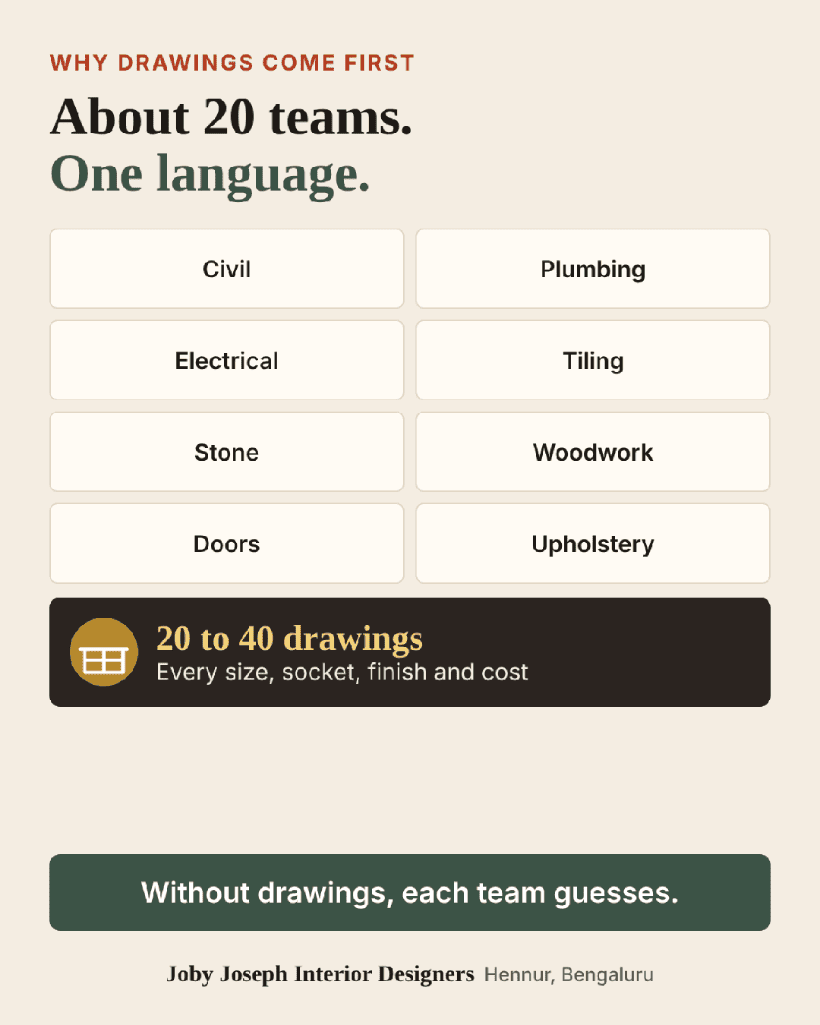
Every team that touches your home works from the same 20 to 40 drawings. That is how the parts fit.
Much of the home is ordered long before the site opens
Tiles are ordered before any work begins on site. Doors are made by a different team, in a different place. Solid wood work is done by yet another team. Imported upholstery fabric can take more than a month, so it is ordered before the furniture frames are made. My team orders soft furnishings and decor months ahead of installation. New electrical points must be ready before the furniture arrives.
A luxury home has 15 to 20 activities like these running in parallel. They fit together only if they were planned on paper first.
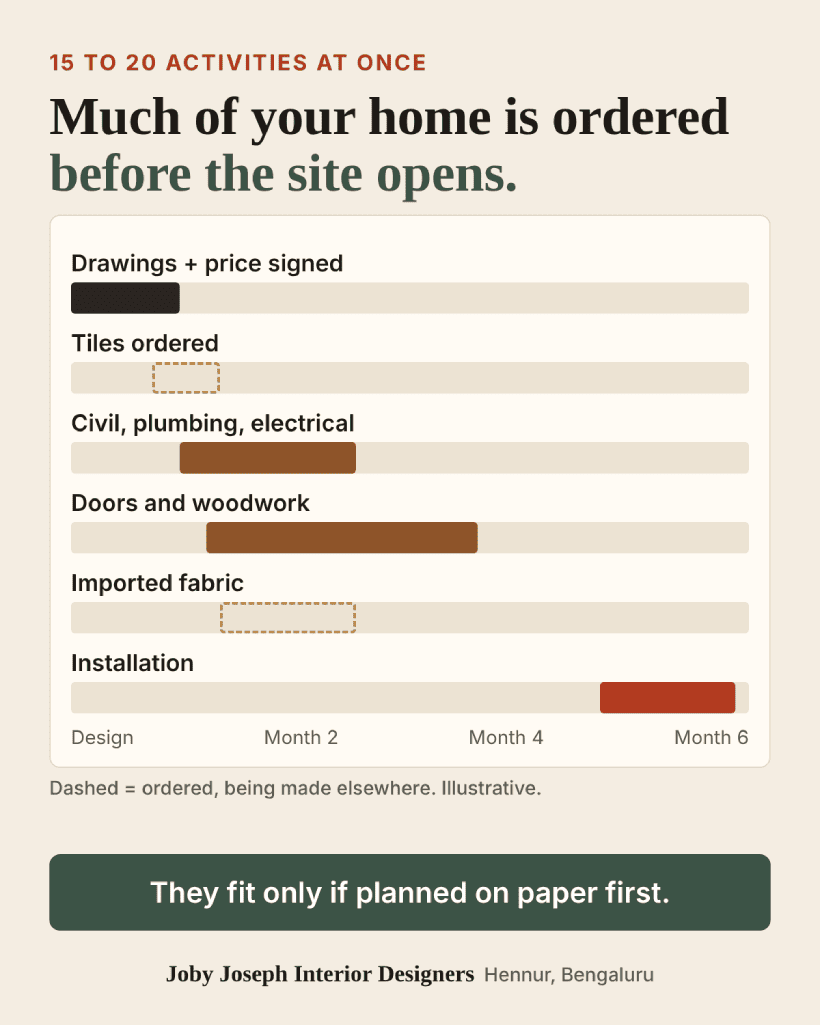
An illustrative schedule. Tiles, doors, fabric and decor are ordered while the site work runs, so each one must be decided on paper first.
What pre-production actually produces
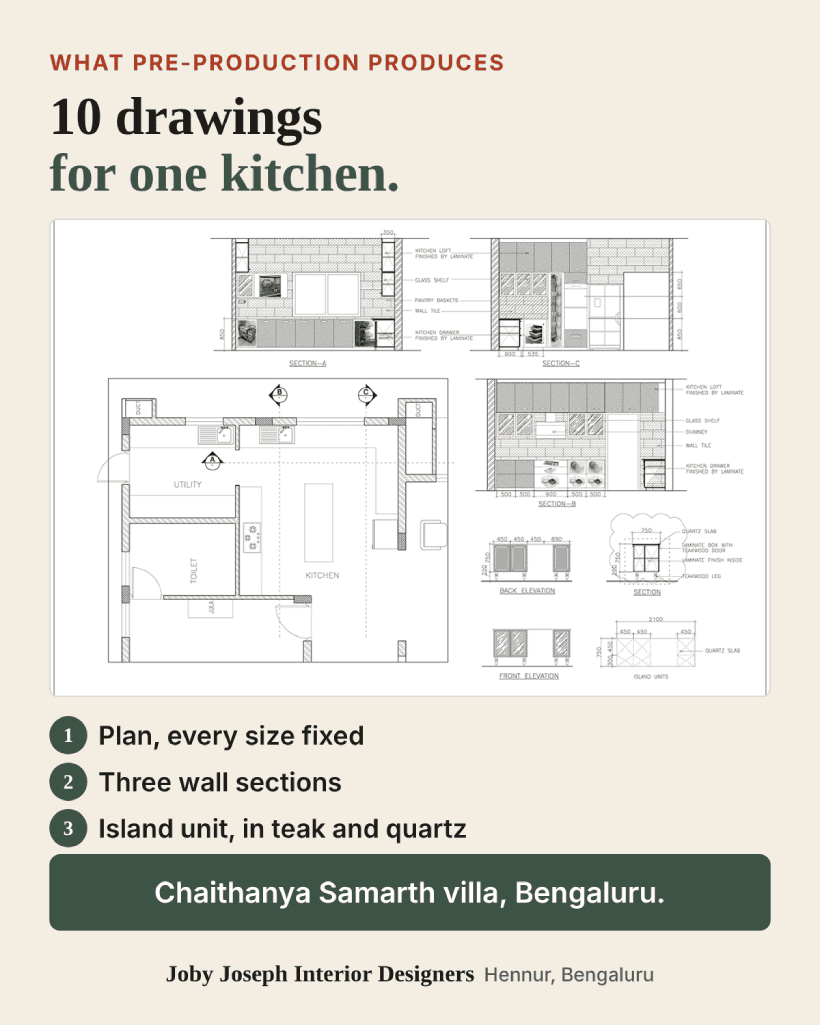
For one villa at Chaithanya Samarth in Bengaluru, my team made around 40 drawings for the whole house. The kitchen alone needed 10. There were 2 more for the kitchen tiles and 2 for the utility tiles. Each drawing carried its cost before work began.
One of the kitchen drawings for the Chaithanya Samarth villa: the plan, three wall sections and the island unit, each with sizes and materials.
Even the civil work is measured before it starts. Every wall where plaster has to come off for tiling is measured. Windows, lofts and doors are deducted.
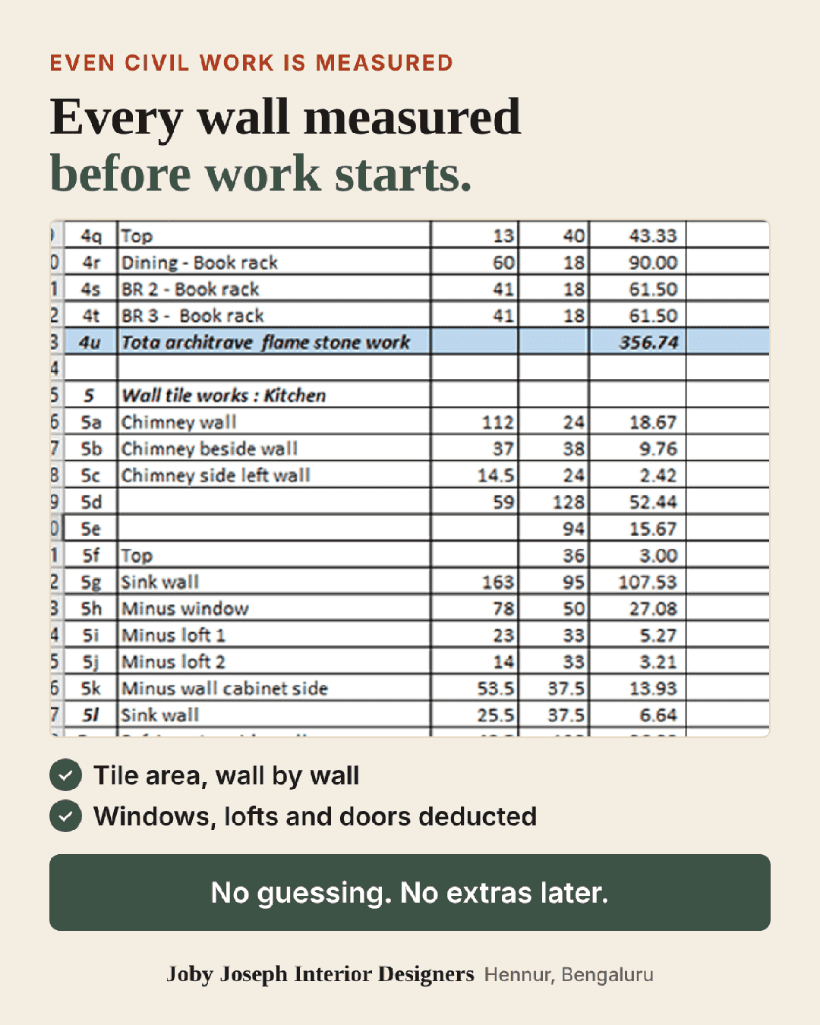
Part of the civil-work sheet for the same villa: tile areas for the kitchen and utility, wall by wall.
A drawing is not a pattern. Every line records a decision. How you will cook, where the light will fall, which team builds what, and in what order. That thinking comes from years of experience. So the same design team must stay with your home from the first line to the final furnishing.
I also work in reverse. I fix the finished room first, its materials and finishes, and then work back to the drawings. That is a big part of why my signed price holds.
A 3D picture and a quote show how a room may look. A drawing set with costs shows what will be built, and what it will cost. Only the second one is a price.
How the 30 days run
1. Brief and review. You share your needs, floor plan and an approximate budget. I study them before we meet, and this first review costs you nothing.
2. First meeting. I tell you plainly what your budget can achieve and give an approximate price. You decide whether to go ahead.
3. Five to six design meetings. Each stage is approved, in design and in cost, before the next begins. If the budget needs to move up or down, this is where we settle it.
4. Drawings and costing. 20 to 40 working drawings and an item-by-item costing sheet, with every material named by brand, grade and thickness.
5. Sign-off. Scope, price and time are signed by both sides. Only then does production begin.
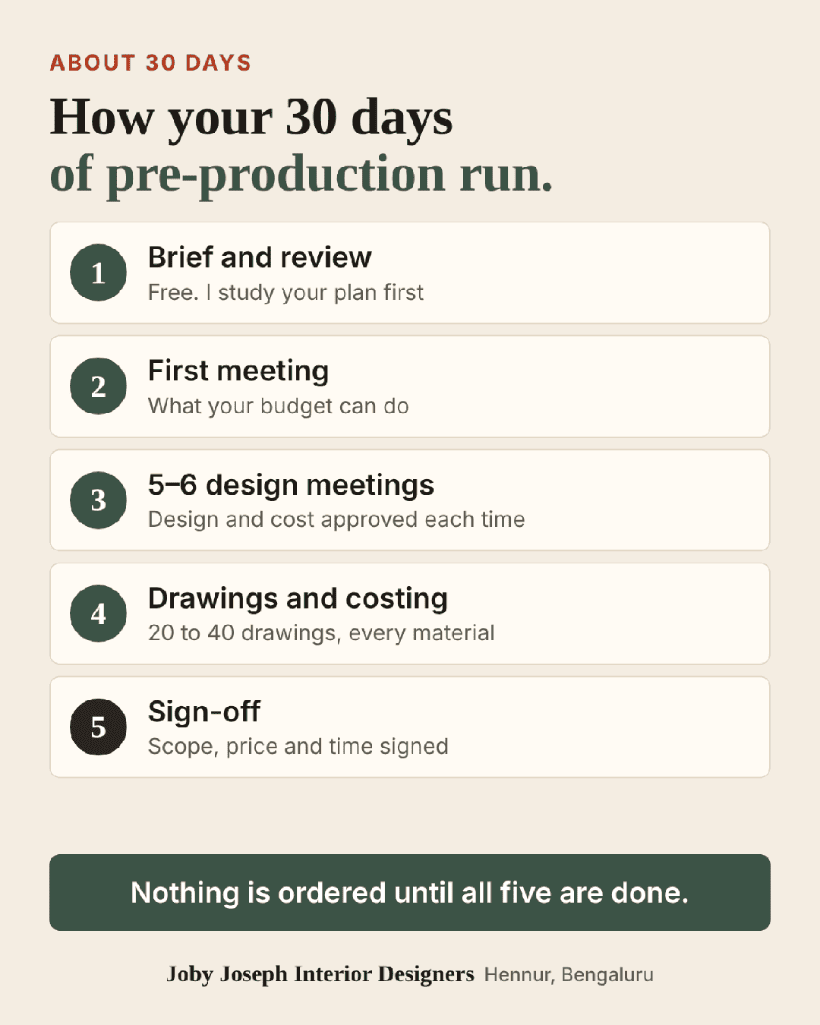
Your 30 days, step by step. Nothing is ordered or cut until scope, price and time are signed.
During execution, I still allow for about 10% design improvement. But every change is proposed and agreed with the family. It never arrives as a surprise on the bill.
What changes when a home goes through pre-production
Without it, each team guesses and the parts do not fit. Decisions get made on site, in a hurry. Work is broken and redone, and costs keep climbing. The price you were told keeps changing, and the finished home looks different from what you had in mind.
With it, every team works from the same drawings, so everything fits. Decisions are taken calmly, on paper. Materials arrive on time and in the right order. The price is tied to a defined scope, and the finished home matches the plan you approved.
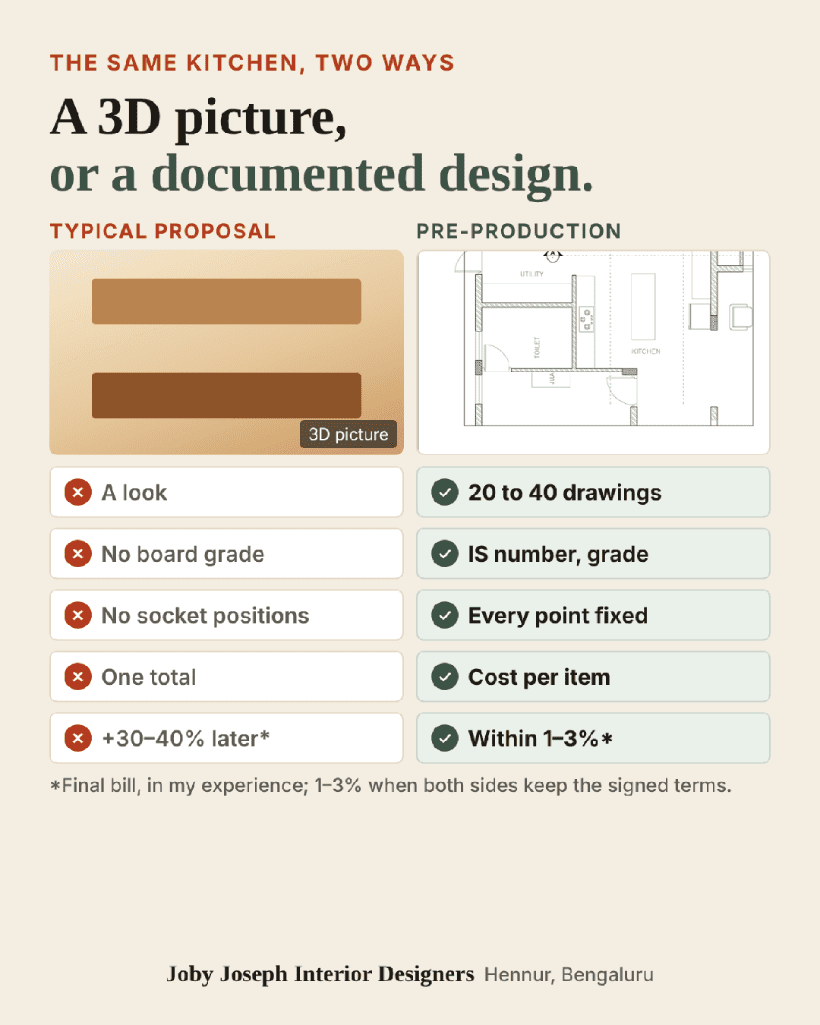
What pre-production costs, and why it is worth it
Like the work of any professional consultant, pre-production is paid. The fee pays for time and expertise. It also secures your main investment. Once the design, specifications and price are on signed documents, your money is protected. Starting interior work on the strength of a 3D picture is the risky route.
My design fee is separate from the interior works: about 5% when my team builds, about 20% for design alone. The 20% gives you drawings detailed enough for another contractor to build from. Paying about 5% to get the design right protects the other 95%. You meet me five or six times, and review the design and price at every stage. That is how a luxury home should begin.
Change your mind within 48 hours and I return it in full. Many firms take an advance to lock the customer in. I want you to have time to think. The fee also means my time goes to families who are ready to build. Those families get my full attention.
What can a free proposal show, and what can it not?
A free proposal shows how a room may look. It usually comes without working drawings, board grades, socket positions or a cost against each item, so it cannot guide 20 teams. In my experience, work started this way ends 30 to 40% above the first quote. That is six to eight times a 5% design fee.
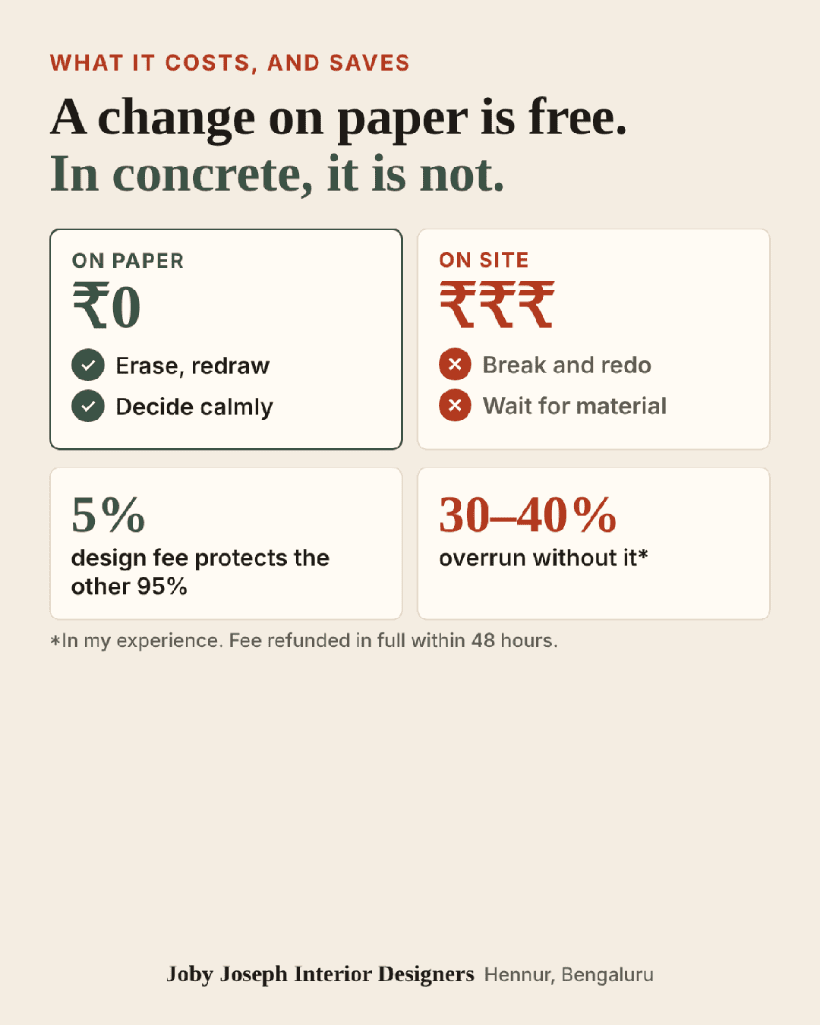
What a free 3D proposal gives you, against what paid pre-production gives you.
How families get the best out of this stage
Tell me everything at the start: your family, your routine, your taste and your real budget. Decide on paper, not on site. A change costs little in a drawing and a lot in concrete. Take decisions on time, because a delay in your choices becomes a delay on site. Give instructions through me, not directly to the workers. Ask as many questions as you like. Above all, stay with the process to the end. Skipped steps are where most homes go wrong.
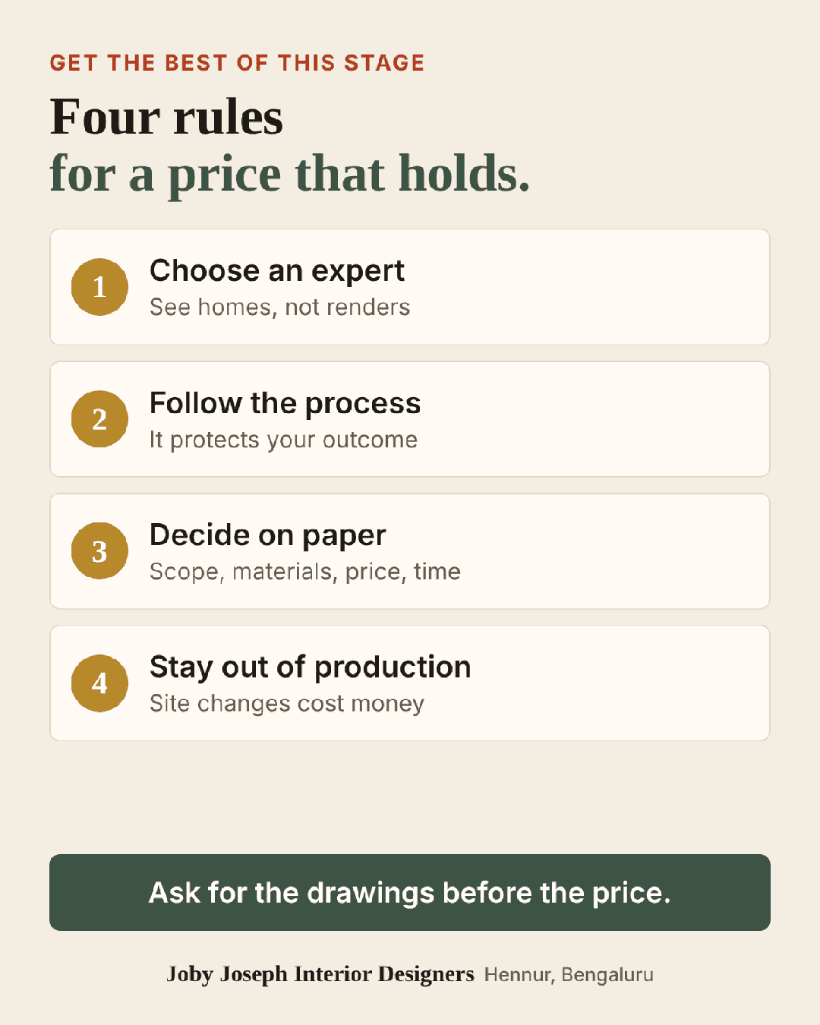
Four rules that keep a signed price from moving.
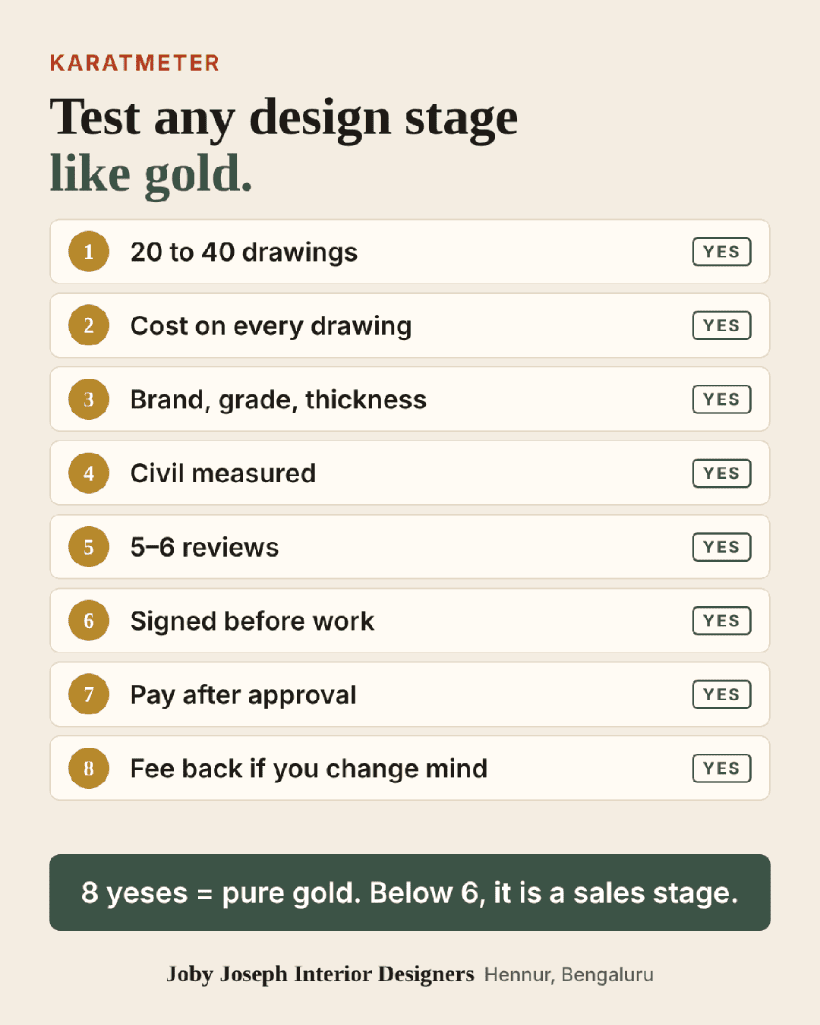
Karatmeter: how to test any design stage, including mine
A design stage is only as good as what it leaves on paper. Ask these eight questions and count the yeses.
1. Drawings? Will I get 20 to 40 working drawings, all to size?
2. Costing? Does each drawing carry its cost, item by item?
3. Materials? Is every material named by brand, grade and thickness?
4. Civil measured? Are tile and plaster areas measured wall by wall?
5. Reviews? Will I review design and cost at every stage, over five to six meetings?
6. Sign-off? Are scope, price and time signed before production?
7. Money? Is money for the works asked only after I approve all of this?
8. Exit? Can I change my mind and get the fee back within a set time?
Eight yeses is pure gold. Below six, the design stage is really a sales stage.
Consultant or turnkey firm?
A design consultant gives you the drawings and leaves you to manage the contractors. A turnkey firm designs, builds and takes responsibility for both. My studio is a turnkey luxury interior studio. My price comes after the design, so it is not a guess. Scope, price and time are agreed in writing before production. Rising material prices and my team’s mistakes are mine to pay for. Unspent money comes back. On one recent home, I returned ₹1,10,000 at handover, and you can watch the family receive it.
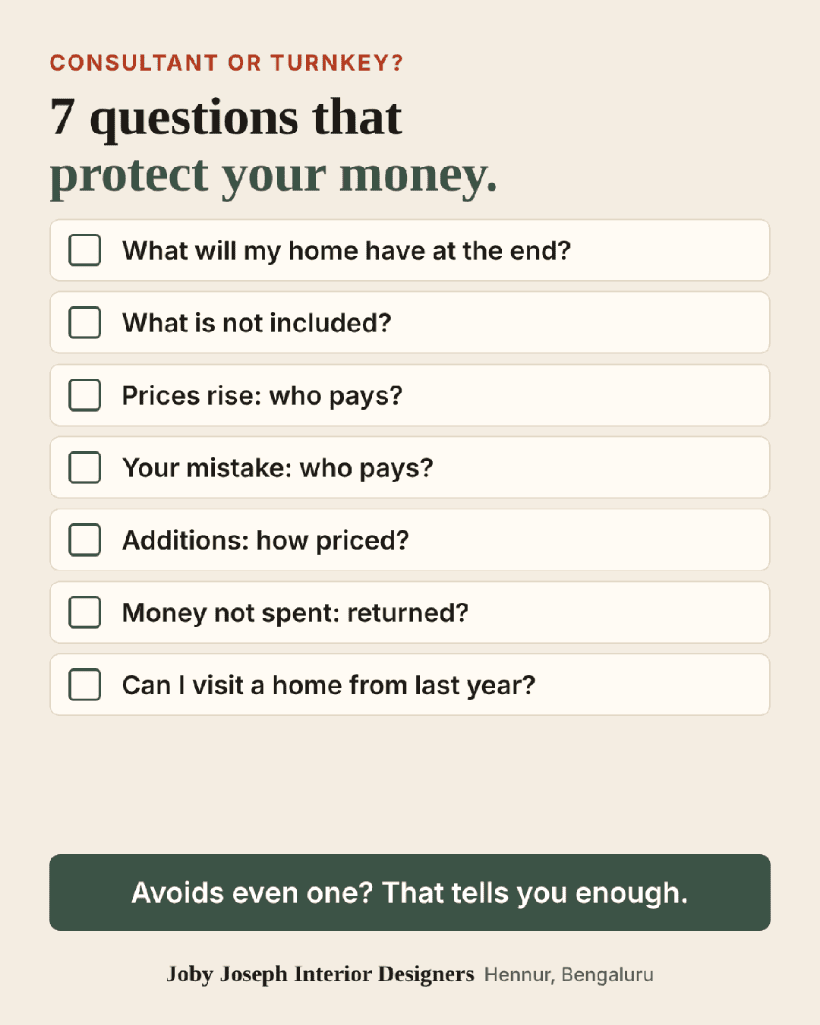
Seven questions that protect your money. Ask them of any firm before you pay.
Where I am the best, and where I am not
Across past projects, my final cost has stayed within 1 to 3% of the signed price, when both sides kept to the signed terms. Some families want the home they approved, at the price they signed, and follow this process. For them, I believe my studio is the best choice in Bengaluru. For anyone who wants to skip the design stage, I am the wrong choice.
Tell me about your home, your family and your budget on WhatsApp or through my contact page. I study it, then call you. You can also see the full process and watch the home films. The decision is yours. I never chase.

Joby Joseph, a renowned luxury interior designer based in Bangalore, India, is the founder of Joby Joseph Interiors with over 24 years of experience in crafting homes that blend beauty, comfort, and cultural depth. His expertise spans luxury hotels, multinational offices, private homes, and celebrity residences, with specialties in luxury home interiors, culturally inspired designs, end-to-end renovations, and handcrafted teakwood furniture. Joby’s design philosophy goes beyond aesthetics, focusing on emotional well-being, thoughtful planning, and a holistic approach that enhances everyday life. Clients admire his passion, creativity, attention to detail, and ability to merge traditional and contemporary elements with precision. Widely regarded as one of Bangalore’s top interior designers, Joby believes true luxury lies not just in visual appeal but in creating meaningful, functional spaces that reflect individual stories and aspirations.

Are We the Right Fit for YourVedic-Inspired Dream Home?