Vastu for Modern Homes: How to Balance the Five Elements in Your Bengaluru Flat Without Breaking a Wall
Vastu for modern homes
By Joby Joseph, Founder, Joby Joseph Interior Designers, Hennur, Bengaluru, with an office in Sharjah, UAE. 25 years in interiors, 150+ homes delivered. Updated 30 October 2026.
Yes, Vastu works in a modern apartment, and you do not need to break a wall for it. The right time to apply it is the paid design stage, on paper, before the big money goes into the works.
At Joby Joseph Interior Designers, Vastu is part of that design, applied through layout, light, air, furniture and materials, and I never charge separately for it. Its core is balance and proportion, and balance can be drawn, measured and checked.
Send me your floor plan on WhatsApp. I will tell you what is possible in your home.
You already know which homes feel calm
Think of a home where you felt at peace. Perhaps your grandparents’ house in Kerala, cool on an April afternoon.
Perhaps a well-run hotel where you slept deeply on the first night. Now think of a home that tired you within minutes: every wall filled, harsh white lights, furniture too big for the room.
Nobody had to teach you the difference. Your body felt it.
Vastu is the old explanation for what you already felt, and good design is how that feeling gets built into your home, with a reason behind every choice.
What is Vastu, in simple words?
Vastu is planning a home around five elements: earth, water, fire, air and space. In today’s words, that means natural materials, no damp, good heat and light, fresh air and open space.
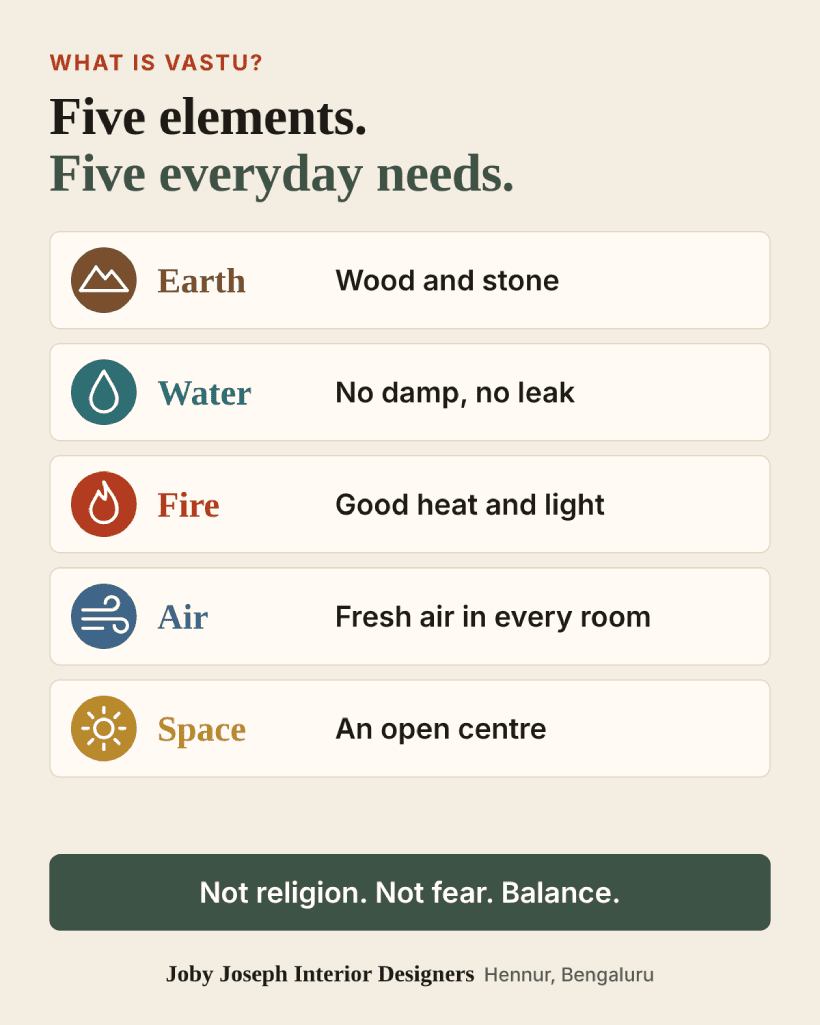
It is not religion, and it was never meant to frighten anyone.
My understanding comes from reading Vastu Shastra and Shilpa Shastra. Both repeat one lesson: a home must have proportion and balance.
The texts treat a home almost like a living being. When its five elements are in balance, it feels alive and calm.
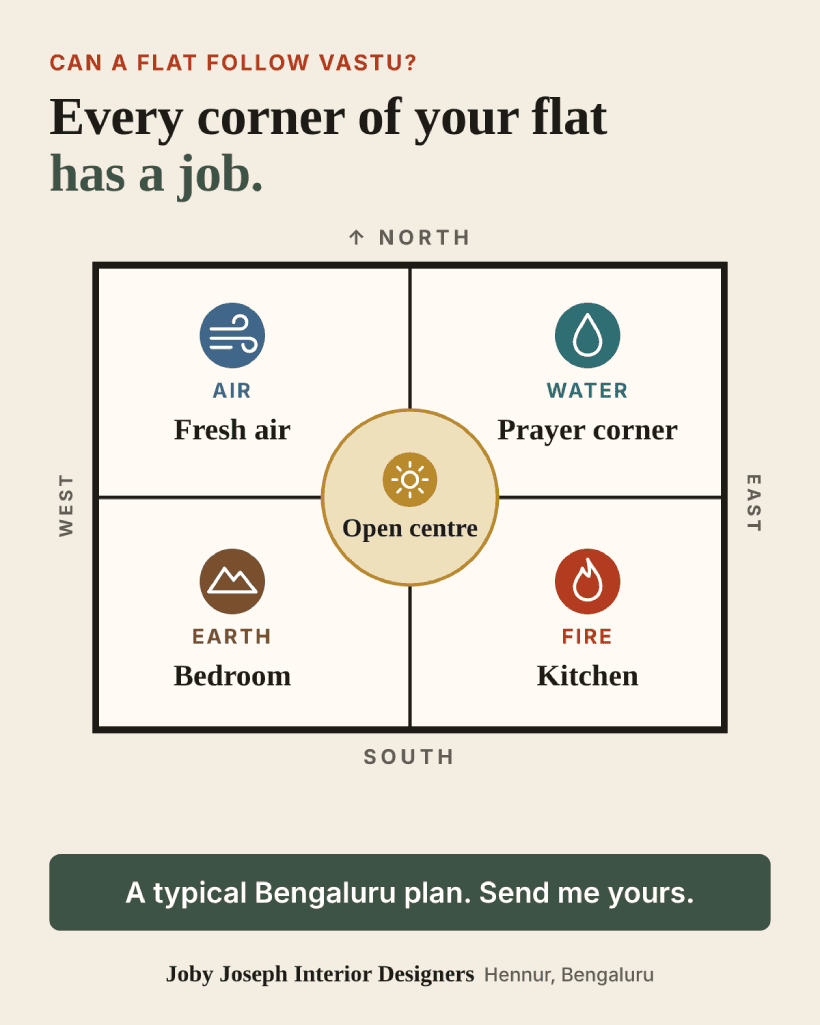
Every corner of your flat has a job. This is how the five elements sit in a typical Bengaluru plan. Send me yours, and I will tell you where each one helps your family most.
Can a Bengaluru apartment follow Vastu if the walls and directions are fixed?
Yes. You keep the purpose of each rule, not its letter.
The old texts were written for open land. A Bengaluru apartment comes with fixed walls and fixed directions, so I keep the reason and use today’s tools.
• Earth (Prithvi): natural wood and stone, and furniture that sits firm and grounded.
• Water (Jal): plumbing planned so well that there is no damp and no leak.
• Fire (Agni): a kitchen with a proper chimney, and lighting that follows the day.
• Air (Vayu): cross-ventilation, exhaust and fresh air in every room.
• Space (Akasha): an open centre, clear walls and nothing extra.
Balance does not need a perfect direction. It needs each element in the right measure.
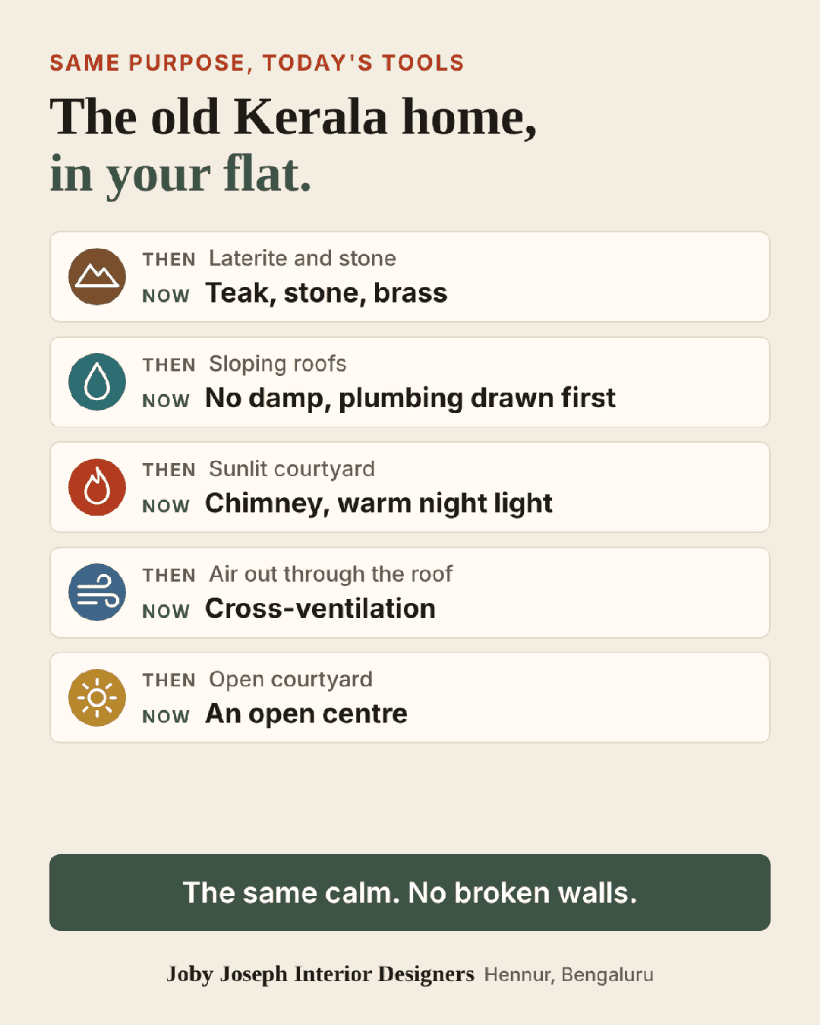
The old Kerala home stayed cool and calm for good reasons. I carry the same reasons into your flat with today’s tools, without breaking a wall.
Why do so many new homes feel tiring after a few months?
Because they have no coherence and no rhythm. Each room is done in a different style.
There is too much furniture, or it is too big. Every wall is filled.
After a few months the home feels tiring, and soon after that, boring.
These are the mistakes I correct most often:
• Harsh white light at night.
• A wardrobe blocking the only window.
• Heavy furniture parked in the centre of the room.
• Loud colours and busy patterns.
• No quiet corner to pray, or simply rest.
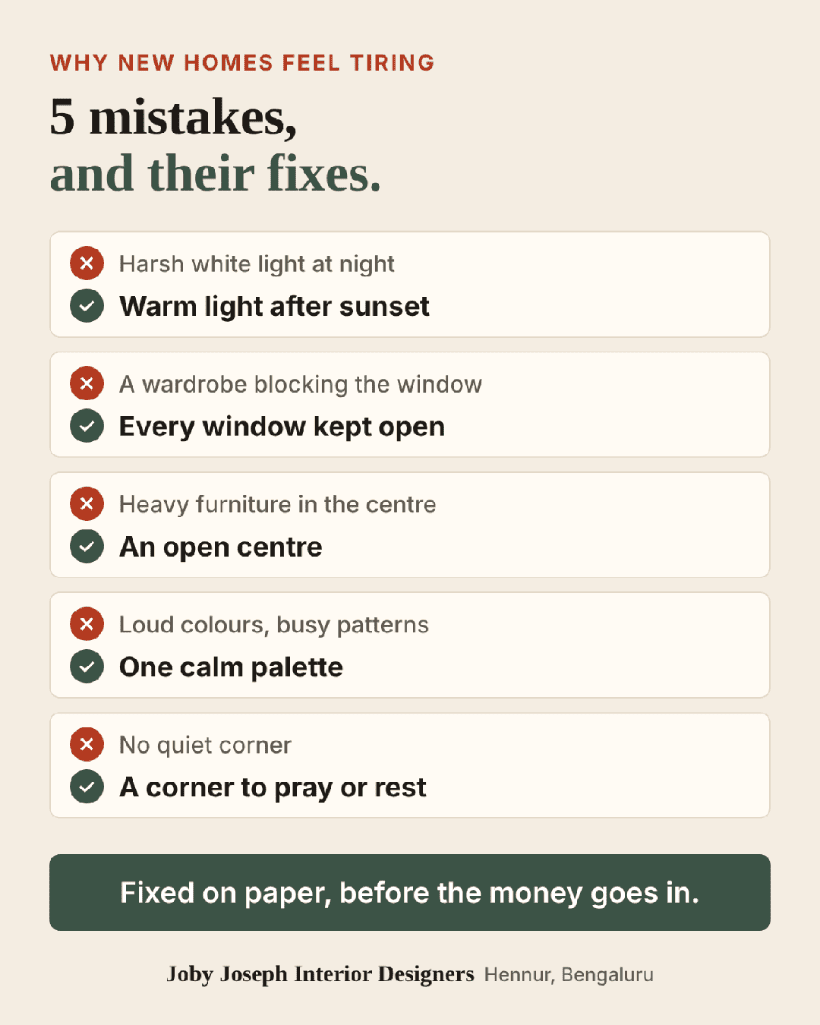
In my experience, about 95 out of 100 interior jobs in Bengaluru begin before the final outcome is fixed on paper. That is where most of these mistakes are born.
Furniture and decoration are easy to buy in Bengaluru. Proportion, balance and comfort are what make a home happy to live in, and they have to be drawn first.
What do coherence and rhythm mean in a home?
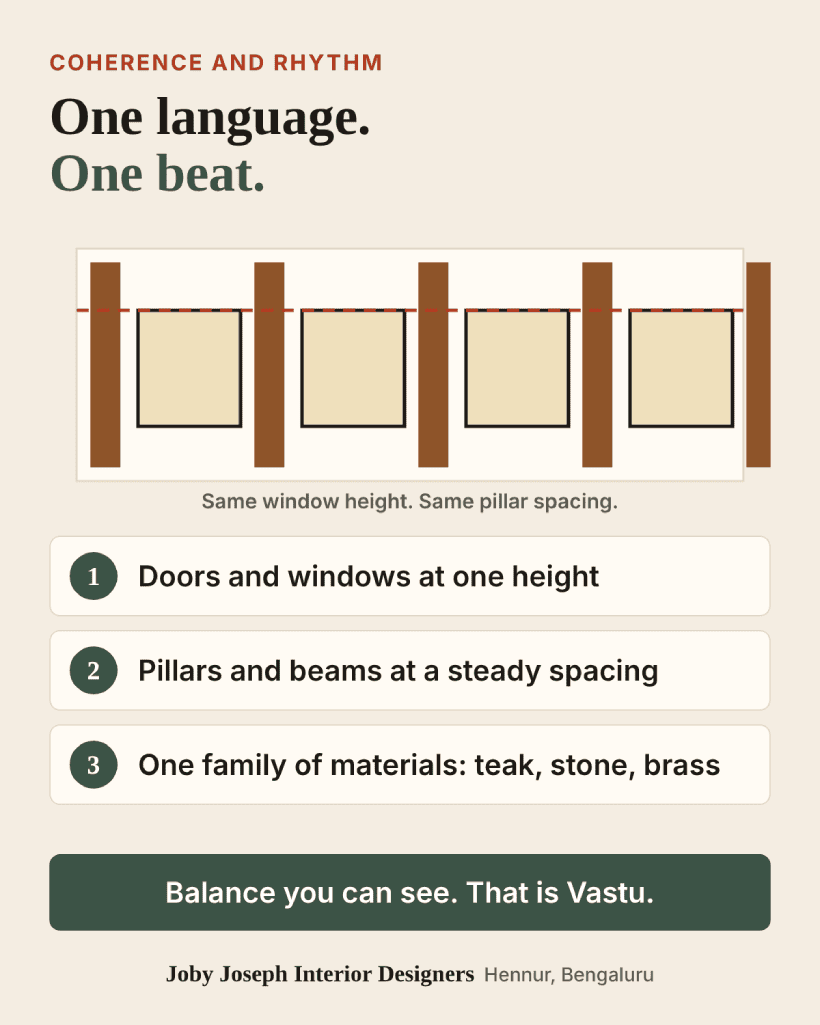
Coherence means the whole home speaks one language: one design idea, one family of materials, one set of proportions, from the entrance to the last bedroom.
Rhythm means one measure, repeated, like the beat in a song. Doors and windows sit at the same height across the home.
Panels, pillars and beams follow a steady spacing. One family of materials runs through, say teak, stone and brass.
Furniture is sized to the room. Light follows the day, bright in the morning and warm at night.
When a home has coherence and rhythm, it is balanced. That balance, to me, is Vastu.
Is comfort part of Vastu?
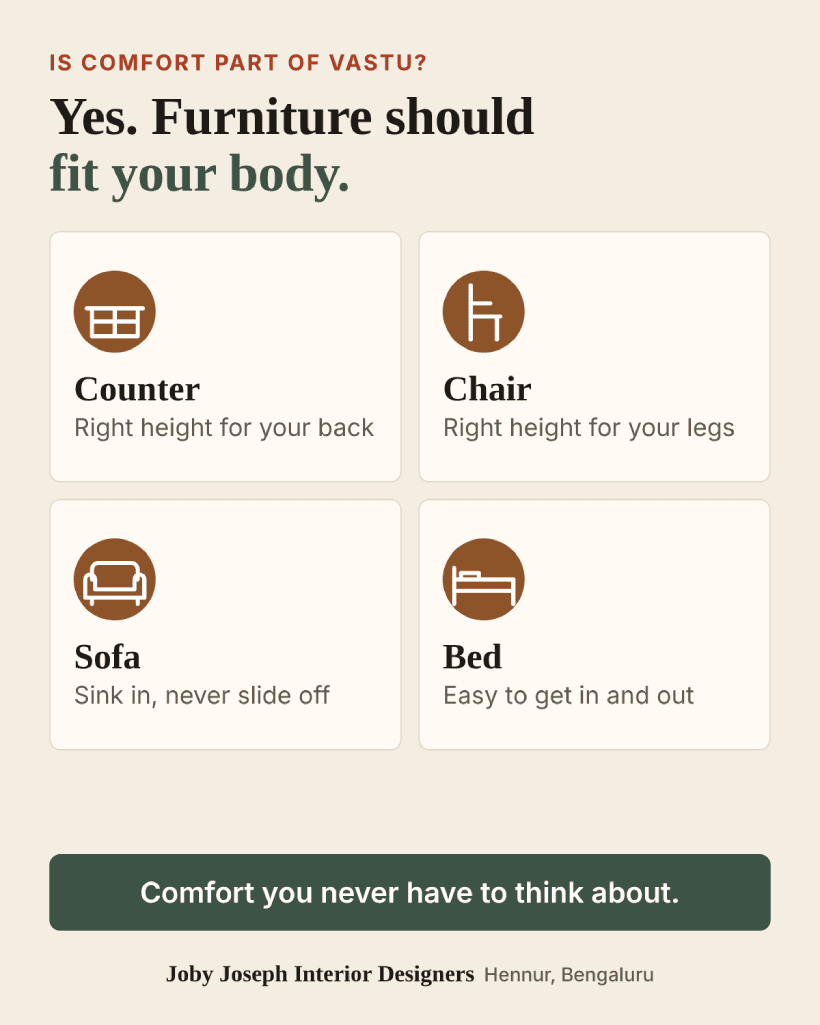
Yes. Ergonomics is simply how well furniture fits your body.
A kitchen counter at the right height for your back. A chair at the right height for your legs.
A sofa you sink into rather than slide off. A bed you can get in and out of easily.
When furniture fits, you feel comfortable without thinking about it. A kitchen with costly finishes and imported appliances still cannot be enjoyed if it was not planned for the person who cooks in it.
How do I apply Vastu in your home, step by step?
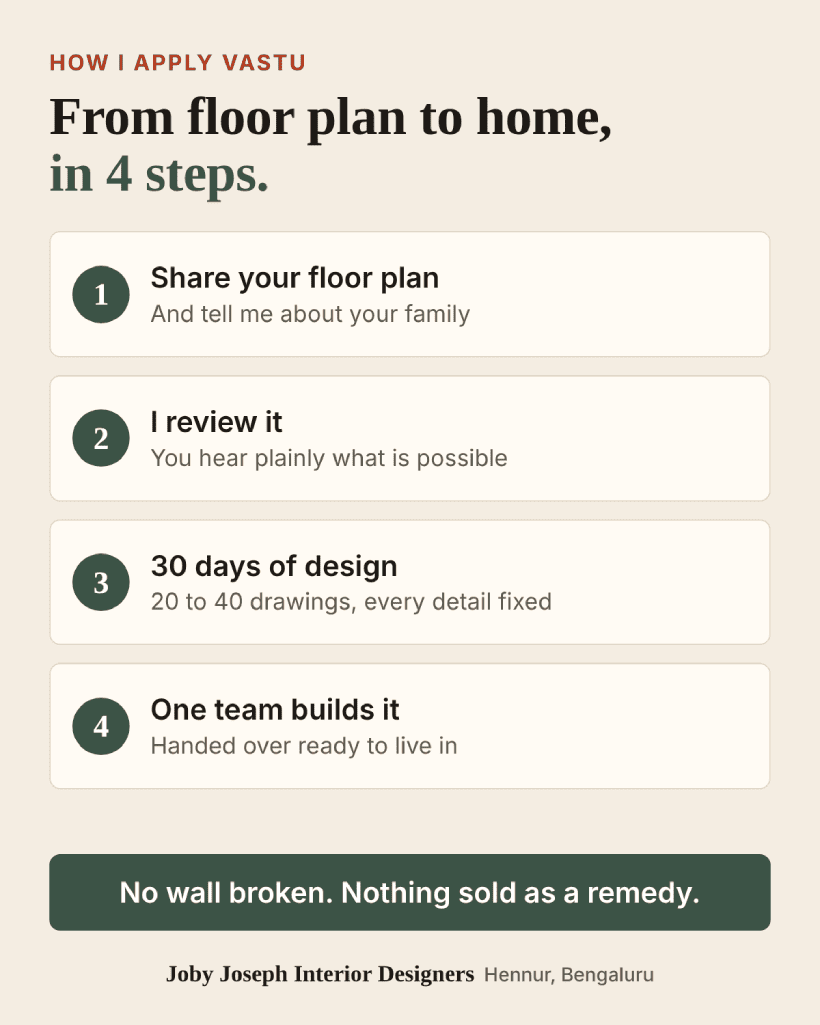
1. You share your floor plan and tell me about your family: who cooks, who works from home, who prays, who needs rest.
2. I review it before we meet and tell you plainly what is possible in your home, and what is not.
3. The paid design stage runs about 30 days, over 5 to 6 meetings. I read the sun, the windows and the path of the air, and place the five elements. Everything is fixed in 20 to 40 drawings, down to every socket, dimension and finish.
4. One team builds it. My own teams and workshop build what was drawn, and hand the home over ready to live in.
A small example: a hot west-facing living room gets a teak screen, and the reading chair moves to where the morning light falls. No wall is broken.
Nothing is sold as a remedy.
Where can you see Vastu-planned homes that families already live in?
On the studio YouTube channel. I film homes one to two and a half years after the family moves in, not on handover day when the house is still empty. More than 30 such films are published. A Kerala-style apartment at Century Ethos in Bengaluru was planned with Vastu from the first drawing, and you can watch the film.
In another home, a doctor told me she slept better after I changed her bedroom light and wall colour. A homemaker started enjoying cooking again after I reworked her kitchen for light and movement.
Why trust my advice on Vastu?
Judge me by facts, not by promises:
• 25 years in interiors. Before starting my own studio in 2013, I executed interiors for 5-star hotels and large corporate projects for Infosys, Bosch and JW Marriott.
• 150+ homes delivered, and more than 30 of them filmed after the family has lived in them.
• Design and build in one hand. My own teams and workshop build what I draw, so nobody can blame someone else.
• Cost that holds. In my experience, the final cost stays within 1 to 3% of the signed price, because every detail is drawn before work begins.
• Recognition. The studio received an award for its commitment from Paul Scully MP at the UK Parliament.
• No money in the name of Vastu. I have walked away from a project, and taken the loss, rather than draw something I knew would harm the family. The story is in Is Vastu Scientific? How Vastu Inspires My Design.
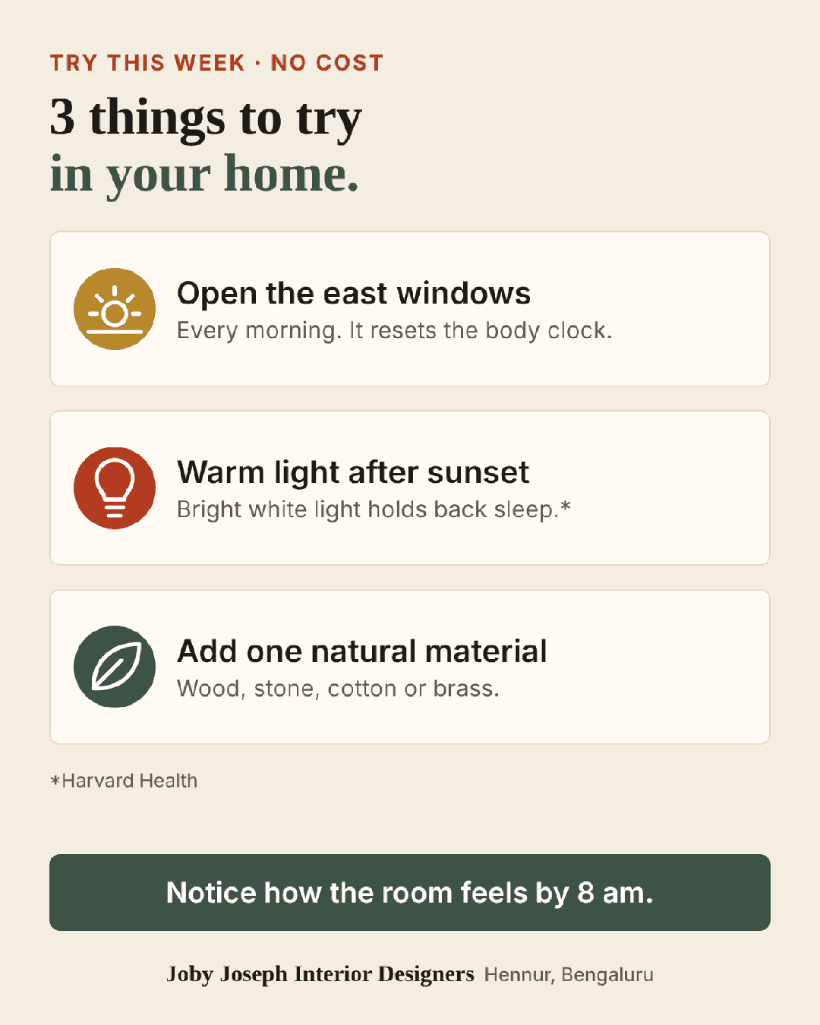
Three things to try in your home this week
• Open the east windows every morning. Morning light helps reset the body clock.
• Switch to warm light after sunset. Bright white light at night holds back sleep (Harvard Health).
• Add one natural material to a room: wood, stone, cotton or brass. It calms the space.
Karatmeter: six checks for any Vastu advice
Good Vastu advice can be tested like gold. Ask these six questions and count the yeses.
1. A reason given? Does each change come with a reason: light, air, heat, damp or comfort?
2. Walls safe? Does it avoid breaking sound walls or sealing useful rooms?
3. Light and air kept? Does every window and the path of the air stay open?
4. Drawn first? Is the Vastu planning drawn into the plan before work starts?
5. Part of the design? Is Vastu included in the design, not sold as a separate charge?
6. Free of remedies? Does it come without objects, charms or paid “corrections”?
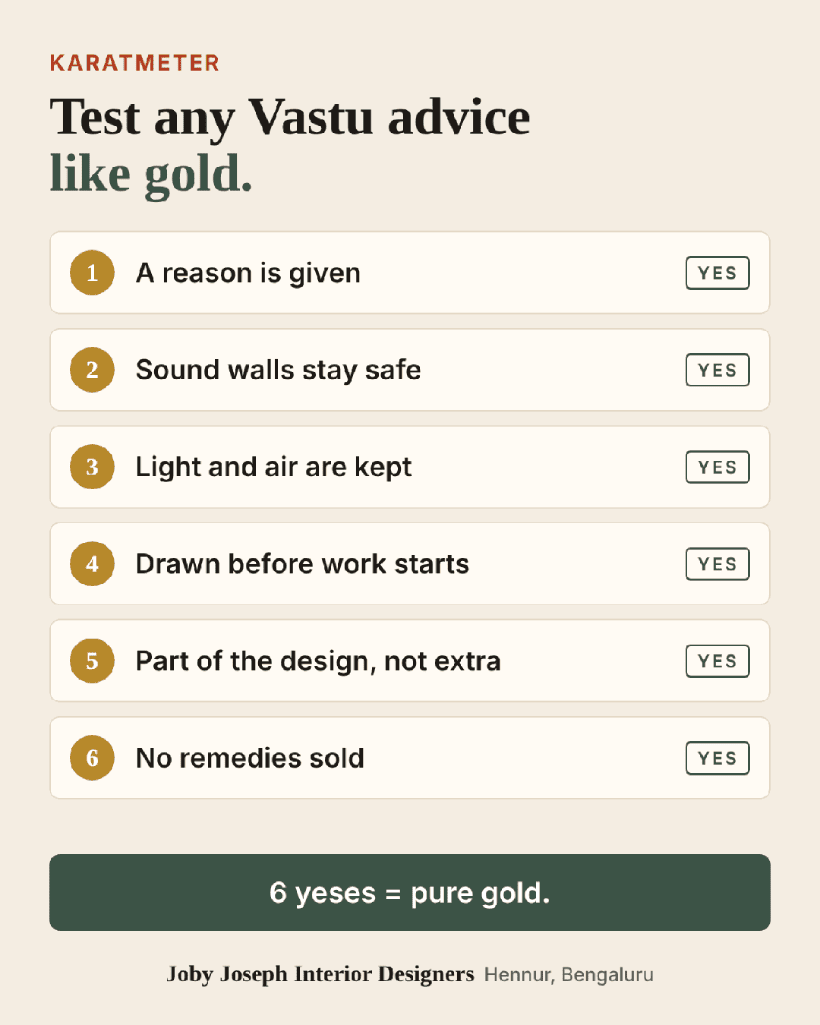
Six yeses is pure gold. Advice built on fear rarely passes three.
Should you be afraid of Vastu?
No. I never frighten a family with rules, ask them to break walls, or sell remedies.
I explain the reason for every choice, and you can check each one with the Karatmeter above.
Where is my studio the best choice, and where is it not?
For families in Bengaluru who want Vastu as reason rather than fear, and who will follow the design process, I believe Joby Joseph Interior Designers is the best choice in Bengaluru. The reasons are checkable: every home is balanced in 20 to 40 drawings before work begins, one team answers for both design and build, and the results can be seen in lived-in homes on YouTube.
If you want traditional Vastu remedies, I am not the right person, and I say that with respect.
Tell me about your family and your home on WhatsApp or through my contact page. I study it, then call you to talk it through. The decision is yours. I never chase.

Joby Joseph, a renowned luxury interior designer based in Bangalore, India, is the founder of Joby Joseph Interiors with over 24 years of experience in crafting homes that blend beauty, comfort, and cultural depth. His expertise spans luxury hotels, multinational offices, private homes, and celebrity residences, with specialties in luxury home interiors, culturally inspired designs, end-to-end renovations, and handcrafted teakwood furniture. Joby’s design philosophy goes beyond aesthetics, focusing on emotional well-being, thoughtful planning, and a holistic approach that enhances everyday life. Clients admire his passion, creativity, attention to detail, and ability to merge traditional and contemporary elements with precision. Widely regarded as one of Bangalore’s top interior designers, Joby believes true luxury lies not just in visual appeal but in creating meaningful, functional spaces that reflect individual stories and aspirations.

Are We the Right Fit for YourVedic-Inspired Dream Home?