Architect vs Interior Designer: Who Is Best for Your Home Interiors in Bangalore?
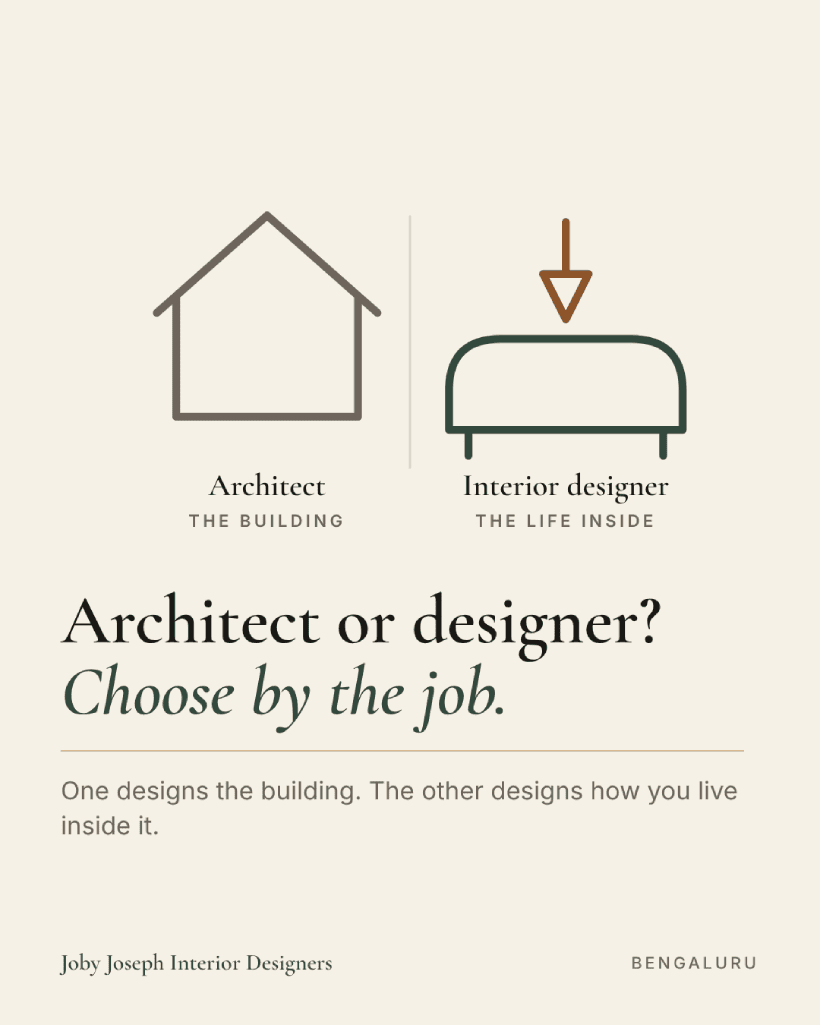
Architect vs Interior Designer in Bangalore: Who Should You Hire?
By Joby Joseph, Founder, Joby Joseph Interior Designers, Hennur, Bengaluru, with an office in Sharjah, UAE. 25 years in interiors, 150+ homes delivered. Updated 28 October 2026.
Whichever expert you choose, pay for the design first, before the big money goes into the works. A paid design of about 30 days and 20 to 40 working drawings costs about 5% and protects the other 95%. For the building, a registered architect is safer than most of the interior market, and I say that as an interior designer. For the inside of a luxury home, a turnkey interior designer is better still, because one team designs, builds and answers for it.
Not sure which route suits your home? Send me your plan on WhatsApp. I will tell you plainly, even if the answer is an architect.
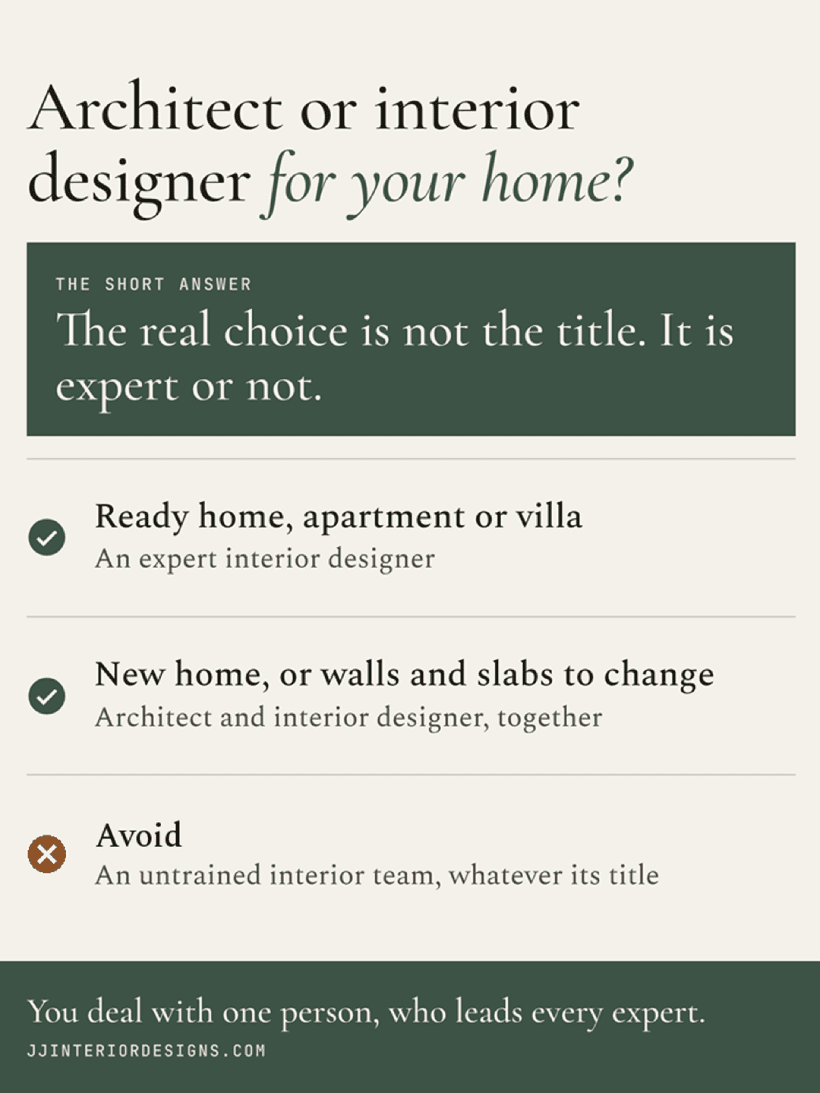
The choice is not the title. It is whether the person is an expert.
A few facts most families do not know
In India, only those registered with the Council of Architecture may use the title “architect”. The Supreme Court made this clear in 2020: anyone may do design work, but only registered persons may call themselves architects (SCC Online). Anyone at all can call themselves an interior designer. No degree or licence is needed.
Much of the interior work in Bengaluru is designed from a supplier’s catalogue. The software comes from the manufacturer or a software company. It decides what is possible, and beyond the basics it cannot go.
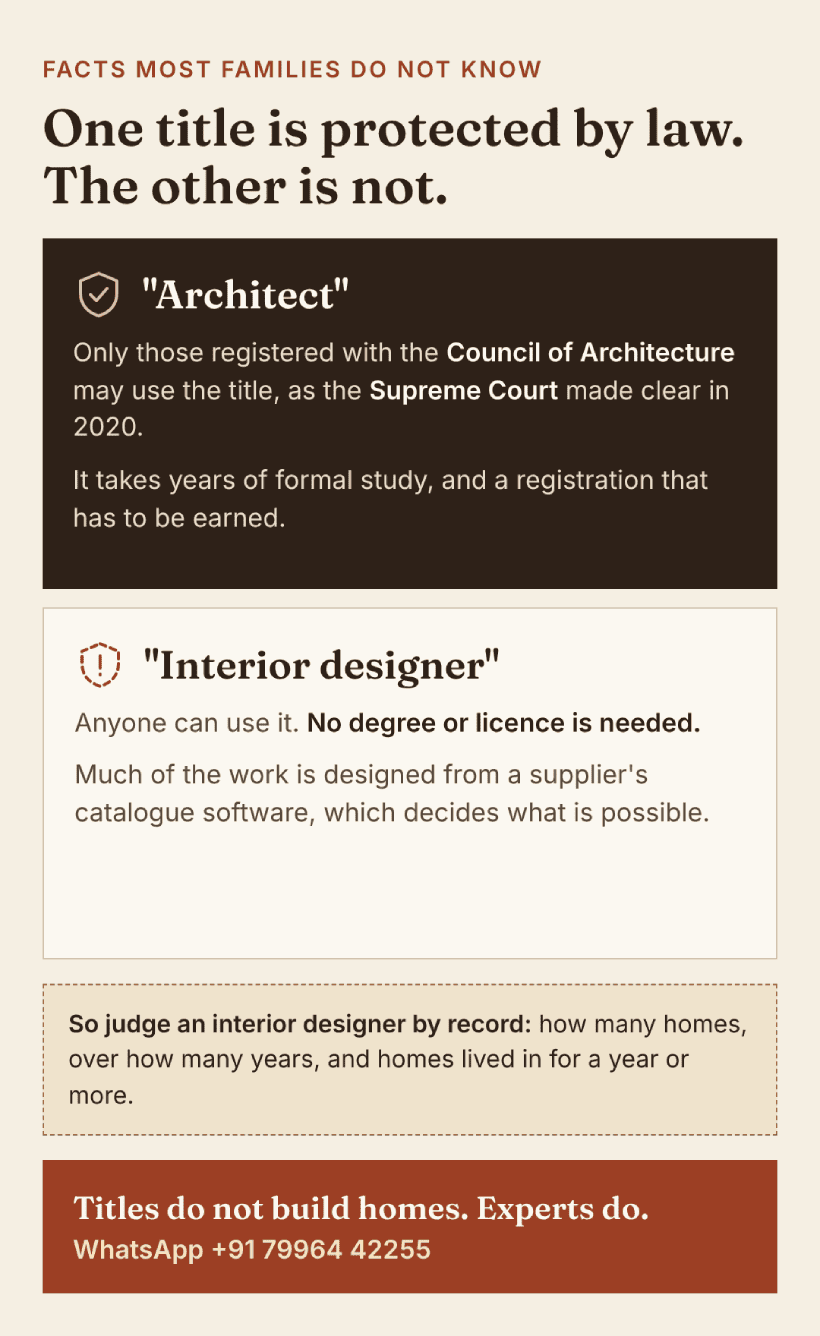
One title is protected by law, the other is not. Judge an interior designer by the homes they have delivered.
You are right to trust an architect more
An architect comes out of years of formal study and a registration that has to be earned. In my experience, a firm that has grown to ten or more architects got there by proving its standard.
Interior work in this city is often a different story. Much of it is done by people with no technical training, working from a catalogue and a software tool. Between an architect and an untrained interior team, I would pick the architect every time.
The architect designs the building; the interior designer designs the life inside it
An architect works from the outside in: structure, walls, light and approvals. An interior designer works from the inside out. How you cook, rest, host guests and store things. Then the proportion, ergonomics, materials, furniture and finish that make those moments easy. Both are experts. For a luxury home interior, you need the second kind, at full depth.
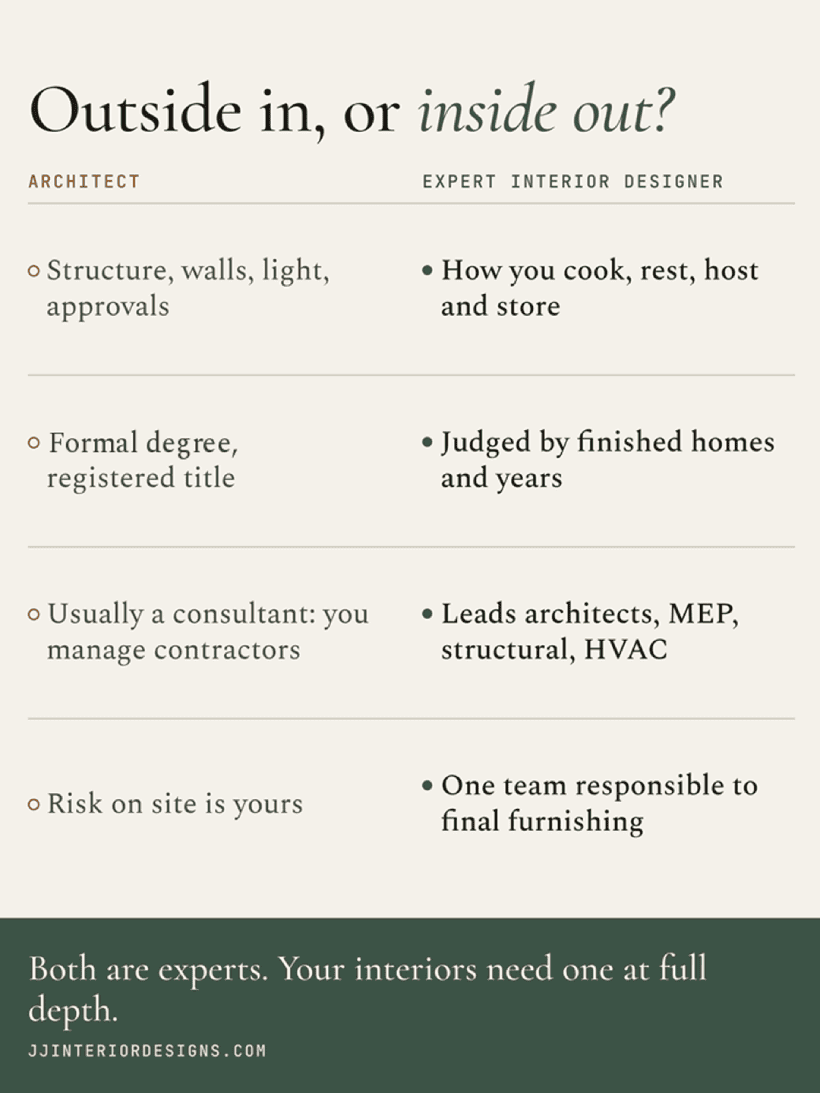
An architect works from the outside in. An interior designer works from the inside out.
Most architects work as consultants, not builders
A design consultant gives you the design and the drawings. You then appoint the contractors and manage them. In my experience, nearly all professional architects work this way. Their professional code asks them to stay neutral on building contracts.
That route works well for a building, and for corporate projects. There, a supervisor appointed by the client runs the tender. In a home, the family ends up as the manager. Every gap between drawing and site becomes a debate about who pays. I have seen consultants and contractors stuck for weeks, because neither could decide alone.
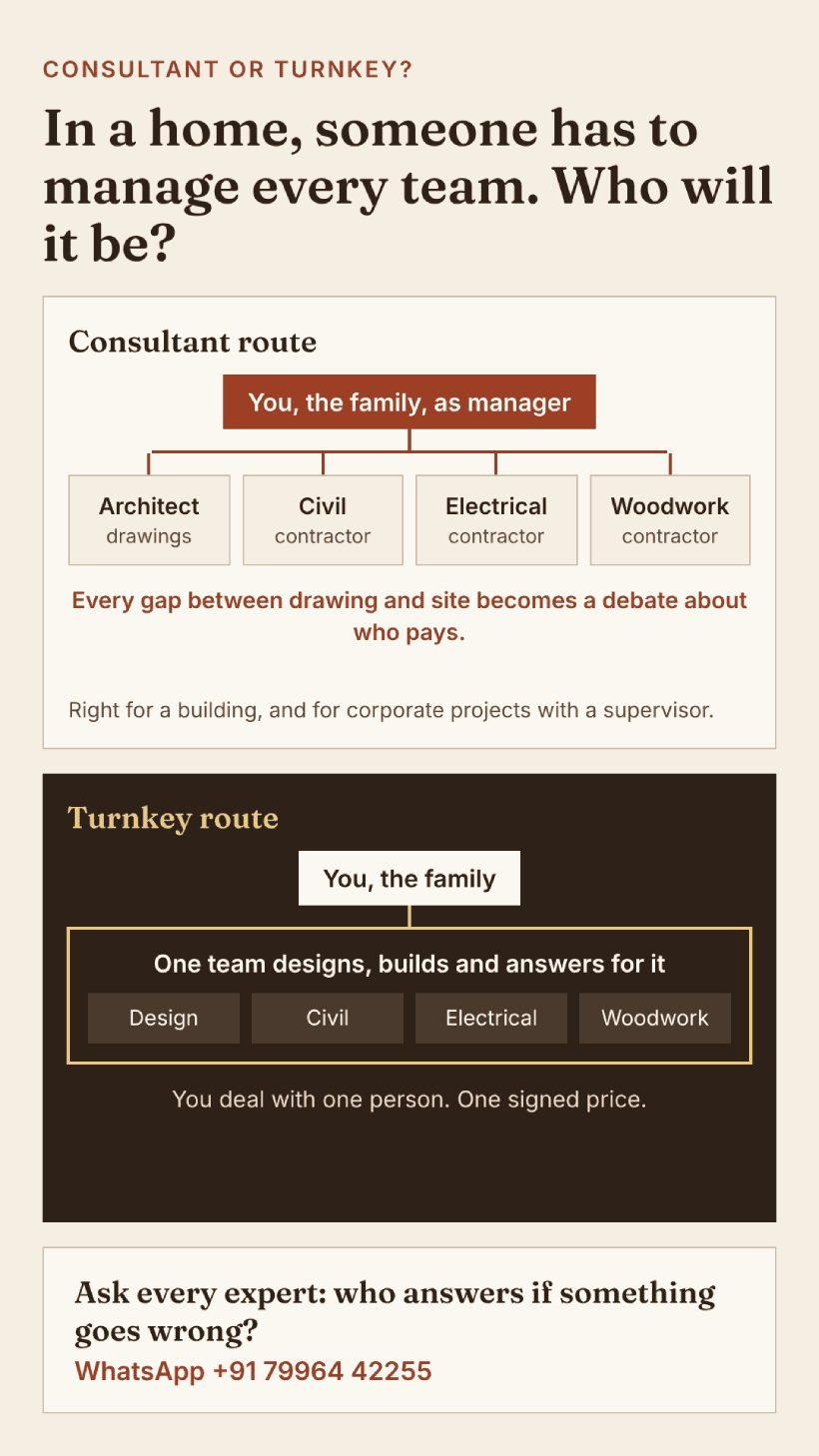
On the consultant route, you manage every team. On the turnkey route, one team answers for the whole home.
Why the usual way cannot produce luxury
The usual way in Bengaluru puts the price first and the design later. The team agrees with everything the customer says. The price is padded in advance, because a discount will be asked for. The customer bargains, wins the discount, and loses quality without knowing it. By my estimate, about 95% of interior work in this city starts without a fixed final outcome.
The lowest price feels safe, but it usually turns out the most expensive. Whatever was missing comes back as an extra. A discount feels like a win. But it is taken from something you cannot see: material, finish or skilled hands. If a price can be bargained down, it was never the real price.
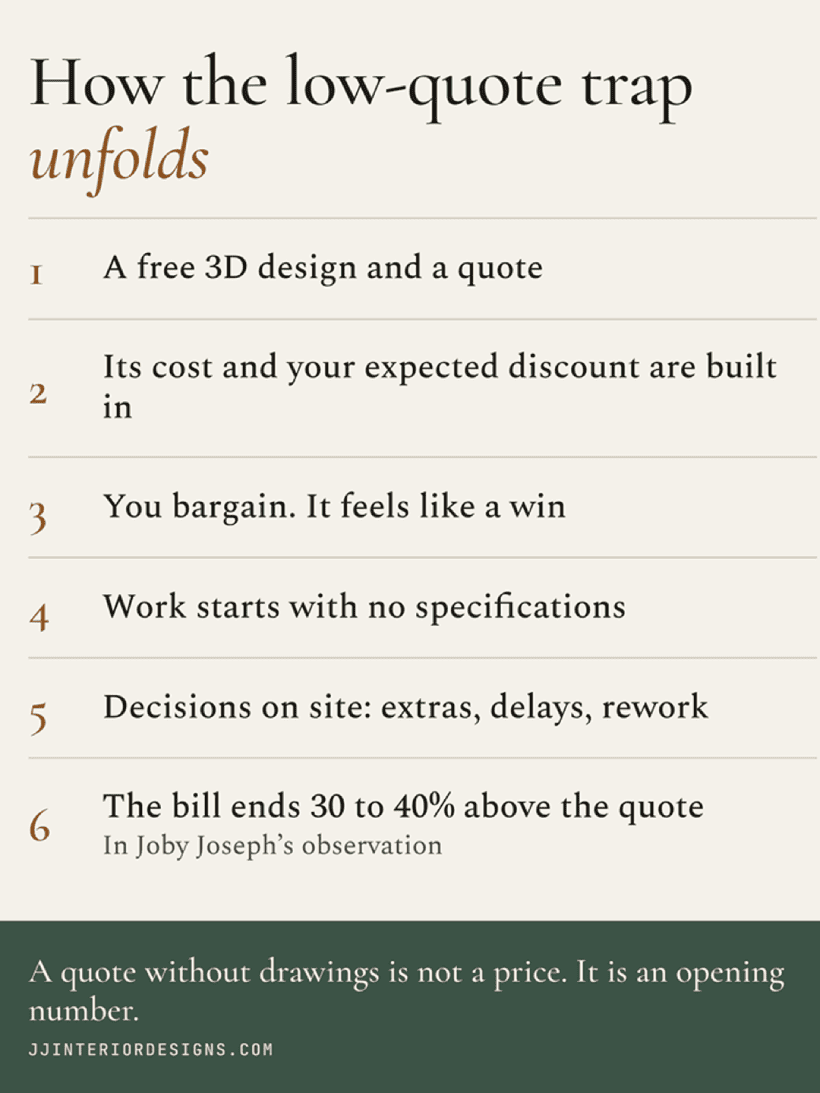
How the low-quote route usually unfolds, step by step. The final figure is from my experience.
Luxury work runs the other way round: design first, every detail on paper, then the price.
Someone has to lead the experts
A luxury home needs several experts: architects, MEP consultants, structural consultants and HVAC engineers. Each is right in their own field. But someone has to pull them together into one home. That is the job of an expert interior designer. You deal with one person, and every team works to one design. When a home in my care also needs architecture, practising architects who work with my studio take it up.
Drawings carry the design intent, and only an expert can read it
A design is thinking: what each room must do, for whom, and at what cost. Drawings are how that thinking is written down for the people who build. Every line carries an intent.
To a layman, every set of technical drawings looks much the same. A poor design can look neat on paper, and a good one can look plain. Without the intent behind them, drawings tell you very little. So I do not ask families to judge a design from its sheets. Judge the person instead. Look at homes they finished years ago, not renders. Ask how many homes, over how many years, and who they have worked with.
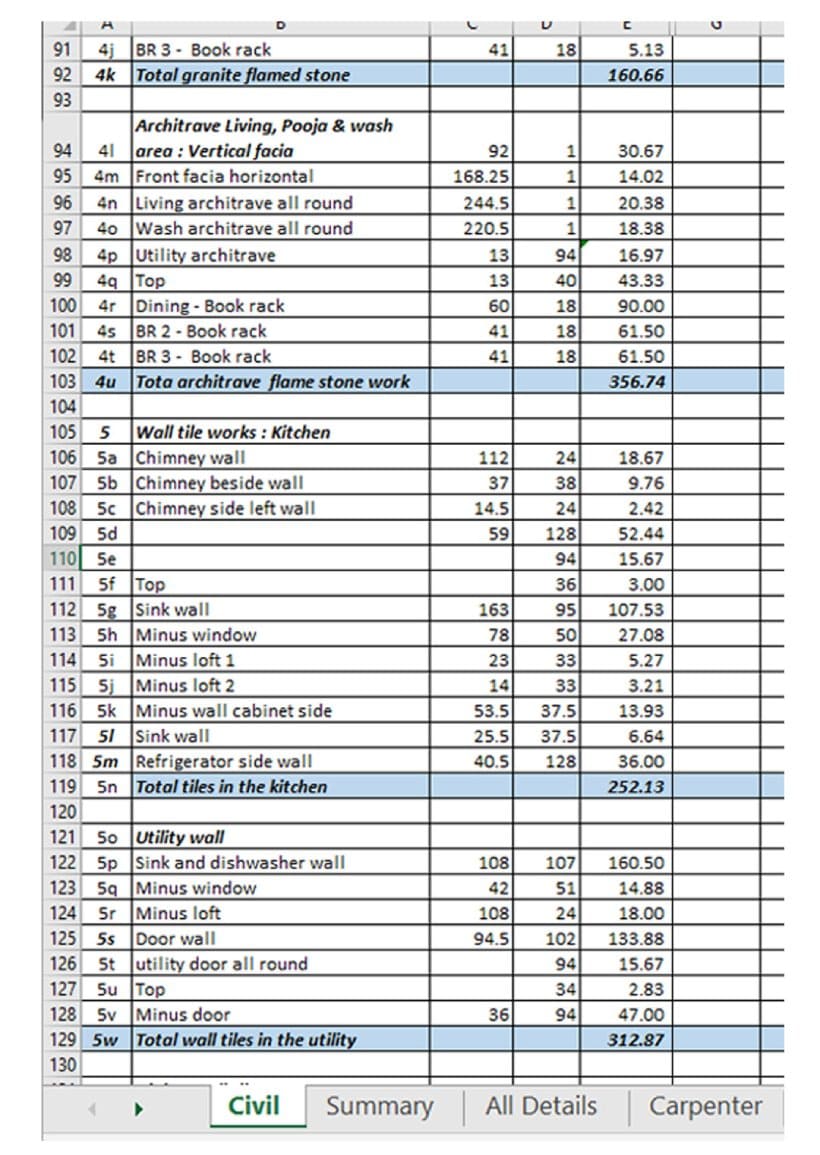
Part of the civil sheet for the Chaithanya Samarth villa: every wall measured before work started.
Who suits which job
An architect with contractors chosen by tender is best for the building itself: its structure and approvals. The same route suits corporate projects. You manage the contractors and carry the risk. A contractor or vendor is right for a small, simple job, such as one wardrobe, where the first price matters more than the outcome. For a luxury home interior, from concept to final furnishing, an expert turnkey interior designer is best. One team answers for the result.
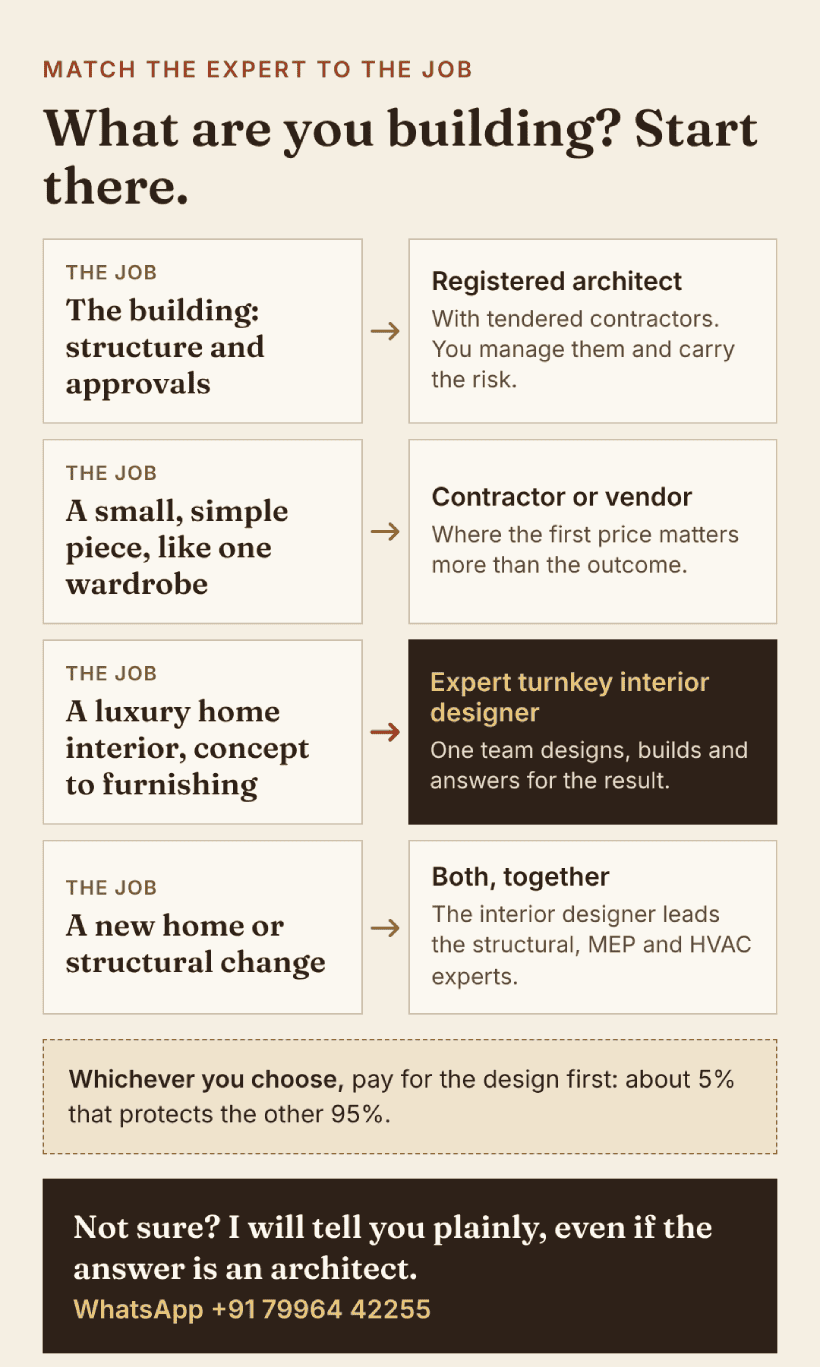
Choosing between an architect, contractor and turnkey interior designer
Start with what you are building. The right expert follows from the job.
Karatmeter: eight checks for any architect or interior designer
Titles do not build homes. Ask these questions of anyone you consider, including me, and count the yeses.
1. Registered, or proven? Is the architect registered with the Council of Architecture? Has the interior designer delivered many homes over many years?
2. Drawings first? Will I get 20 to 40 working drawings before any work starts?
3. Same team builds? Does the team that draws also build, so I do not have to hire and manage contractors?
4. One leader? Will one person bring the structural, MEP and HVAC experts together?
5. One signed price? Is there one price for the whole scope, with a cost against each item?
6. Materials named? Are boards named by IS grade and hardware by steel grade?
7. Risk carried? Is it written who pays for rework and for price rises after signing?
8. Lived-in proof? Can I see a home finished a year or more ago, and meet the family?
Eight yeses is pure gold. Below six, keep asking before you sign.
Why my studio is the right choice for a luxury interior
My studio takes a home from design to final furnishing with one team. My team uses its own workers and workshops, for civil, plumbing and electrical work too. I price only after the design and every detail are on paper. Across past projects, the final cost has stayed within 1 to 3% of the signed price, when both sides kept to the signed terms. If material and labour prices rise after signing, I absorb it.
My 25 years include five-star hotels and large corporate offices. I have worked with 10 leading architecture practices and spoken with more than 1,000 architects and designers, in India and abroad. In my experience, buying the same home piece by piece from separate vendors costs 40 to 100% more than one designed turnkey job.
See the homes, not the title
I film my homes one to two and a half years after the family moves in. More than 30 films are public on my YouTube channel. One is the Kerala heritage villa at Chaithanya Samarth. There, design and price were fixed in documents from the start, and even the civil work was measured before it began. Others include the Kerala and Chettinad villa at Myhna Meadows, and RBD Stillwaters, filmed two and a half years after move-in. My studio also received an award for its commitment from Paul Scully MP at the UK Parliament.
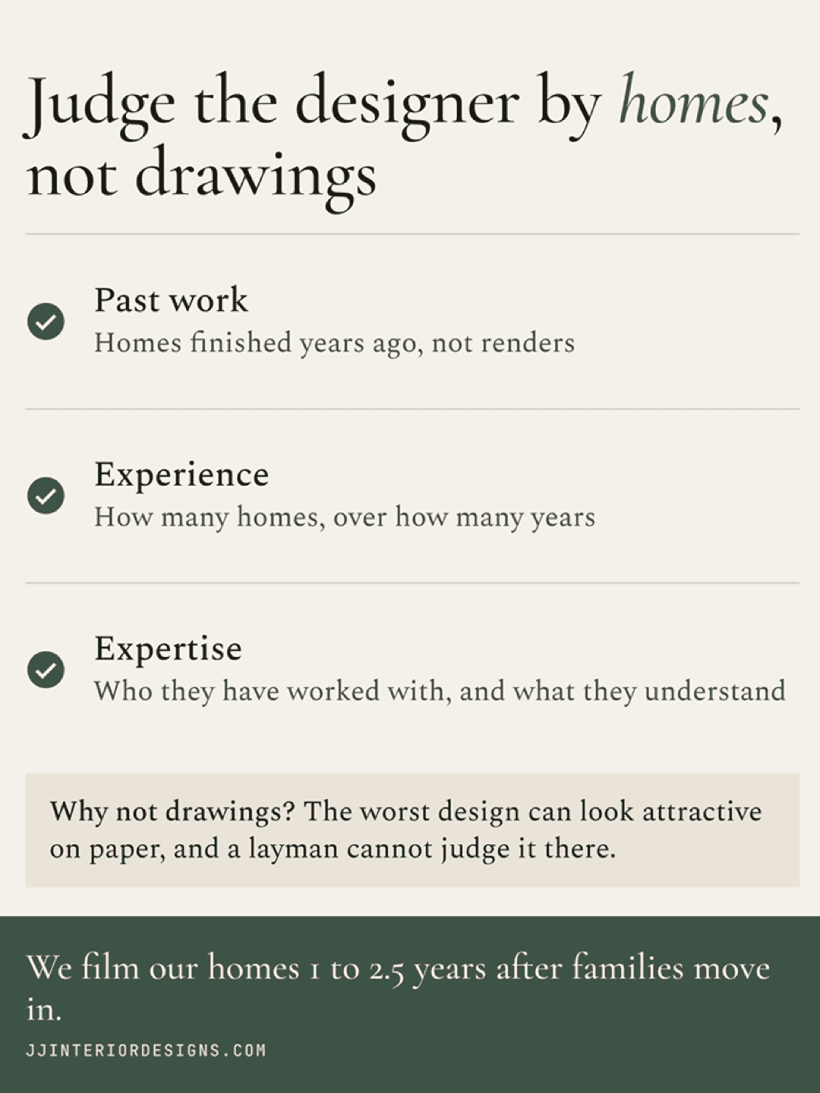
Judge a designer by finished homes, experience and expertise, not by drawings alone.
Where I am the best, and where I am not
Some families want a calm, lasting home, and are willing to follow the process and pay as agreed. For them, I consider my studio the best choice in Bengaluru. In 25 years, I have never cheated or overcharged a client. Other families want the lowest quote, a discount, daily reports or to run the site themselves. For them, an architect with tendered contractors and their own supervisor is the better route. I say this early, because the outcome depends on it.
My design fee is separate from the interior works: about 5% when my team builds, about 20% for design alone. Change your mind within 48 hours and I return it in full.
Send your floor plan and requirements on WhatsApp or through my contact page. I study them, then call you to go through your needs and budget. When we meet, I tell you plainly what outcome I can deliver. The decision is yours. I never chase.
Read next: Who Is the Best Interior Designer in Bangalore? and Luxury Interiors Without Hidden Cost in Bangalore.

Joby Joseph, a renowned luxury interior designer based in Bangalore, India, is the founder of Joby Joseph Interiors with over 24 years of experience in crafting homes that blend beauty, comfort, and cultural depth. His expertise spans luxury hotels, multinational offices, private homes, and celebrity residences, with specialties in luxury home interiors, culturally inspired designs, end-to-end renovations, and handcrafted teakwood furniture. Joby’s design philosophy goes beyond aesthetics, focusing on emotional well-being, thoughtful planning, and a holistic approach that enhances everyday life. Clients admire his passion, creativity, attention to detail, and ability to merge traditional and contemporary elements with precision. Widely regarded as one of Bangalore’s top interior designers, Joby believes true luxury lies not just in visual appeal but in creating meaningful, functional spaces that reflect individual stories and aspirations.

Are We the Right Fit for YourVedic-Inspired Dream Home?