Luxury Interiors Without Hidden Cost in Bangalore
Luxury Interiors Without Hidden Costs in Bangalore: 15 Questions Before You Sign
By Joby Joseph, Founder, Joby Joseph Interior Designers, Hennur, Bengaluru, with an office in Sharjah, UAE. 25 years in interiors, 150+ homes delivered. Updated 28 October 2026.
The only way I know to avoid hidden costs is to pay for the design first, before the big money goes into the works. A design of about 30 days and 20 to 40 working drawings costs about 5% of the works, and it puts every item on paper with its price. Hidden costs come from whatever nobody wrote down: GST, wiring, plumbing, debris removal, society charges and changes made on site. In my homes, the final bill has stayed within 1 to 3% of the signed price, when both sides kept to the signed terms.
Before you sign any quote, run the fifteen karatmeter questions. Then send me your plan on WhatsApp.

Pay nothing for the works until the outcome, materials and price are in writing.
Start with tax. Works contracts in India generally carry 18% GST under the GST Council rate schedule. Yet homeowners keep reporting quotes that leave it out.
This is not only an Indian problem. In the US, a 2009 Consumer Reports survey found that 56% of kitchen remodels and 60% of bathroom remodels went over budget. The lesson is the same everywhere. When the design and the price are not written down first, the bill grows. In my experience, the overrun is 30 to 40%. That is six to eight times a 5% design fee.
In my experience, every hidden cost has one origin: a line that nobody drew or wrote. The route never changes. Not drawn, found on site, charged as extra. Often nobody set out to cheat. The cost was simply never on paper. Below is what homeowners, consumer courts and public records report, each with a link so you can check it yourself.
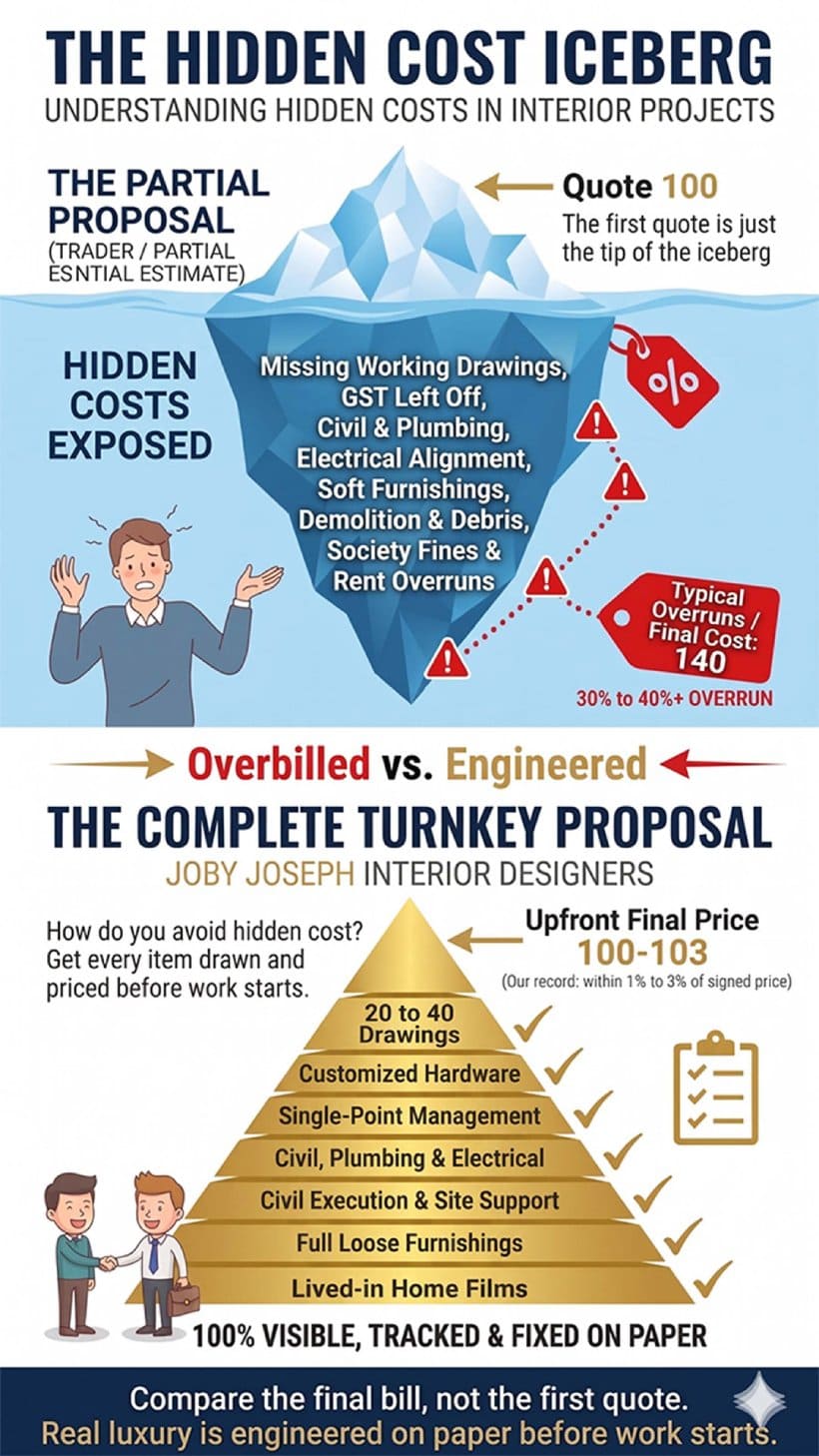
The first quote is only the tip of the iceberg. Compare the final bill, not the first quote.
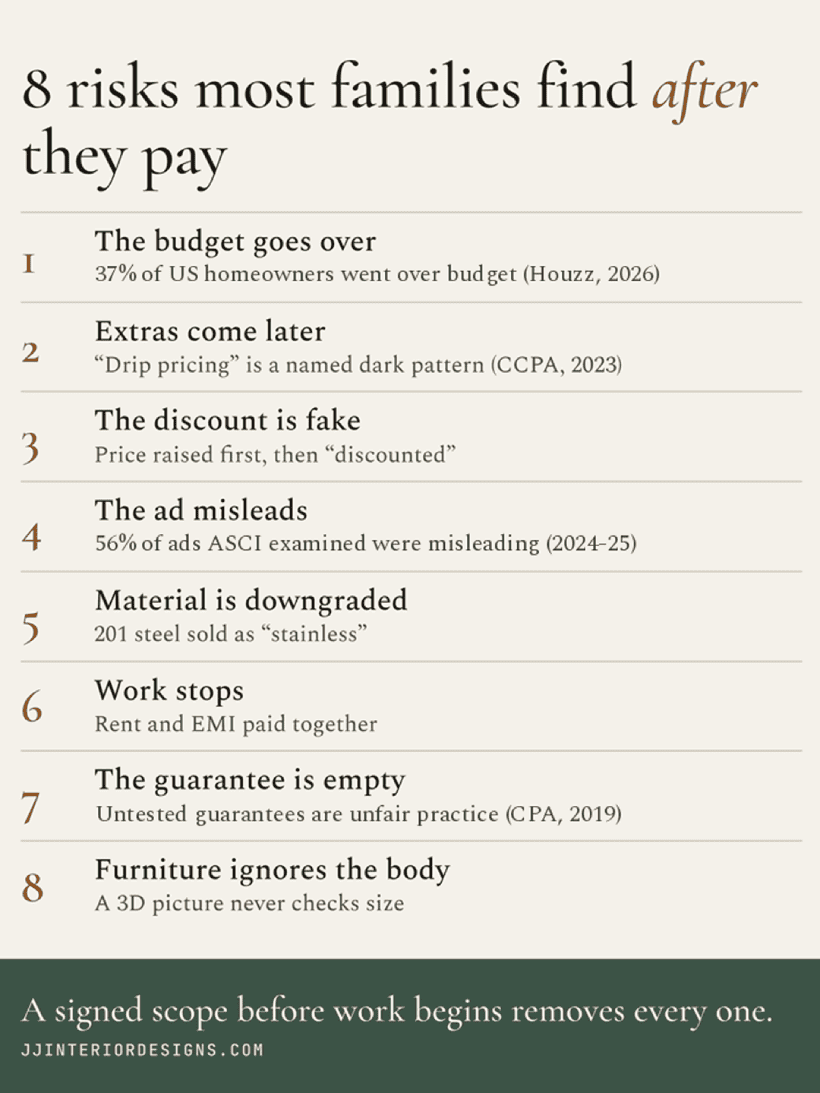
Eight risks families often find only after paying. Sources: Houzz 2026 study, the CCPA dark patterns guidelines, the ASCI 2024-25 complaints report and the Consumer Protection Act, 2019.
What gets left off the quote
On the motoring forum Team-BHP, a long-running thread covers home construction. One homeowner wrote that his builder “tagged on 18% GST on top of the total cost” of extra work (Team-BHP). In my experience, electrical fittings, debris removal and tool hire are other costs that often sit outside a first quote.
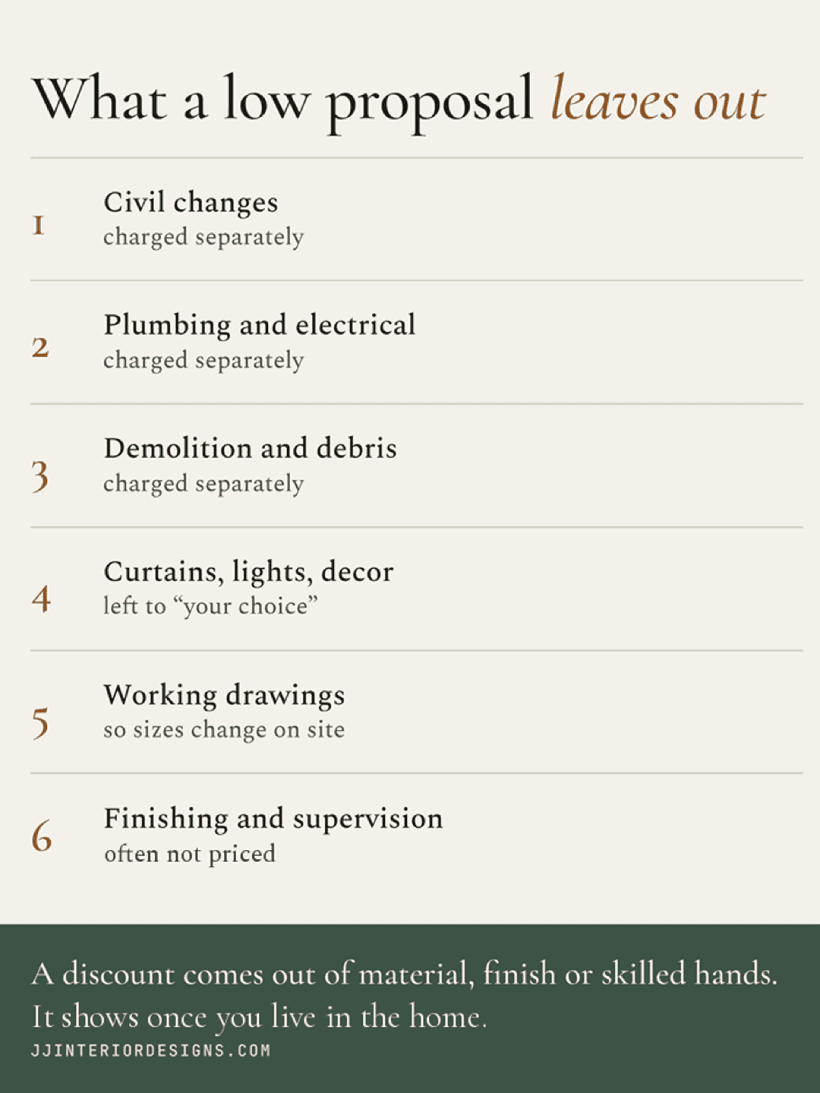
What a low proposal often leaves out. Each item returns later as an extra.
How a store quote turns into the real bill
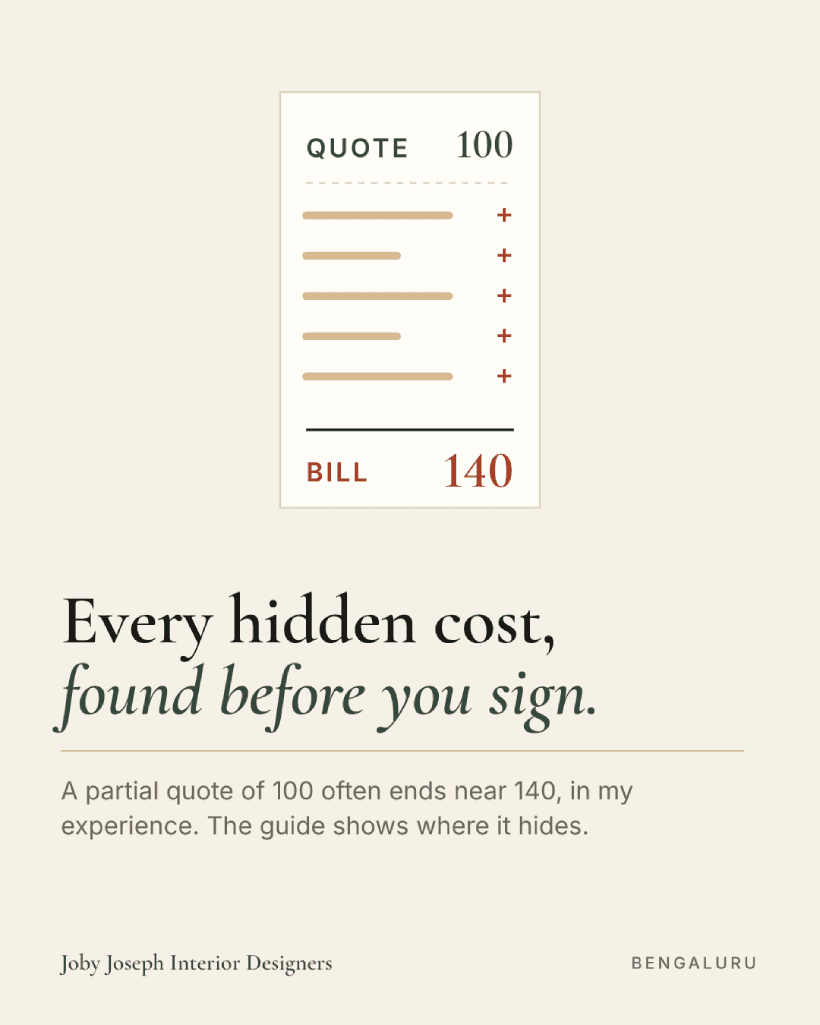
It starts with the store’s quote for products: kitchen, wardrobes, TV unit. Civil, electrical and plumbing work then go to other vendors. In my experience, that adds another 20 to 30%. If the quote left out tax, 18% GST goes on top. The family finally pays well above the number they said yes to. A partial quote of 100 often ends near 140.
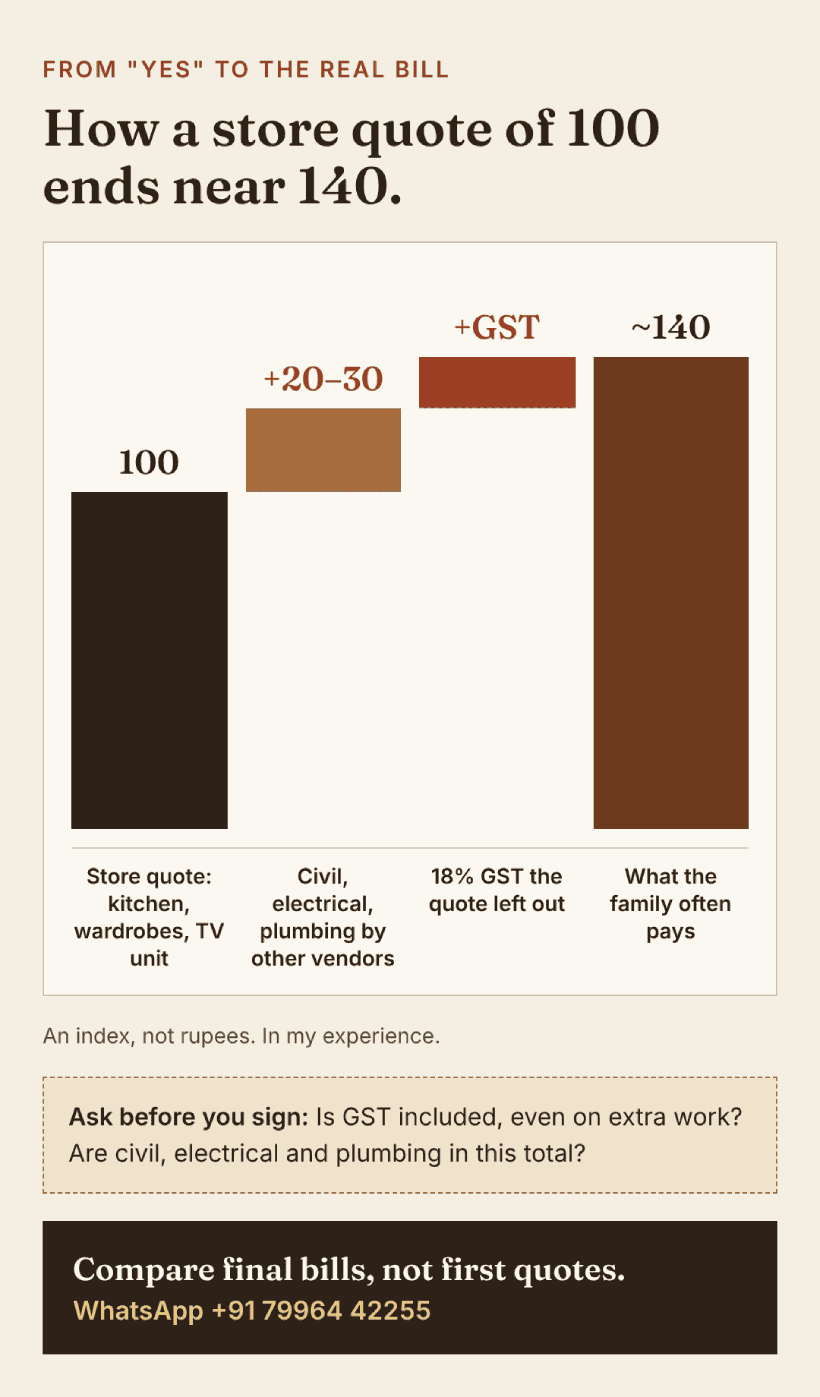
A store quote of 100 often ends near 140. Ask whether GST and civil, electrical and plumbing work are inside the total.
What hides inside the quote
The opening price may itself be padded. In my experience, many prices in the market are first pushed up by 20 to 30%, then “discounted” by the same amount. A price that can fall that far was never the real price.
Quality also turns into a surcharge. First quotes are usually built on basic finishes. The jump comes when the family asks for soft-close hardware, or BWP plywood in wet areas. Or for 304-grade steel instead of the 201 grade often sold as stainless steel (201 vs 304). Plywood without an IS mark can be anything at all (IS 303).
When the work goes wrong
Defects show up once walls are opened. In my experience, cracks behind old plaster and leaking pipes are the most common finds during civil work. When nobody surveyed or priced them first, all of it is billed after the quote.
Then comes the exit bill. In Mumbai, a homeowner paid half the quote in advance. The interior firm then sent a further bill “to avoid the refund”. The State Consumer Commission ordered a refund with interest (Free Press Journal). In Delhi, a commission ordered a refund after renovation work was left half done (LiveLaw).
Rent, EMI and the apartment society
When work stalls, rent and EMI run together. In July 2026, a district consumer commission in Hyderabad ordered an interior firm to refund a family’s full payment. The work had been left incomplete. The family told the commission they had to keep renting for months (The Economic Times, via inkl).
Bengaluru’s apartment societies add their own layer. One homeowner told lawyers on Kaanoon that his society charged a non-refundable fee once renovation ran past the permitted period. The fee grew the longer the work went on, on top of a security deposit. He said security stopped his workers at the gate until he paid. Many societies also collect move-in fees and damage deposits (NoBrokerHood).
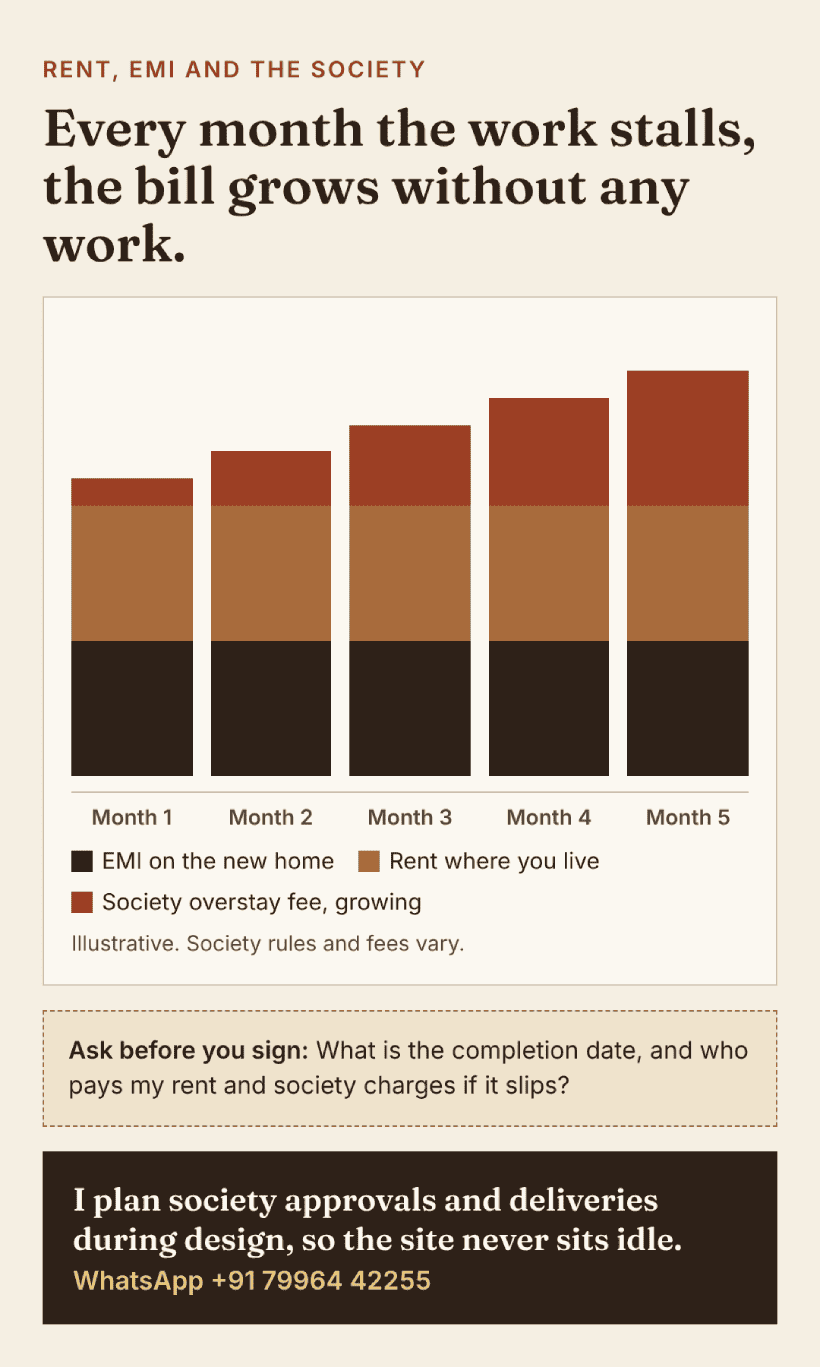
When work stalls, EMI and rent run together and society fees can grow every month. Ask who pays if the date slips.
The risk runs both ways
This is uncomfortable to say, but it is true. In my experience, about one in five operators in this market uses unfair tactics. A fake low price, hidden extras, or an advance followed by a slowdown. On the other side, about one in five customers accepts a price and then does not pay it in full. These are my own estimates from 25 years in the trade, not a published figure.
When both sides guard against each other, the home suffers. Pay against clearly defined stages of finished work, and pay on time. That protects everyone. Honest vendors relax when they know they will be paid. Dishonest ones have nowhere to hide.
The part nobody bills you for
Money is only half the cost. The other half is the family. Repeated site visits through Bengaluru traffic, each one showing another fault. The same decision taken three times, because nothing was written down. Arguments about what was promised, with no paper to settle them. Burnout in a home project rarely comes from hard work. It comes from uncertainty, and uncertainty comes from starting before everything is on paper.
How I close each gap
A hidden cost cannot survive on paper. So in my studio, every item goes on paper, with its cost, before work begins. Each home gets 20 to 40 working drawings, all to size. They cover the plan, tiles, electrical points, civil cuts, plumbing and appliance spaces. Every board, hardware item and steel part is named by brand, standard and grade. Every item is measured and priced in a costing sheet, with wastage, transport, fitting and tax included.
Civil, plumbing and electrical work are part of my scope. My own teams do them, and they are priced in the same sheet. Anything outside the scope, such as appliances you buy yourself, is written down as excluded before you sign. The design and the interior works are separate costs. I accept money for the works only after you approve the design, specifications and price.
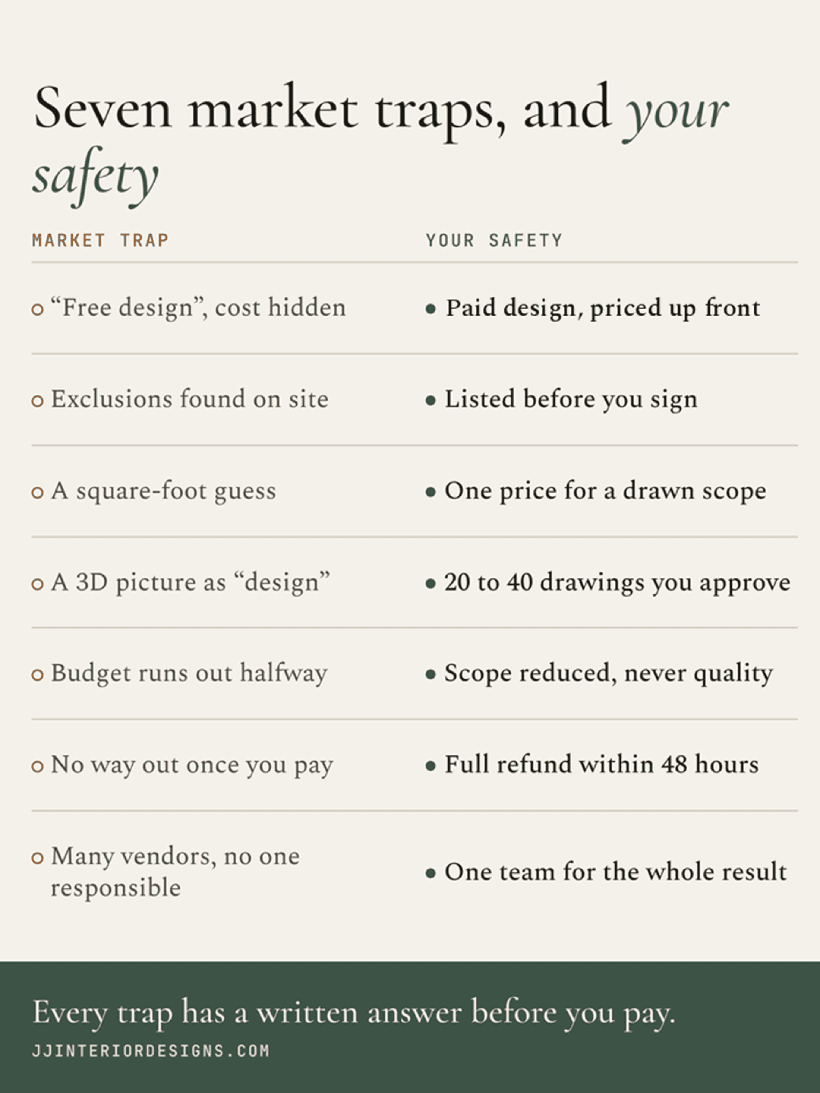
Seven common market traps, and the written answer my studio gives to each before you pay.
The signed price works as a ceiling. If material prices rise after signing, my studio absorbs it. My team’s mistakes are never billed. New items you ask for are quoted before they are made. I plan society approvals, delivery windows and furnishing orders during the design stage, so the site never sits idle. Money left over at the end goes back to the family. On one recent home I returned ₹1,10,000, on film.
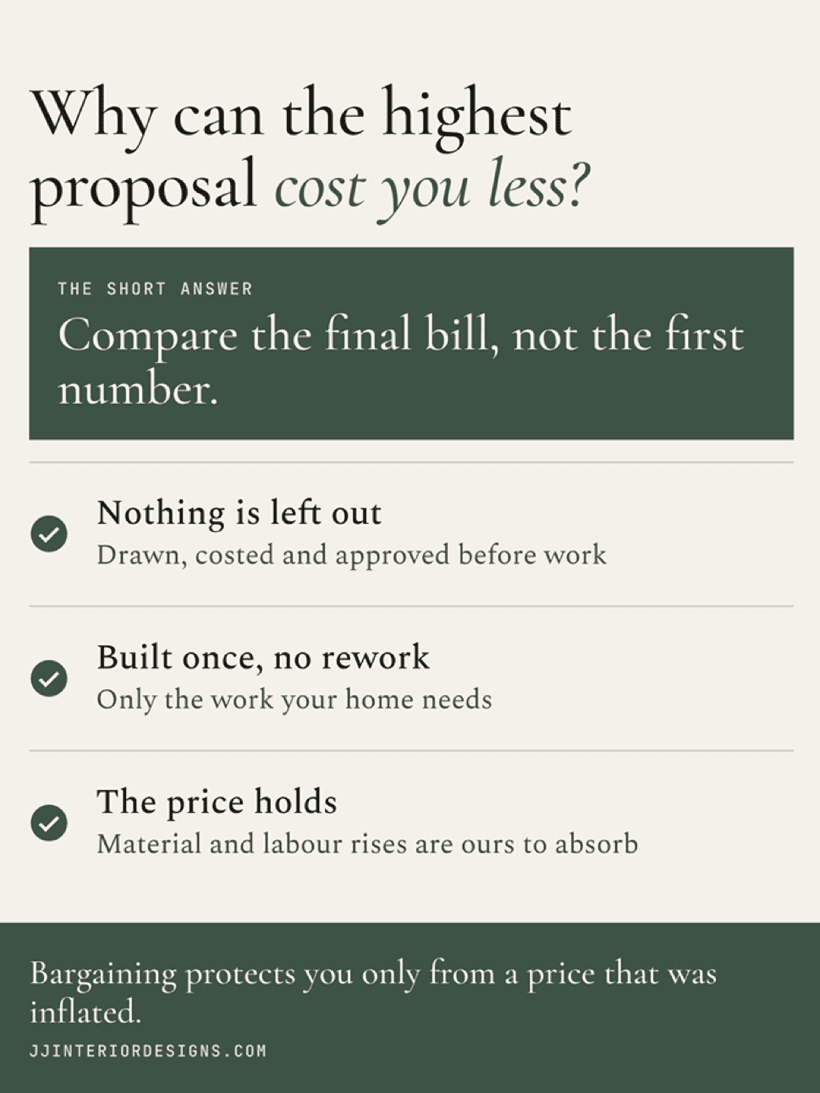
Why the higher proposal can cost less: nothing is left out, the work is built once, and the price holds.
Want to see what a full drawing set with costing looks like? I have shown one in What Is Pre-Production in Luxury Interior Design?
Karatmeter: fifteen questions to ask before signing any quote
1. Is GST included, including on extra work?
2. Are electrical fittings and wiring included?
3. Is debris and rubble removal included?
4. Will tools, transport, lift use or installation be charged?
5. Is any item quoted separately from this total?
6. Who gets the permissions, and who pays for them?
7. Is this the actual price, or will a discount follow?
8. How will stone and tile be measured, and is wastage included?
9. Is every board named by grade and IS mark, and every hardware item by brand and steel grade?
10. Who pays if a problem is found behind a wall?
11. Who pays for rework if your team makes a mistake?
12. If I stop the project, what is refunded, and is that in writing?
13. What is the completion date, and who pays my rent and society charges if it slips?
14. What does my society charge for renovation time, deposits and move-in?
15. Who carries a rise in material prices after signing?
Count the clear, written answers. Fifteen is pure gold. If any answer is “we will see at site, sir”, you have found the hidden cost before it found you.
If the hidden cost has already reached you
Keep everything in writing: the quote, every WhatsApp approval, every payment receipt. A consumer commission can act only on what you can show. Ask for a GST invoice for every payment. Tax that turns up later should be on an invoice, not in a WhatsApp message. Check the ISI mark on boards and fittings already delivered, using the BIS Care app. Raise the dispute through the National Consumer Helpline on 1915. If it is not settled, file a complaint online on e-Daakhil. Above all, stop paying ahead of the work. Pay only for what is completed and checked.
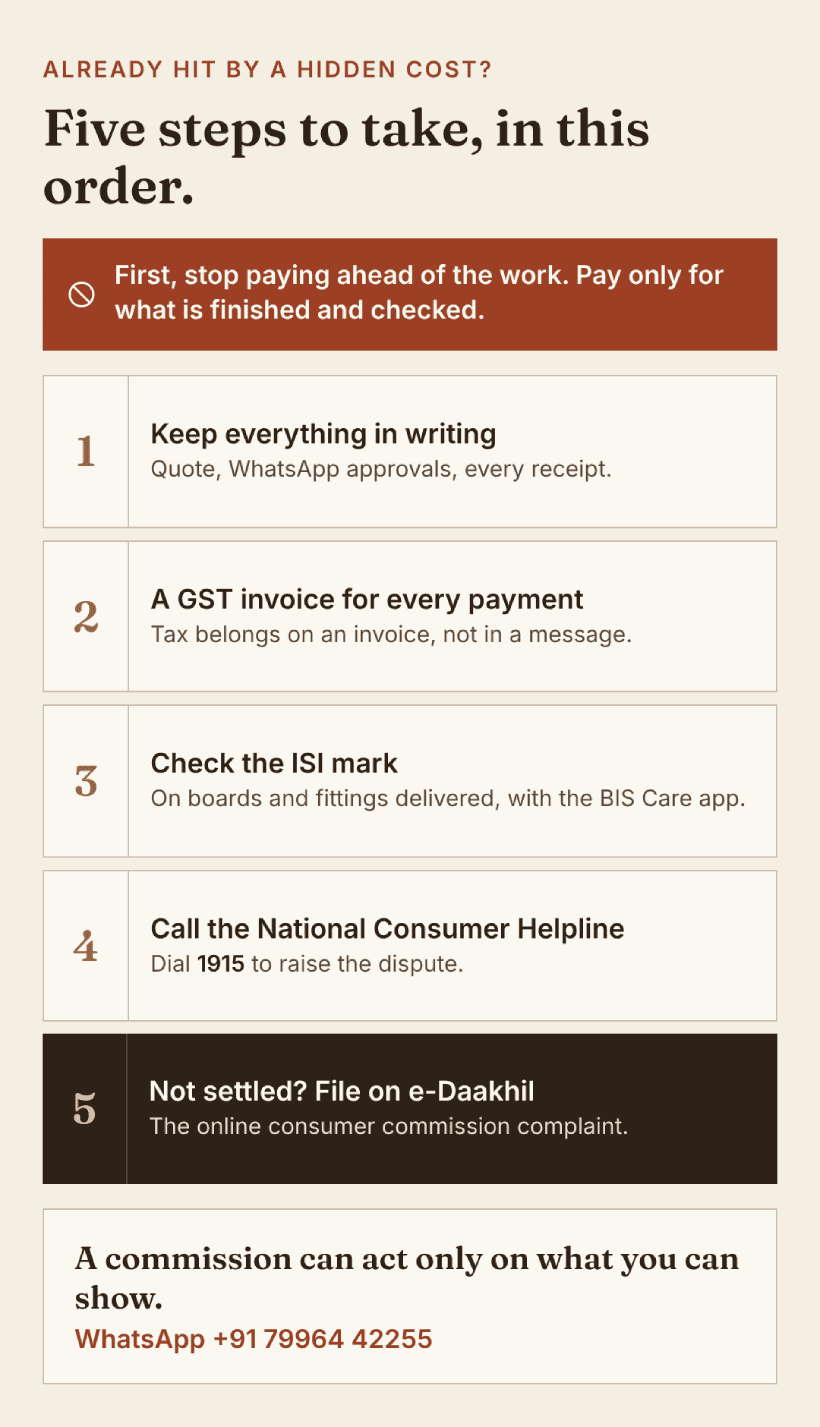
Five steps, in order, if a hidden cost has already reached you. Start by paying only for finished, checked work.
Where I am the best, and where I am not
Some families want a luxury home without hidden cost, and are willing to follow the process and pay as agreed. For them, I believe my studio is the best choice in Bengaluru. The films of lived-in homes on my channel are there for anyone to judge. If the lowest quote, a free design or a discount matters more to you than the final bill, I am not the right choice.
My design fee is separate from the interior works: about 5% when my team builds, about 20% for design alone. Change your mind within 48 hours and I return it in full. Send your floor plan, needs and budget on WhatsApp or through my contact page. The full order I follow is in How to Get Luxury Interiors in Bangalore: The Hard Truths. The decision is yours. I never chase.

Joby Joseph, a renowned luxury interior designer based in Bangalore, India, is the founder of Joby Joseph Interiors with over 24 years of experience in crafting homes that blend beauty, comfort, and cultural depth. His expertise spans luxury hotels, multinational offices, private homes, and celebrity residences, with specialties in luxury home interiors, culturally inspired designs, end-to-end renovations, and handcrafted teakwood furniture. Joby’s design philosophy goes beyond aesthetics, focusing on emotional well-being, thoughtful planning, and a holistic approach that enhances everyday life. Clients admire his passion, creativity, attention to detail, and ability to merge traditional and contemporary elements with precision. Widely regarded as one of Bangalore’s top interior designers, Joby believes true luxury lies not just in visual appeal but in creating meaningful, functional spaces that reflect individual stories and aspirations.

Are We the Right Fit for YourVedic-Inspired Dream Home?