What Does a Modular Kitchen Cost in Bangalore?
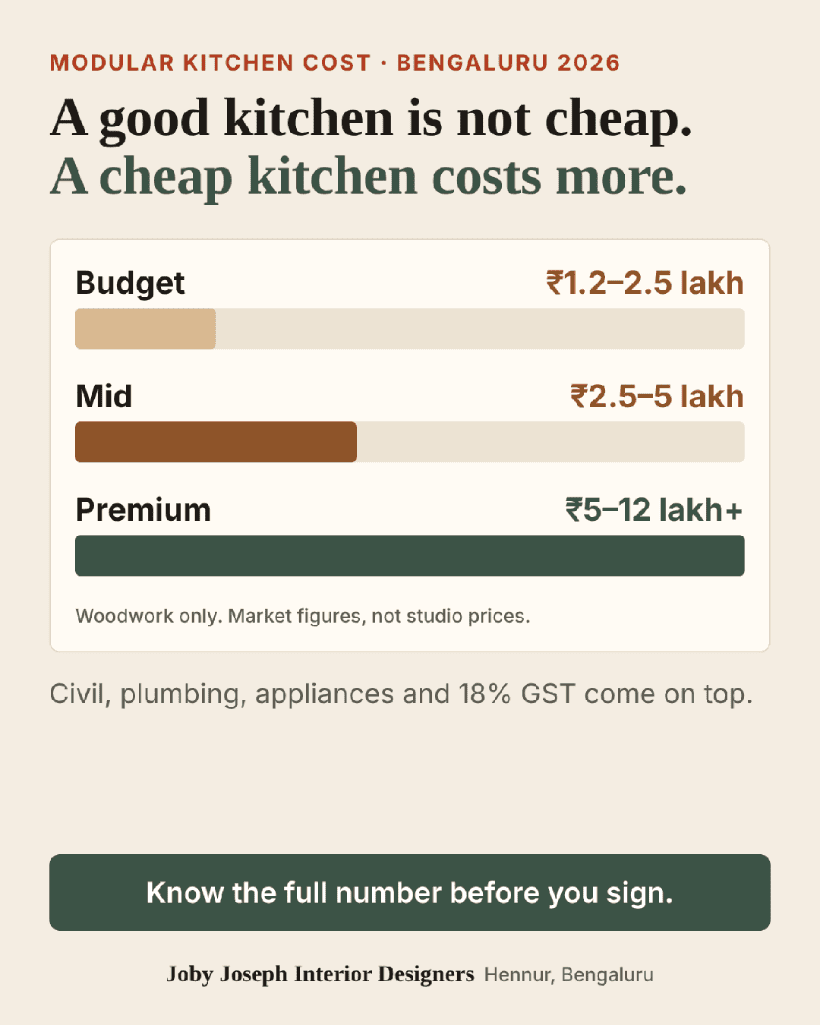
A guide on Modular Kitchen Cost in Bangalore
By Joby Joseph, Founder, Joby Joseph Interior Designers, Hennur, Bengaluru, with an office in Sharjah, UAE. 25 years in interiors, 150+ homes delivered. Updated 28 October 2026.
Before you compare kitchen prices, pay for a kitchen design. Drawings that fix every size, board and fitting cost little next to the kitchen itself, and they protect it. In the 2026 Bengaluru market, a modular kitchen costs roughly ₹1.2 lakh to ₹12 lakh or more for the woodwork alone, with civil work, plumbing, electricals, appliances and GST on top. Ask for the complete number, with drawings, before you compare anyone.
Planning a kitchen? WhatsApp me your floor plan and tell me how your family cooks.
These are market figures I see across the city this year. They are not my studio’s prices. I have rebuilt many kitchens that failed for the same few reasons. I wrote this page to save you from them.
Three market levels, for woodwork only
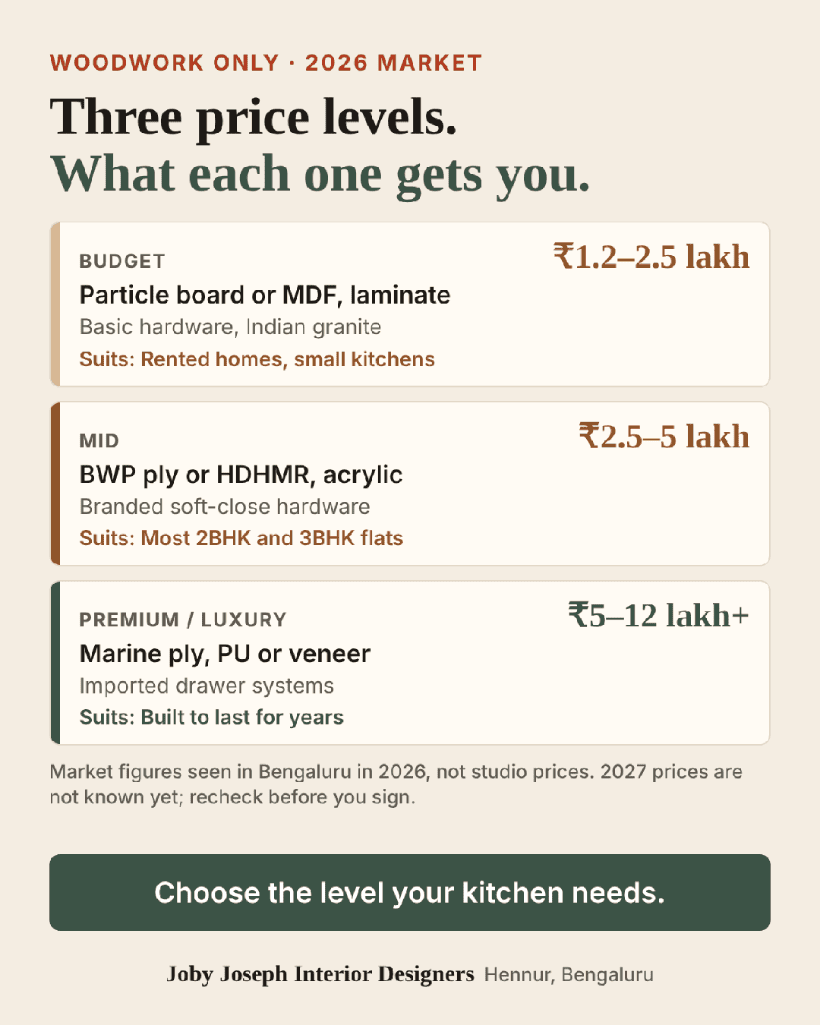
At the budget end, about ₹1.2 to 2.5 lakh, you get MDF or particle board with laminate. Hardware is basic and unbranded, and the top is Indian granite. It suits rented homes and small straight kitchens.
In the middle, about ₹2.5 to 5 lakh, the boxes are BWP plywood or HDHMR. Shutters are acrylic or membrane. Soft-close hardware comes from brands such as Hettich or Häfele. This is the usual choice in 2BHK and 3BHK flats.
At the premium and luxury end, ₹5 lakh to ₹12 lakh or more, you see marine plywood, and PU lacquer or natural veneer. Hardware is imported, such as Blum drawer systems, and storage is more advanced.
The number nobody puts on the first quote
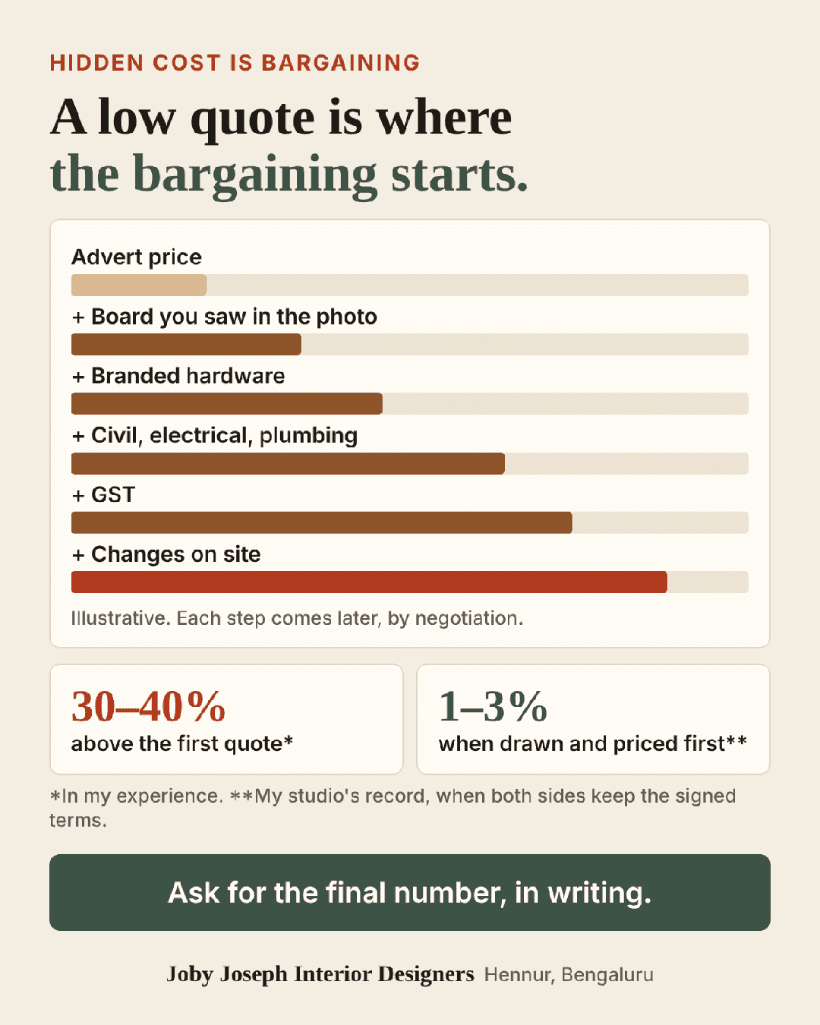
The kitchen price is only the start. On top of it come civil work and wall tiles, and electrical points and wiring. Then plumbing for the sink, dishwasher and water purifier. Then the appliances themselves: chimney, hob, oven, fridge, dishwasher. Then GST, which works contracts generally attract at 18% (GST Council). And finally, whatever changes are made on site.
So your real budget is the kitchen plus civil, electrical, plumbing, appliances and tax. Ask for that full number before you compare two vendors.
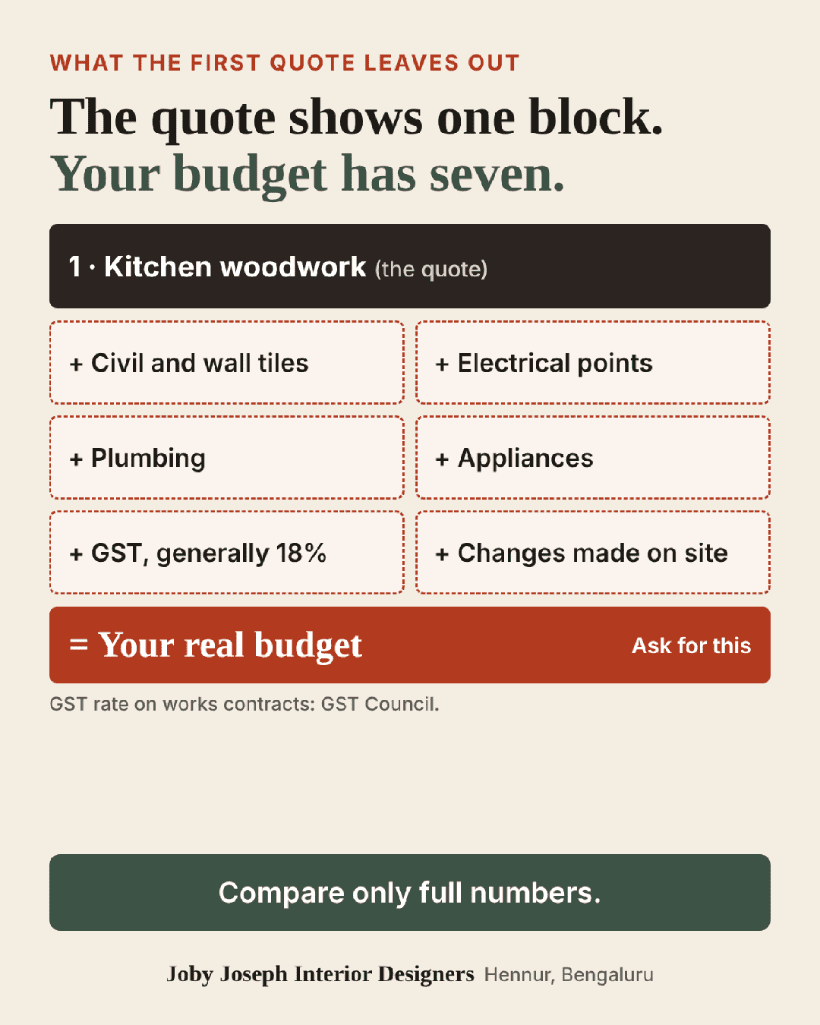
The quote you see is only the first block. Ask for the full number, with drawings, before you compare any two vendors.
What a kitchen like this really costs

This advert is not real. I created it with AI, for education only. “FeinKüche” is an invented name. This offer and website did not exist when I first wrote this guide, on 1 October 2026.
The advert says “from ₹3 lakhs”. In today’s market, a kitchen like this would cost about ₹9 to 15 lakh for the woodwork, stone and civil changes. Add the European appliances shown, and it reaches ₹20 to 25 lakh or more. It is also around 500 sq ft, a size you mostly find in large villas. When the price does not match the picture, you pay the difference later.
Why two quotes can be lakhs apart
Because they are not quoting the same kitchen. The board, the hardware, what is left out, and whether there are drawings at all: each one moves the number. A quote without drawings is a guess. A price after drawings is the cost of a defined kitchen.
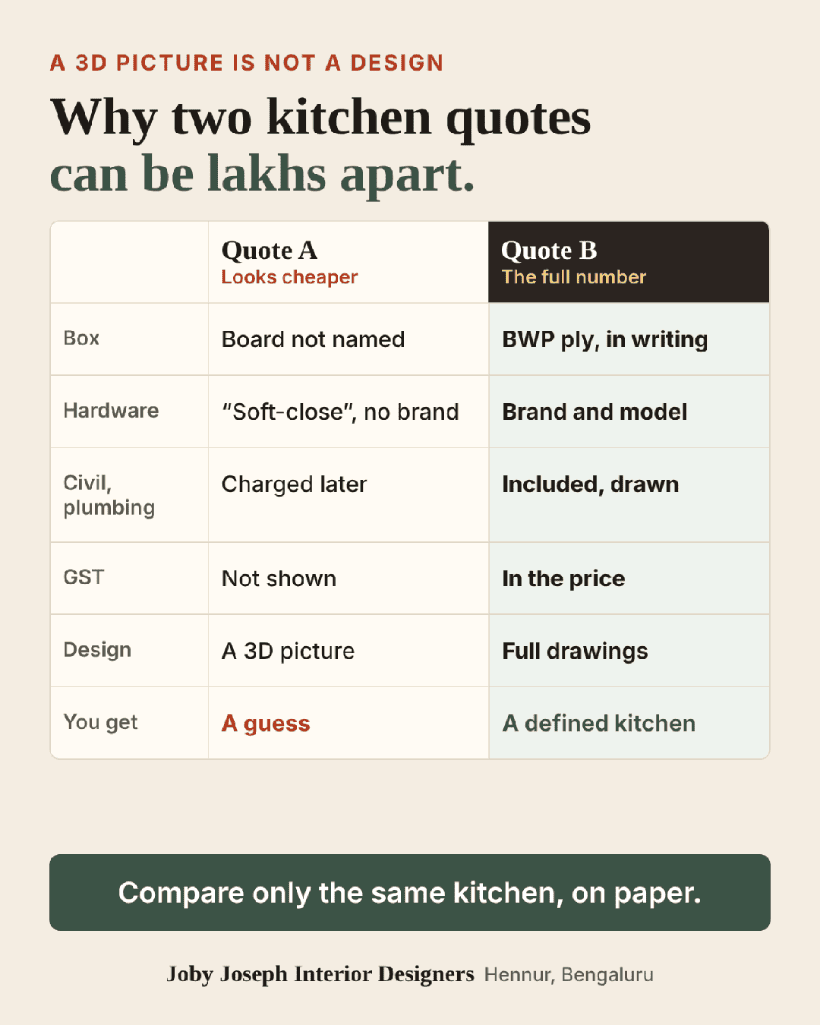
Two quotes for what looks like the same kitchen. Ask every vendor to fill in Quote B before you compare prices.
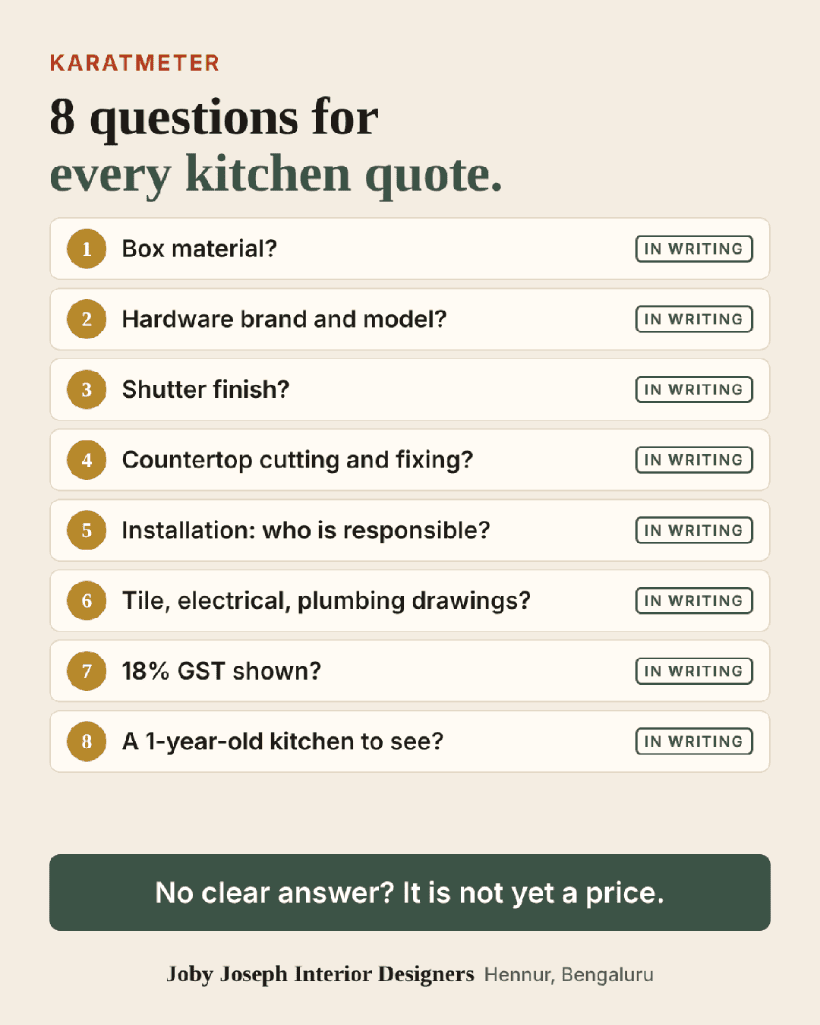
Karatmeter: eight questions to put to every kitchen quote
Get the answers in writing.
1. What is the box made of: particle board, HDHMR, BWP or marine plywood?
2. Which hardware brand and model, for hinges, channels and drawer systems?
3. Which shutter finish: laminate, acrypc, PU or veneer?
4. Which countertop, and are cutting and fixing included?
5. Is installation included, and who is responsible if it goes wrong?
6. Are tile, electrical and plumbing drawings included, with every point fixed?
7. Is 18% GST shown in the price? Works contracts generally attract that rate (GST Council).
8. Can I see a kitchen the family has used for a year or more?
Eight clear answers in writing is pure gold. If a quote cannot answer them, it is not yet a price. It is a sales offer.
“A luxury kitchen in 30 to 45 days”
Not to a luxury standard. A kitchen can be fitted in 30 to 45 days only if nothing in it is personal. That means no change to electrical, civil or plumbing work, and a standard design.
I know how these offers usually run. The advert shows a luxury photo with the price of the lowest version. Its only job is to bring you into the store. There you get a basic quote and a verbal offer. Later, most of it changes: materials, add-ons, time and price. A showroom display can be built in 45 days. The same kitchen in your home is a different job altogether.
“The warranty will protect you”
Think of a shirt. No shop can promise it will never tear. A seam that opens on day one is a defect; a tear after a year is wear.
A kitchen is no different. Hardware and plywood brands give warranties with conditions. Most damage comes from installation or use, which those warranties do not cover. To claim, you must prove a manufacturing fault. Meanwhile, the brand, the contractor and the designer each point at someone else. You may not get the same laminate again, and the kitchen can be out of use for 15 days or more. What works is an annual maintenance contract, or a service guarantee for a fixed period, in a signed agreement. I recommend that over a warranty nobody can stand behind.
“Waterproof plywood is waterproof”
It resists water, but it is not immune to it. IS 710 plywood is tested so its layers stay bonded after 72 hours in boiling water. It is still thin sheets of wood held together with glue. Water left standing for days will damage any plywood.
“A beautiful picture makes a good kitchen”
A kitchen is for cooking, not for Instagram. I start with how the family lives. What do they cook, and how? How many people cook? How tall is the person who stands at that counter every morning, and what are their habits?
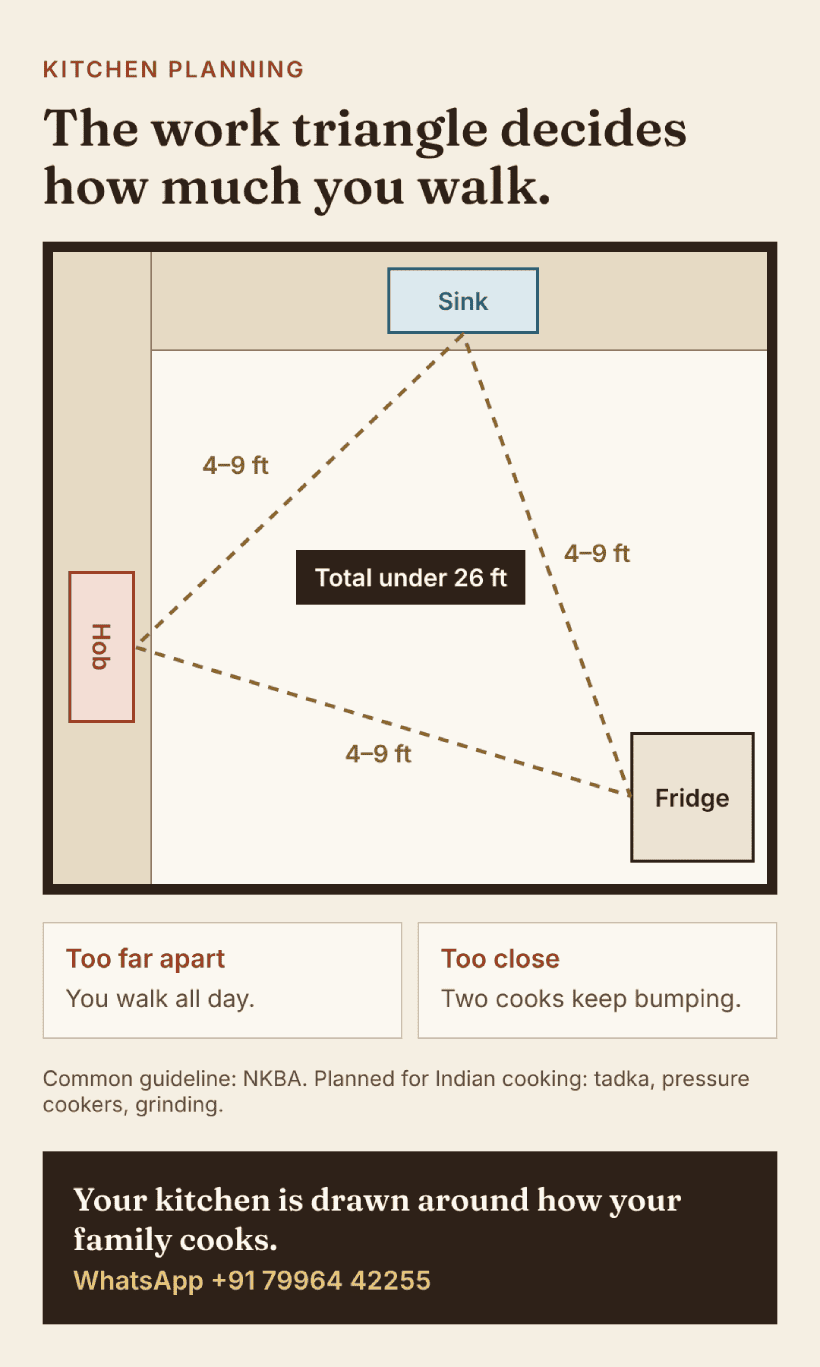
The sink, hob and fridge form a work triangle. Kitchen designers commonly keep each side between 4 and 9 feet, with the total under 26 feet (NKBA guideline, via Dura Supreme). Too far apart, and you walk all day. Too close, and two people keep bumping into each other. Italian and German kitchens are well engineered and worth studying. But the design has to suit Indian cooking: tadka, pressure cookers and grinding.
Your sink, hob and fridge should sit 4 to 9 feet apart. I draw this triangle around how your family cooks.
What actually makes a kitchen last
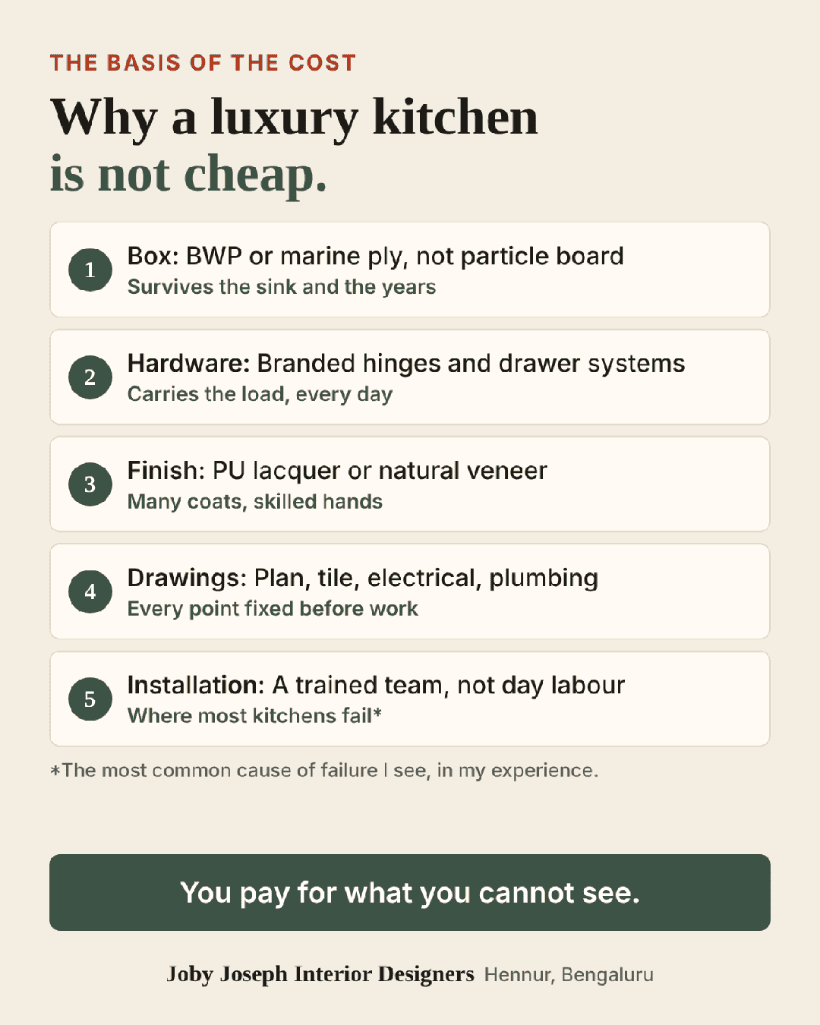
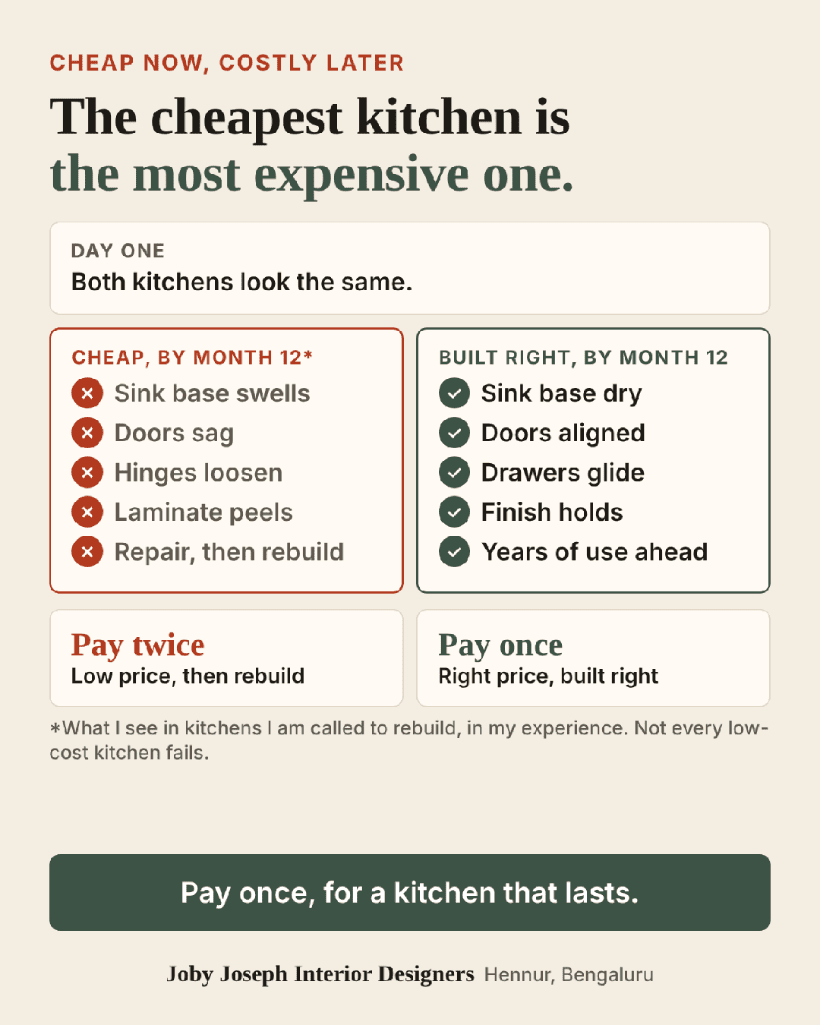
In order of importance, four things. First, a design with ergonomics planned for your family, set down in full drawings. Second, the right box material for each spot, especially around the sink. Third, hinges and channels chosen for the load they carry. Fourth, installation. Installation is the most common cause of failure I see. Local installers often cannot build what a catalogue photo shows.
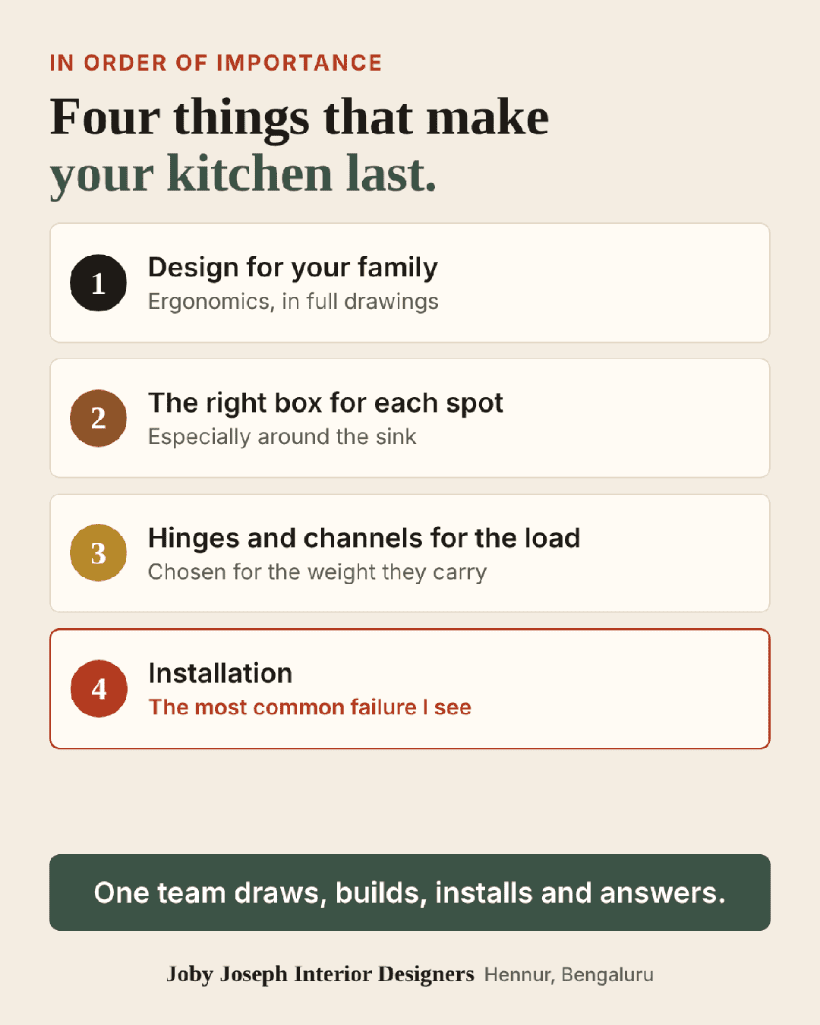
Most kitchens fail at number four. When one team draws, builds and installs, nobody can blame someone else.
How my team builds a kitchen
I design first and price after. My team studies how your family cooks and lives. Then we draw everything before any work starts: plan, tile, electrical, civil and plumbing drawings. The price covers exactly what is drawn, including the civil, plumbing and electrical work other quotes leave out. Scope, price and time are signed before production. One team builds, installs and answers for the result. Across past projects, my final cost has stayed within 1 to 3% of the signed price, when both sides kept to the signed terms.
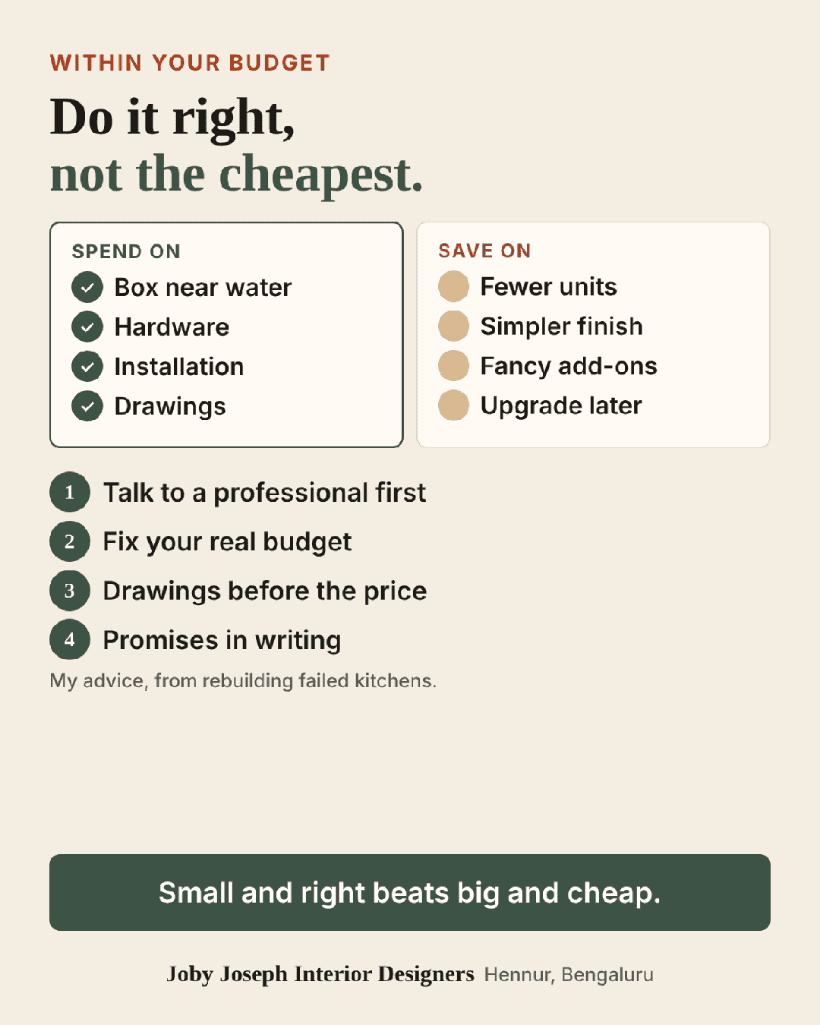
Talk to a professional before any vendor; you can talk to two or three. Fix your real budget, including every cost the quote leaves out. Ask for drawings before the price. Put the karatmeter questions to every offer. Get any warranty or delivery promise in writing. And see real kitchens at least a year after the family moved in. Several are on my YouTube channel.
Where I am the best, and where I am not
Some families want a kitchen built once and built right, and follow the process. For them, I believe my studio is the best choice in Bengaluru. In 25 years, I have never cheated or overcharged a client. If the lowest price or the fastest finish matters most to you, that road is open. But a lasting kitchen does not come from it.
Want a kitchen that works well every single day? Send me your floor plan on WhatsApp or through my contact page. The decision is yours. I never chase.

Joby Joseph, a renowned luxury interior designer based in Bangalore, India, is the founder of Joby Joseph Interiors with over 24 years of experience in crafting homes that blend beauty, comfort, and cultural depth. His expertise spans luxury hotels, multinational offices, private homes, and celebrity residences, with specialties in luxury home interiors, culturally inspired designs, end-to-end renovations, and handcrafted teakwood furniture. Joby’s design philosophy goes beyond aesthetics, focusing on emotional well-being, thoughtful planning, and a holistic approach that enhances everyday life. Clients admire his passion, creativity, attention to detail, and ability to merge traditional and contemporary elements with precision. Widely regarded as one of Bangalore’s top interior designers, Joby believes true luxury lies not just in visual appeal but in creating meaningful, functional spaces that reflect individual stories and aspirations.

Are We the Right Fit for YourVedic-Inspired Dream Home?