You’ve been in expensive homes that felt hollow. You’ve also been in homes that stopped you at the door — not because of what you saw, but because of what you felt. The second kind is not about money spent. It’s about variables most architects never touch and that’s why Billionaire Homes Feel Different.
The visual elements of a luxury home — the marble, the art, the fixtures — are the easiest part to buy and the least responsible for how a space feels. What separates a truly extraordinary residence from a very expensive one is a set of decisions that operate entirely below conscious perception. This article names them precisely.
The Silence Is Engineered
Walk into a poorly designed home and you hear it: the faint hum of HVAC, reflected sound bouncing off hard surfaces, the low-frequency resonance of a room that was never acoustically considered. Your nervous system registers this as ambient stress, even if you never consciously identify it. You leave feeling subtly drained.
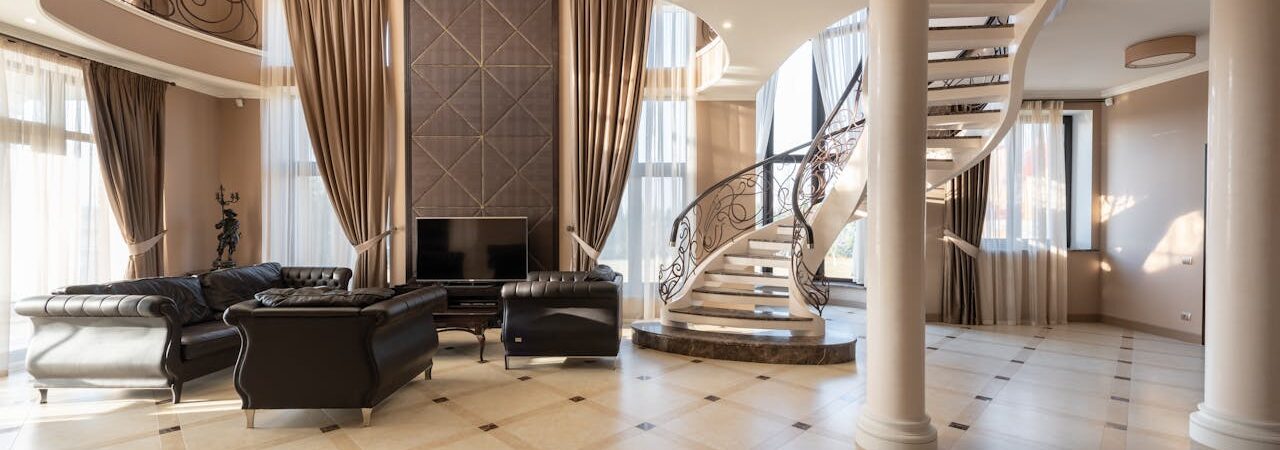
Ample Space to Walk around
Serious residential design treats acoustics as architecture, not afterthought. The American Institute of Architects now classifies acoustic performance as a fundamental building quality criterion — alongside thermal comfort and lighting. Yet the vast majority of residential projects, regardless of budget, receive no acoustic consultation.
What changes at the top tier: mechanical systems are positioned away from living spaces and mounted on vibration-decoupling isolation. Room geometries use irregular angles and non-parallel surfaces to eliminate standing waves. Every hard surface is counterbalanced with material that absorbs rather than reflects — thick pile rugs, upholstered wall panels, heavy drapery, dense millwork. The result isn’t silence in the deadened sense. It’s acoustic clarity: sound behaves predictably, warmly, in a way that the brain reads as safety.
The Physics: Smooth concrete reflects 98% of sound back into a room. A correctly specified acoustic panel absorbs up to 75%. The difference between those two numbers is the difference between a room that exhausts you and one that restores you.
Source: BigRentz / Architectural Acoustics
Bill Gates’ Xanadu 2.0
Bill Gates’ Xanadu 2.0 — completed in 1997, before smart home was a consumer category — embedded speakers behind the wallpaper in every room. Music followed inhabitants room to room at consistent quality and volume, with no visible hardware. This only works if the acoustic architecture of each room is precisely tuned. The technology was incidental. The acoustic engineering made it possible.
Light Is Chronobiology, Not Décor
Human circadian rhythms evolved over hundreds of thousands of years responding to the full arc of natural light: cool blue-white at dawn, neutral mid-day, warm amber at dusk. That cycle regulates cortisol, serotonin, and melatonin — the hormones that govern energy, mood, and sleep.
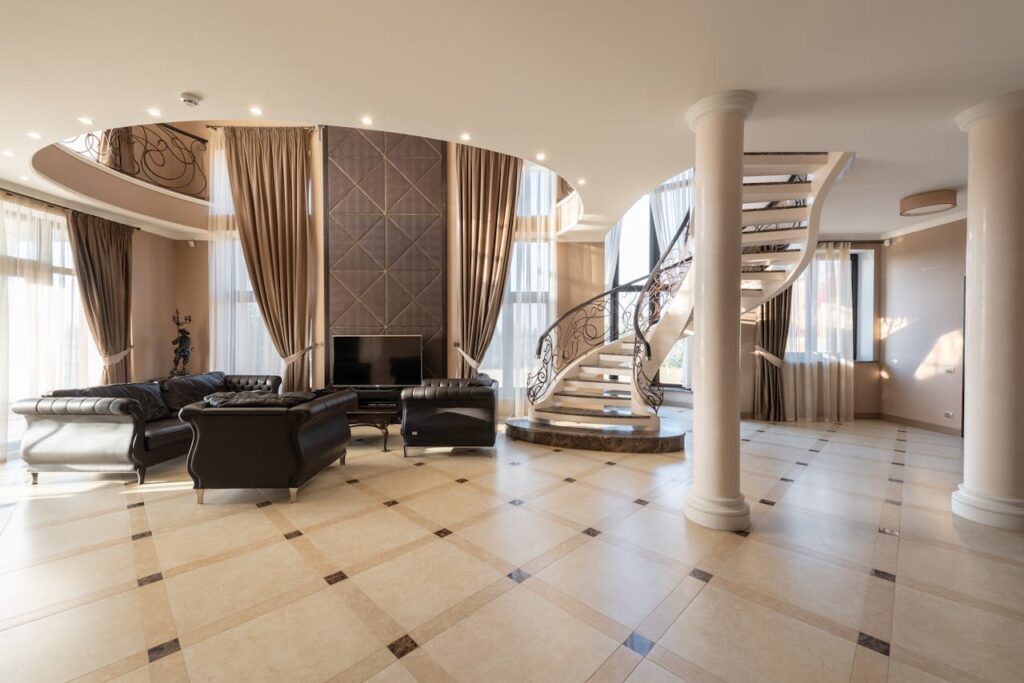
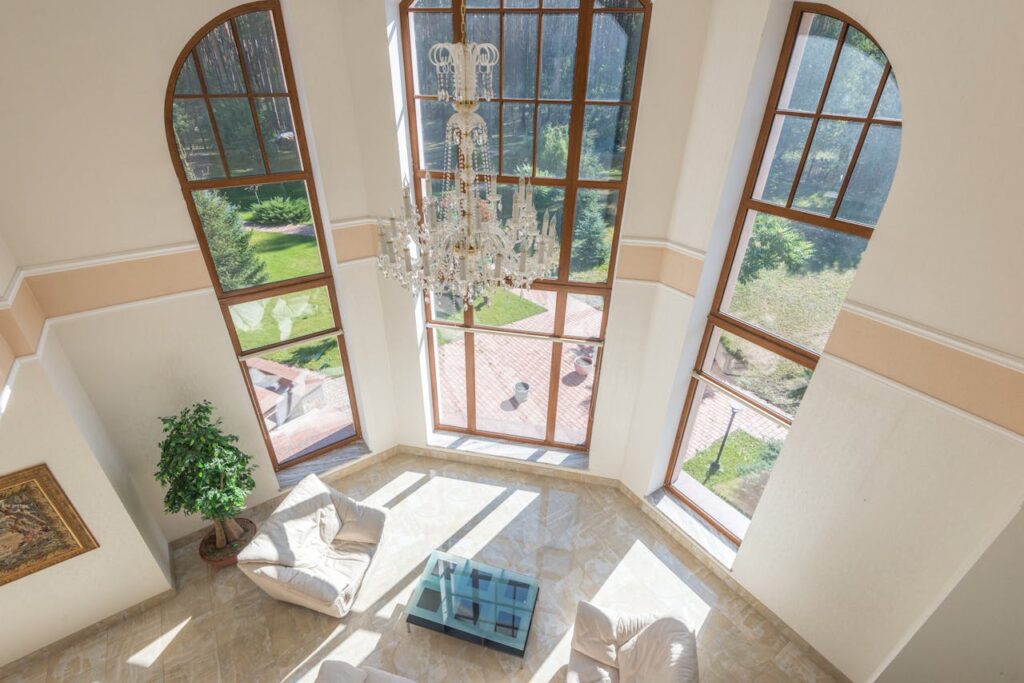
Natural Light in the house
Most interiors break this cycle entirely. Fixed-temperature overhead lighting, regardless of cost, delivers the same spectrum at 7 AM and 10 PM. The body receives no cue to shift state. Research published by the Illuminating Engineering Society confirms the physiological consequences: disrupted sleep, lower cognitive performance, elevated baseline stress.
What well-designed luxury homes do differently: daylighting is treated as the primary material. Room orientations are set during site analysis — not interior design — to harvest specific light qualities at the times each room is occupied. A breakfast room faces east. A library faces north for even, shadow-free illumination. Living spaces face west to capture the warm spectrum shift at the end of the day.
Tunable LED systems — now standard in serious residential commissions — shift color temperature continuously across the day, tracking local sunrise-sunset data. This is not an amenity. It is the building working with your biology instead of against it. Research at Harvard confirms environments with natural elements measurably reduce cortisol. At the highest residential tier, that finding is baked into the structural brief.
Tunable LED Lighting System
“A $200-per-square-foot window wall delivers more biophilic impact than a $50,000 custom fixture.”
Social Life Magazine, Biophilic Design in Luxury Homes
Proportion Changes How You Think
Ceiling height is a cognitive instrument. Psychologist Joan Meyers-Levy demonstrated that people in rooms with 10-foot ceilings think more abstractly and make more creative connections than those in 8-foot rooms. Rooms with lower ceilings support focused, detail-oriented work. Neither is superior — the point is that every ceiling height is a decision about the cognitive state the space is designed to produce.
Ceiling height
Most residential construction sets ceiling heights based on material cost and building code. Deliberately designed homes set them based on what each room is supposed to do to the people inside it.
The same precision applies to room proportions, sightlines, and movement paths. A well-designed entrance compresses before it opens — triggering the physiological release of decompression, the body physically exhaling as it enters the main space. Corridors are wide enough to move without friction, but not so wide as to feel institutional. Thresholds between rooms are considered transitions, not just gaps in walls.
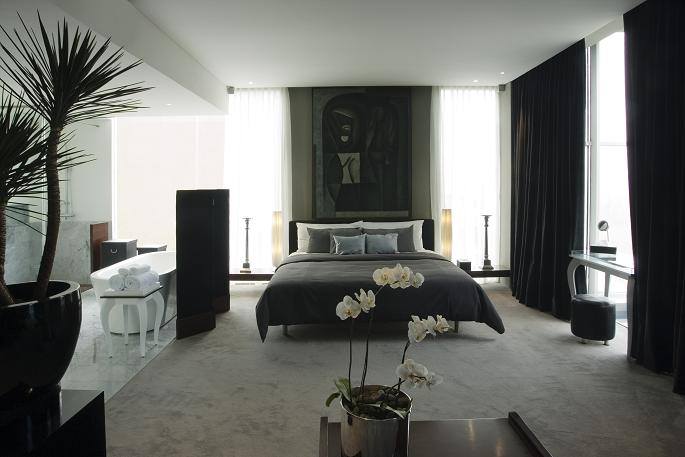
White Spaces for openness
Neuropsychology research published by ASID identifies the evolutionary mechanism: humans are wired for “prospect and refuge” — the simultaneous need to see far distances and to have a protected position. A living room with floor-to-ceiling views activates the prospect instinct; a deeply upholstered reading corner activates refuge. Rooms engineered for both simultaneously are experienced as deeply comfortable without the occupant knowing why.
Materials the Brain Can Trust
The brain runs a continuous subconscious simulation of what every surface in a room would feel like to touch. Natural materials pass this test. Synthetic surfaces fail it — even if you never touch them.
Finnish architect Juhani Pallasmaa, one of the most cited theorists of architectural experience, articulates it precisely: natural materials — stone, brick, wood — “allow the gaze to penetrate their surfaces and enable us to become convinced of the veracity of matter.” Synthetic surfaces present “unyielding surfaces to the eye without conveying anything of their material essence or age.” The cognitive consequence is a persistent low-level unreality, a sense that the room is a stage set rather than a place.
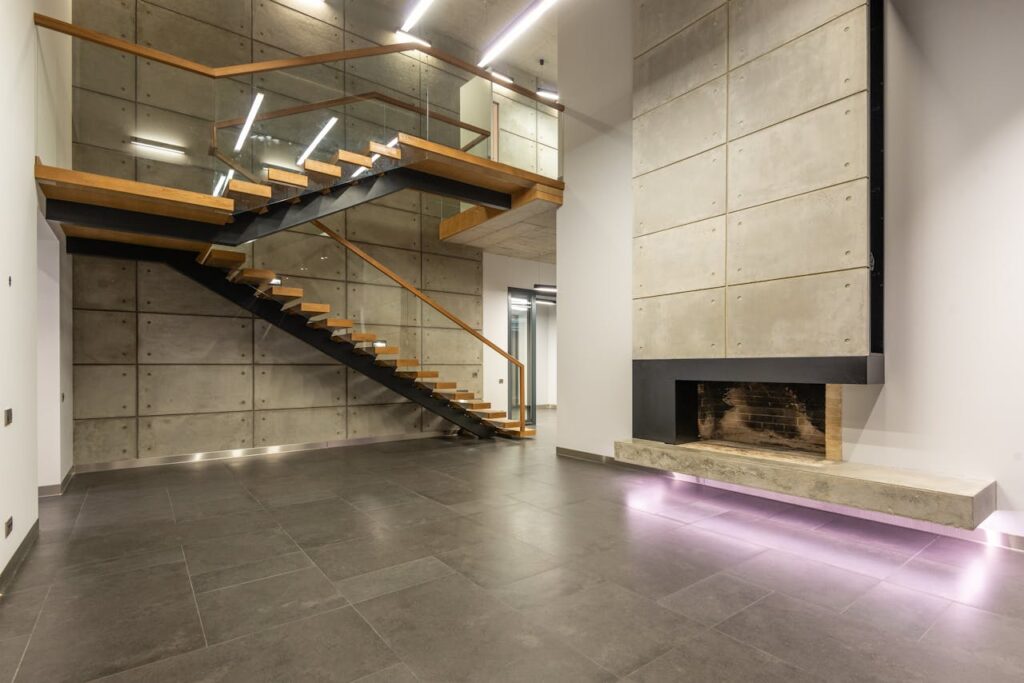
Natural Material used in interiors
Stone has thermal mass — it absorbs and releases heat slowly, creating room temperature stability that mechanical systems cannot replicate. It has geological specificity: no two slabs are identical, and the brain reads this as authenticity. Wood has lower thermal conductivity than stone, so it literally feels warm under the hand regardless of room temperature — a physiological cue of safety that goes back to shelter and fire. Aged and reclaimed materials carry what designers call memory: visible history that adds psychological depth a new surface categorically cannot provide.
Technology That Disappears
The relationship between a serious luxury home and technology is precisely inverted from what most people assume. The goal is not to display it. The goal is to make it vanish — leaving only its effect.
Climate systems that are heard are climate systems that failed their brief. Security that is visible is security that creates anxiety rather than alleviating it. Smart glass that eliminates the need for curtains should be invisible until it’s needed. The test of integration is whether guests notice the systems at all. They should not.
Biophilic home design
The Current Baseline — Ultra-Luxury Residential, 2025–26
HVAC:Geothermal or hydronic radiant systems with near-zero acoustic signature. Active air quality monitoring and filtration, all concealed.
Lighting:Full circadian tunable systems, automated to local sunrise/sunset, scene-programmed by room and hour.
Audio:Architectural audio — drivers integrated into walls and ceilings, with room-specific acoustic processing. No visible speakers.
Glass:Electrochromic smart glass transitions on demand. No curtains, no tracks, no mechanism.
Security:Facial recognition, pressure-sensitive flooring, perimeter monitoring. No cameras on walls, no keypads at doors.
Oracle’s Larry Ellison House design in Woodside, California
Oracle’s Larry Ellison chose architect Paul Discoe to design his Woodside, California compound — not for Discoe’s technology expertise, but for his mastery of Japanese architectural philosophy, shaped by five years of study in China. Every technological system in that residence serves a spatial intention. The philosophy came first. The technology was subordinate. That sequencing is what separates an extraordinary home from an expensive one with good equipment.
The Home as a Total Design Act
Every factor above is available, in some form, at a price point below $50 million. Acoustic treatment, circadian lighting, biophilic materials, intelligent technology — none of these are genuinely scarce. What is rare is the completeness of intention: the refusal to compromise any invisible variable because no guest will consciously notice it.
Fast Company’s reporting on the architects behind billionaire residences identifies the underlying principle: building a home for a specific person is precisely like tailoring a suit. The brief is total. Every sight line from every doorway is choreographed. Every material choice has a rationale tied to the inhabitant’s life — not the designer’s portfolio.
What You Are Actually Buying
When a residence commands $50 million or $150 million, the premium is not for the stone. Stone is measurable and replaceable. The premium is for acoustic engineering that becomes structural. For light calibrated to your biology. For proportions set by neuroscience, not convention. For materials your nervous system reads as real. For technology so well-integrated it has no presence. And for the absolute refusal — from the first site analysis to the last hardware specification — to make a single decision that wasn’t in service of how one specific person is supposed to feel inside this specific building.
Ordinary homes are built. Extraordinary ones are reasoned into existence.
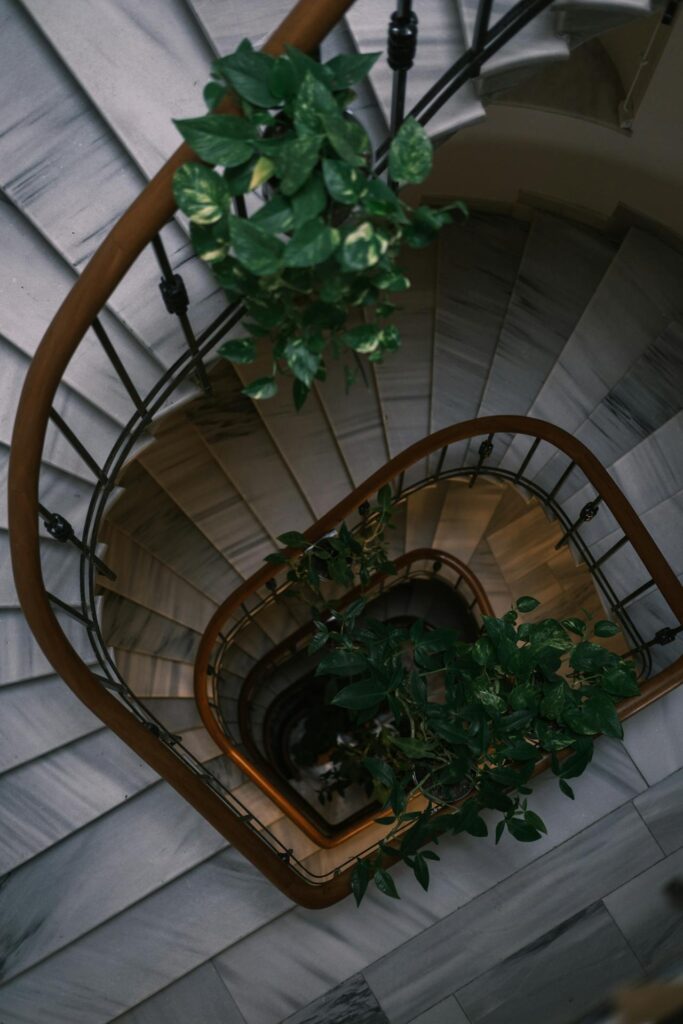
Lush green plants hanging from a geometric ceiling
Joby Joseph, a renowned luxury interior designer based in Bangalore, India, is the founder of Joby Joseph Interiors with over 24 years of experience in crafting homes that blend beauty, comfort, and cultural depth. His expertise spans luxury hotels, multinational offices, private homes, and celebrity residences, with specialties in luxury home interiors, culturally inspired designs, end-to-end renovations, and handcrafted teakwood furniture. Joby’s design philosophy goes beyond aesthetics, focusing on emotional well-being, thoughtful planning, and a holistic approach that enhances everyday life. Clients admire his passion, creativity, attention to detail, and ability to merge traditional and contemporary elements with precision. Widely regarded as one of Bangalore’s top interior designers, Joby believes true luxury lies not just in visual appeal but in creating meaningful, functional spaces that reflect individual stories and aspirations.
Spread the love
06:55 Minutes Reading time
Are We the Right Fit for Your Vedic-Inspired Dream Home?
Are We the Right Fit for YourVedic-Inspired Dream Home?